
If you share your life with a Pug, an English Bulldog, a Boxer, or a Shih Tzu, your flying options just narrowed. As of October 1, 2026, Alaska Air Cargo will no longer accept short-nosed dogs and cats in the cargo hold of any Alaska Airlines, Hawaiian Airlines, or Horizon Air flight. The change folds Hawaiian Airlines into Alaska's rulebook after the two carriers merged, and it quietly closes a door that flat-faced dogs could still squeeze through just a few weeks ago.
For the millions of American households with a squishy-faced companion, this is a bigger deal than it sounds. French Bulldogs and Bulldogs sit near the very top of the country's most popular breeds, and these are exactly the dogs airlines are increasingly unwilling to carry below deck. Here's what actually changed, why carriers keep tightening the rules on these breeds, and how to get your dog where it needs to go without putting it at risk.
What changed on October 1
Alaska Air Cargo updated its brachycephalic (short-nosed) breed policy so that one set of restrictions now applies across all three airlines in the combined fleet. Previously, Hawaiian Airlines accepted some of these breeds in cargo. That exception is gone, and the ban now covers flights to, from, and within Hawai'i.
The restricted list is long and includes many of the breeds owners are most likely to want to fly:
- Dogs: Boston Terrier, Boxer (all types), Bulldog (all types), Brussels Griffon, Chow Chow, English Toy Spaniel, Japanese Chin, Mastiff (all types), Pekingese, Pug (all types), and Shih Tzu
- Cats: Burmese, Exotic Shorthair, Himalayan, and Persian
Mixed-breed dogs that carry any of this ancestry are covered too, so a Boxer mix or a Bulldog cross falls under the same rule. All three carriers now share one identical set of breed and kennel restrictions, which at least makes the policy easier to predict than the patchwork that existed before.
Three breeds that gained access
Not every change was a restriction. The updated policy reclassifies three terrier breeds—the Staffordshire Terrier, the Pit Bull Terrier, and the Bull Terrier—as eligible for cargo transport. These dogs are not truly brachycephalic, and grouping them with flat-faced breeds had long frustrated owners. Moving them off the restricted list is a rare bit of good news for people who fly with bully-breed dogs.
Why airlines keep saying no to flat-faced dogs
Alaska's own explanation is blunt: "Short-nosed pets may have breathing challenges that can be worsened by the stress of air travel." The anatomy is the problem. Brachycephalic breeds were bred for a flat, pushed-in face, but all the tissue of a normal muzzle is still crammed into that shortened space—narrowed nostrils, an elongated soft palate, and a smaller windpipe. Even on a calm day on the couch, these dogs work harder to move air than a longer-nosed dog does.
Put that same dog in a cargo hold, where temperature, air pressure, and stress all swing hard, and the margin for error shrinks fast. The data has borne this out for years. In a widely cited review of airline-reported incidents, the American Veterinary Medical Association found that about half of the dogs that died in airline cargo over a five-year span were brachycephalic breeds. Of the 122 dogs that died in that period, 25 were English Bulldogs and 11 were Pugs—the only two breeds to reach double digits.
That track record is why the U.S. Department of Transportation has long urged owners of short-nosed breeds to study the risks and talk to their veterinarian before ever booking cargo travel. The AVMA echoes that caution in its guidance for owners of short-nosed dogs, noting that these breeds are simply more vulnerable to the heat and pressure changes a cargo hold can throw at them. Seen that way, Alaska's policy isn't an outlier—it's the airline catching up to the science.
If your dog is on the list, you still have options
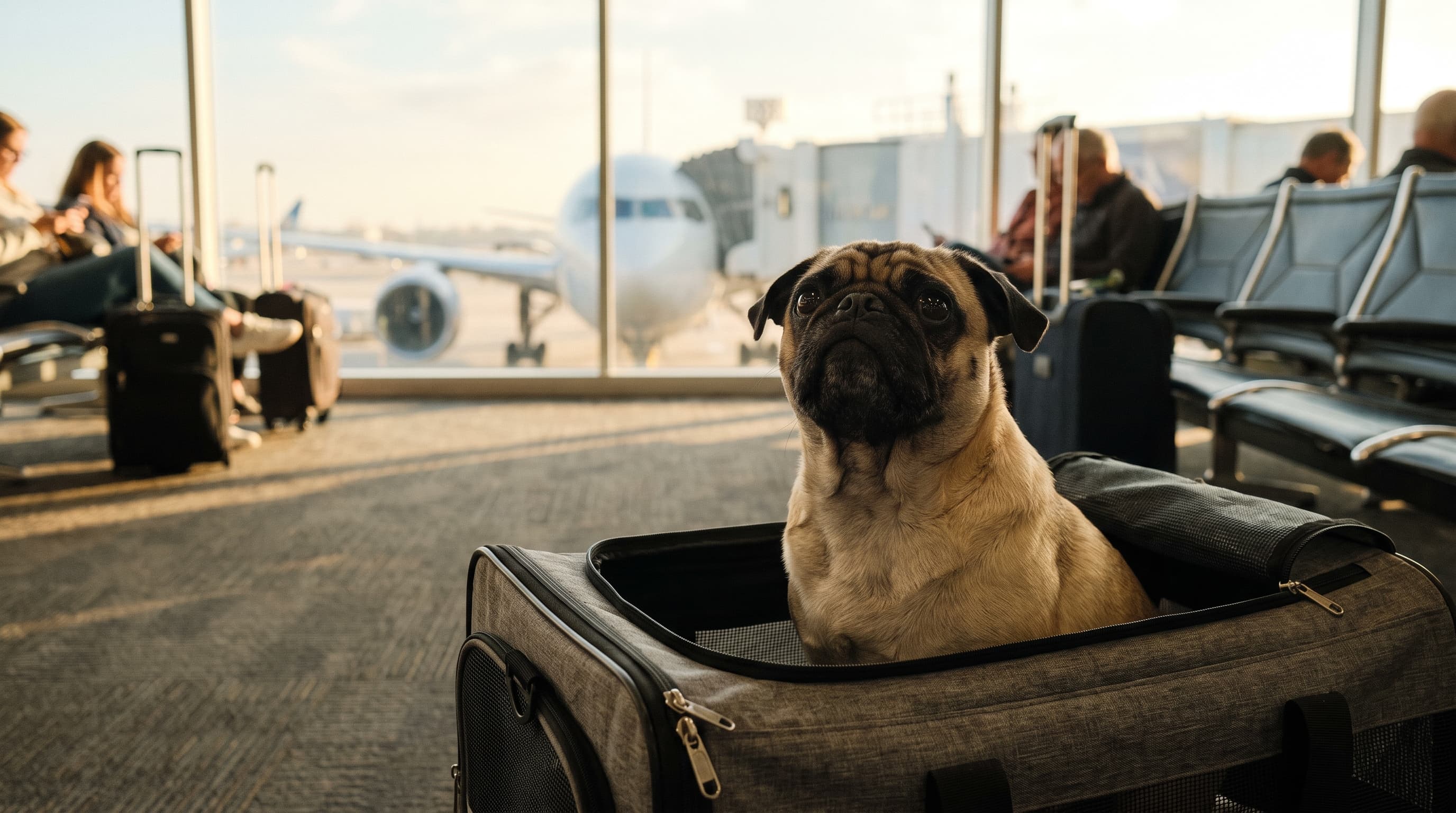
A cargo ban is not the same as a travel ban. The single most important thing to know: restricted breeds can still fly in the cabin, as long as your dog and its carrier fit comfortably under the seat in front of you. For small Pugs, Boston Terriers, Shih Tzus, and Brussels Griffons, that's a realistic path—and honestly the safer one, since your dog travels in the climate-controlled cabin at your feet rather than in the hold.
A few things to plan around:
- Book the cabin spot early and separately. In-cabin pet slots are limited per flight and are reserved directly with the airline, with their own fees and carrier-size rules.
- Measure your carrier against the seat, not the breed standard. A larger Bulldog or Boxer won't fit under a seat, which is precisely why these owners are in the toughest spot under the new rule.
- Watch the weather windows. Alaska restricts all pet cargo travel when temperatures along the route are forecast above 85°F or below 45°F, with cold-weather exceptions only when a veterinarian issues an acclimation certificate within 10 days of travel.
- Consider ground transport for big flat-faced breeds. For a 120-pound Mastiff or a stocky Bulldog that can't fit in the cabin, a reputable professional ground-transport service is often the only safe long-distance option.
Part of a much bigger shift
Alaska's move doesn't stand alone. Over the past few years, the broader airline industry has pulled back sharply from carrying pets in cargo at all. Delta and United have suspended their general-public cargo pet programs entirely, restricting hold travel to active-duty military and diplomatic families on official orders. Rules around service animals have tightened too, with carriers now accepting only dogs individually trained to perform tasks for a person with a disability.
The through-line is clear: flying a dog in the belly of a plane is getting harder every year, and for flat-faced breeds, the cabin or the road is quickly becoming the only responsible way to travel. If you own one of these dogs, the smartest move is to assume cargo is off the table and plan your trip around in-cabin or ground options from the start.
Breed bans and shifting airline rules can feel like one more hurdle for dog owners who just want to bring their best friend along. But in this case, the restriction lines up with what veterinarians have warned about for more than a decade—these dogs really are more fragile in the air. Knowing that going in lets you choose the route that keeps your dog breathing easy, whether that's a carrier under your seat or four wheels on the ground.
For more plain-English guides to traveling, living, and adventuring with your dog, keep it locked on Sidewalk Dog—we dig through the fine print so you can spend less time reading policies and more time with your pup.