
Updated October 15, 2026
As Chicago nights turn cold, a city rule passed in March faces its first winter. The City Council rewrote the cruelty-to-animals section of the Municipal Code. The rewrite limits how long a dog can be tethered outside overnight in the cold, spells out what a legal outdoor dog shelter looks like, and sets the fine at $5,000 per offense, per day.
We read the ordinance, the City Clerk's legislative record and the current text of the Municipal Code. Here's what the rule says, what changed, and what to do if you see a dog left out in the cold.
The short version
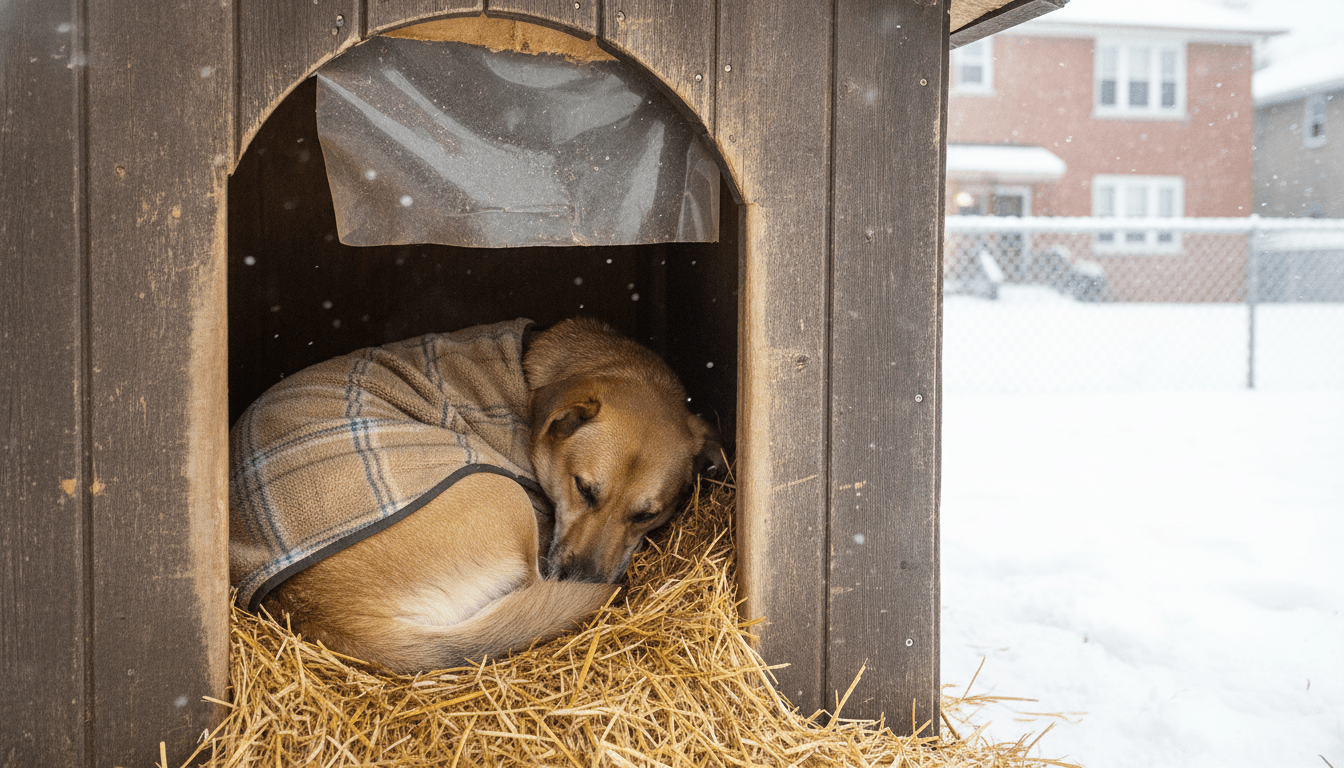
- The cold-weather tethering rule: Between 10 p.m. and 6 a.m., when it's below 45°F or during a weather advisory, a dog can't be tethered outdoors for more than 30 minutes unless it can get into a proper shelter. The shelter must be just big enough for the dog to stand up and turn around, with a windproof flap or self-closing door, and dry, insulating bedding such as straw.
- A two-hour cap on staking out: No dog, of either sex, may be staked out on private property for more than two hours in a row. A female dog in heat can't be left outside unattended for any amount of time.
- One fine for every violation: $5,000 for each offense, plus forfeiture of the animal. Each day a violation continues counts as a separate offense.
- Timeline: The City Council passed the ordinance on March 18, 2026, and it took effect on passage and publication. This is the first winter it applies to.
- To report a concern: Call or submit a request to 311. Chicago Animal Care and Control (CACC) handles all public service requests through 311.
What the ordinance changed
The changes are in Section 7-12-290 of the Municipal Code, "Cruelty to animals – Fines." Ald. Raymond Lopez (15th Ward) introduced the ordinance on Feb. 19, 2025. More than a year later, on March 3, 2026, the Committee on Public Safety amended it and recommended passage. The full City Council passed it on March 18, 2026, according to the City Clerk's record (SO2025-0015393). The new language now appears in the official Municipal Code, citing the Council Journal of March 18, 2026, page 41628.
The redlined ordinance shows these changes for dog owners:
- New overnight tethering limits for cold weather, with specific shelter requirements (details below).
- A new two-hour limit on staking out any dog on private property. The old rule only addressed female dogs in heat.
- "Breed-appropriate" care. Owners must provide breed-appropriate food, water, air and sanitary shelter. The shelter must protect the animal from excess heat and cold and be large enough for it to move around freely.
- Veterinary care. Failing to provide reasonably necessary medical care, by commonly accepted veterinary standards, is now listed as a violation.
- A flat $5,000 fine. Before the change, some violations carried fines of $1,000 to $5,000 and others $300 to $1,000. Now every violation of the section is fined $5,000 per offense, plus forfeiture of the animal.
The cold-weather tethering rule, in plain terms
This is the part that matters most between now and spring. Under subsection (i) of the current code:
- When: It applies between 10 p.m. and 6 a.m.
- Trigger: It applies when temperatures are below 45°F or during a weather advisory.
- Limit: A dog can't be tethered outdoors for more than 30 minutes in those conditions, unless it can get into an appropriate shelter.
A shelter counts only if it meets every one of these requirements:
- It is just large enough for the dog to stand up and turn around.
- Its entrance is covered by a flexible windproof material or a self-closing door.
- It contains clean, dry bedding made of an insulating material that doesn't hold moisture, such as straw.
- The bedding is deep enough for the dog to burrow into.
As passed, the first sentence of the subsection is worded awkwardly. The Municipal Code's publisher added an editor's note saying the intended language "appears to be" a limit on tethering a dog outdoors between 10 p.m. and 6 a.m. for more than 30 minutes in those conditions. The note adds that "future legislation will correct if needed." The summary above follows the code text and that published note.
One practical point for owners setting up an outdoor shelter: the code names straw as an example of acceptable bedding. It requires material that is insulating and doesn't retain moisture.
Other rules worth knowing this winter
- Cars: The current code bars leaving an animal unattended in a vehicle long enough to threaten its life or health. That includes inadequate air circulation and exposure to extreme heat or cold. An animal control officer or police officer who has probable cause can enter the vehicle "by any reasonable means" after a reasonable effort to find the owner.
- Abandonment: Abandoning or intentionally releasing an animal on a public way, or anywhere it may suffer, is a violation.
- Impoundment: If a violation endangers public health and safety or an animal's welfare, CACC's executive director can impound the animal until the conditions are fixed. If the owner doesn't fix them within 7 days, the animal becomes the property of the department.
What this means for you
If your dog spends time outside:
- Bring your dog in overnight when it's cold. If your dog is ever tethered outside after 10 p.m. in the cold, make sure the shelter meets each requirement above: snug size, windproof entrance, dry insulating bedding deep enough to burrow in.
- Check that bedding regularly. The code requires it to be clean and dry.
- Don't stake out any dog on your property for more than two hours in a row, in any season.
- Don't leave your dog waiting in a cold car.
If you see a dog that may be in trouble:
- Contact 311. CACC says all public requests for service are taken through 311. Its "Neglect, Abuse, and Well-Being Concerns" category covers concerns such as no food, no water, unsanitary conditions, or a pet that needs a wellness check.
- Give details. Note the address, time, temperature and what you saw. CACC asks callers to provide "as much information as possible" and to include contact information, because cases at a residence may need follow-up.
- Use 911 for an animal fight in progress. CACC directs callers to 911, not 311, if they witness animal fighting in progress.
For warmer ways to keep your dog active this winter, see our indoor guide to a Chicago winter, our roundup of heated patios, and the Chicago dog parks directory for milder days.
Also from the city shelter
CACC posted its third-quarter 2026 shelter statistics this month. Here's how dogs fared, by our calculation from CACC's published data, using the live release rate formula on CACC's statistics page:
- More dogs are leaving alive this year. The live release rate for dogs from January through September was 84.2%, up from 79.9% in the same months of 2025.
- Fewer dogs were euthanized for health, behavior or space. CACC's tables show 900 dogs in its "other euthanasia" category from January through September, compared with 1,214 a year earlier.
- September was heavier. CACC took in 838 dogs in September, compared with 722 in September 2025. Owner surrenders rose from 153 to 231.
- The quarterly rate has slipped. The rate fell each quarter this year, from 85.2% in the first quarter to 83.0% in the third.
The Commission on Animal Care and Control, the city's advisory board for CACC, holds its next public meeting on Thursday, Nov. 19, at 8:30 a.m. at the shelter, 2741 S. Western Ave., with a livestream. To speak during public comment, email [email protected] by noon the day before, or fill out a comment card at the meeting before 8:30 a.m. Up to 10 people may speak, for three minutes each (meeting notice).
We'll update this article if the City Council amends the tethering language or if CACC publishes enforcement figures.
Sources
- Office of the City Clerk, SO2025-0015393, legislative record (introduced Feb. 19, 2025; Committee on Public Safety, March 3, 2026; passed March 18, 2026)
- Ordinance as amended, Section 7-12-290 redline (Committee on Public Safety)
- Municipal Code of Chicago, §7-12-290 Cruelty to animals – Fines (current through 2026 S-74; Coun. J. 3-18-26, p. 41628)
- Chicago Animal Care and Control, Field Services
- Chicago Animal Care and Control, CACC Data Statistics: quarterly shelter statistics for Q1–Q3 2026 and Q1–Q3 2025, and monthly statistics for September 2026 and September 2025
- Commission on Animal Care and Control, meeting dates and public comment rules