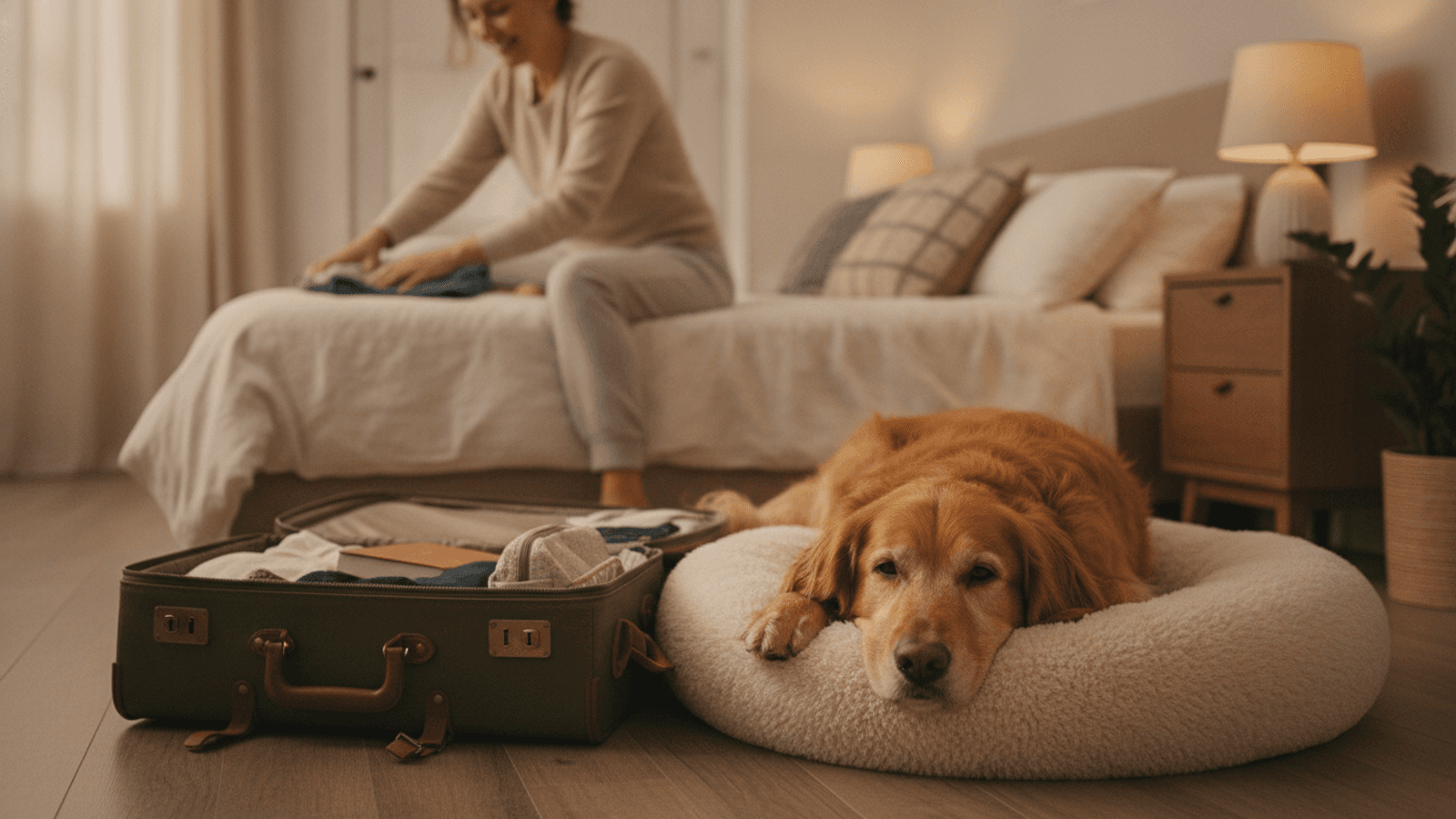

Most dog owners brace for one moment before a trip: the goodbye. The bags by the door, the leash left hanging, the door closing behind them. It’s easy to assume that moment causes the most dog stress during vacation.
The research tells a more complicated story about dog stress during vacation. What actually seems to drive it isn’t a single departure. It’s the accumulation of small disruptions that surround it: shifted feeding times, a rearranged schedule, unfamiliar people in the house, walks that happen at different hours or not at all. The goodbye is one data point in a week that’s already come apart at the seams.
Routine Is Doing More Work Than We Think
A 2024 review published in Veterinary Sciences pulled together a wide body of research on cortisol, the hormone most commonly used to measure stress in dogs. One pattern held up again and again: consistent routine correlates with lower cortisol in dogs, while unpredictable daily structure correlates with higher cortisol. Regular feeding times, regular exercise, regular rest. The review’s authors describe consistent routines as something that reduces uncertainty and creates stability, which in turn lowers stress.
That’s a useful reframe. A dog doesn’t need its owner in the room to feel settled. It needs to know what happens next.
The Kennel Isn't Always the Villain
There’s a longstanding assumption that boarding a dog is inherently traumatic, that a kennel stay piles stress on top of an already hard week. A 2014 study out of the University of Lincoln, University of Birmingham, Queen’s University Belfast, and the Royal Veterinary College complicates that assumption. Researchers measured stress markers in 29 privately owned dogs both at home and during short stays at boarding kennels.
Cortisol was higher in the kennel setting, as expected. But the researchers pointed out something easy to miss: cortisol elevation indicates arousal, not exclusively distress. A short kennel stay may register physiologically as novelty and stimulation rather than suffering. The study’s authors suggested short-term kenneling can produce excitement in dogs rather than fear, at least over a short window.
This doesn’t mean boarding is stress-free. It means the length of the stay, the structure of the facility, and what happens before and after matter more than the fact of being boarded at all. (We’ve covered the practical side of that decision before in our guide to what to do when you need to leave your dog on vacation.)
The Pandemic Left Us an Unplanned Experiment
One of the more surprising findings comes from a 2022 study in the journal Animals, which followed 1,807 UK dogs through the pandemic’s shifting lockdown periods. Researchers compared how much time each dog spent alone before lockdown, during it, and after restrictions eased.
The dogs whose alone-time dropped the most during lockdown, the ones who suddenly had their owners home around the clock, were the ones most likely to develop new separation-related behaviors once normal life resumed and owners started leaving again. Reduced alone-time predicts increased separation-related behavior risk in dogs. Less practice being alone didn’t protect these dogs. It left them less prepared for it.
The takeaway isn’t really about lockdowns. It’s about what happens when a dog’s routine reorganizes itself around a person’s constant presence, then that presence disappears all at once, which is close to what a family vacation does on a smaller scale. The days leading up to a trip often look like a mini version of that lockdown pattern: more time together, more attention, more departures from the normal rhythm, followed by a sudden and complete change.
Trainers Are Seeing the Same Pattern Right Now
This isn’t just a pandemic-era artifact. Bark Busters, the largest in-home dog training company in the US, published its 2026 National Dog Behavior Analysis in March, drawing on nearly 50,000 real training inquiries from the past year. Separation anxiety remained one of the most common concerns nationwide, and the company’s National Director of Training pointed to the same underlying cause the research keeps circling back to.
“Dogs thrive on routine, predictability, and consistency,” said Michelle Willey. “When routines change dramatically, behavior changes follow. We’re seeing more dogs struggle when structure disappears or when they are left alone after extended periods of constant companionship.”
That’s a trainer describing, in plain language, the exact mechanism the 2022 lockdown study measured. It’s not a coincidence. It’s the same pattern showing up in real households, in real time, years after the original disruption that first revealed it.
A Week That Looks Familiar
Picture a family of four planning a nine-day trip. In the two weeks before departure, the schedule quietly shifts. Walks get shorter because there’s packing to do. The dog gets an extra round of belly rubs on a Tuesday because someone feels guilty. A grandparent starts sleeping over Thursday to “get the dog used to them.” Feeding times slide by twenty or thirty minutes most days because mornings are busier than usual.
None of this looks dramatic from a human perspective. From the dog’s side, five or six small variables have shifted in the same two-week window, and none of them have reset before departure day arrives. That’s the accumulation the research keeps pointing to. It isn’t one big change. It’s several small ones stacked without a chance to settle.
What This Actually Means for Trip Planning
A separate body of research on separation-related behavior, including a 2024 longitudinal study following puppies from a young age, points to the same protective factor over and over: stable routine builds resilience to separation in dogs. Dogs that experience consistent structure, including planned time without their owner, tend to handle real separations better than dogs whose alone-time is irregular or rare.
That points toward a few practical shifts for the week around a trip, rather than just the day of departure:
Don’t compress the goodbye into one big event. Piling on extra attention, extra walks, and extra treats in the final 48 hours creates a sharper contrast between “before” and “after” than a dog needs to feel.
Protect feeding and walk times as much as possible, even while packing and prepping happen around the house. The disruption dogs seem to register most is the unpredictability, not any single change.
If boarding is part of the plan, treat it as a routine of its own rather than a gap in the dog’s week. A facility with structured feeding schedules, regular exercise, and predictable daily rhythm gives a dog something to settle into, rather than another layer of unpredictability stacked on an already unusual week.
That last point is where a well-run boarding and daycare facility earns its keep. Club Mead Pet Resort, located near Leduc and Edmonton International Airport, structures its playgroups by age, breed, size, and temperament rather than mixing every dog into one open space, which keeps the day itself predictable for a dog rather than chaotic. One owner described a dog who used to bolt for the door at pickup from a different kennel, stressed and eager to leave. At Club Mead, the same dog now leaves slowly and calmly. That’s not a coincidence. It’s what a stay built around structure rather than just supervision looks like from the outside. For families flying out of a nearby airport, that proximity also means less transit time added to a week that’s already asking a lot of a dog’s nervous system.
The Real Lesson
Dogs don’t need their owners to never leave. They need the rest of their world to hold steady when someone does. The research increasingly points away from the goodbye itself and toward everything surrounding it: the schedule, the structure, the predictability of the days before and after. Protect that, and the trip itself becomes a much smaller event in a dog’s week than most owners assume.
Sources:
- Veterinary Sciences, 2024: “Behavioral, Physiological, and Pathological Approaches of Cortisol in Dogs”
- Physiology & Behavior, 2014: University of Lincoln, University of Birmingham, Queen’s University Belfast, and Royal Veterinary College kennel stress study
- Animals, 2022: “Impact of Changes in Time Left Alone on Separation-Related Behaviour in UK Pet Dogs”
- Animal Welfare, 2024: “Canine separation-related behaviour at six months of age,” Generation Pup longitudinal study
- Bark Busters USA, 2026: National Dog Behavior Analysis, based on nearly 50,000 U.S. training inquiries