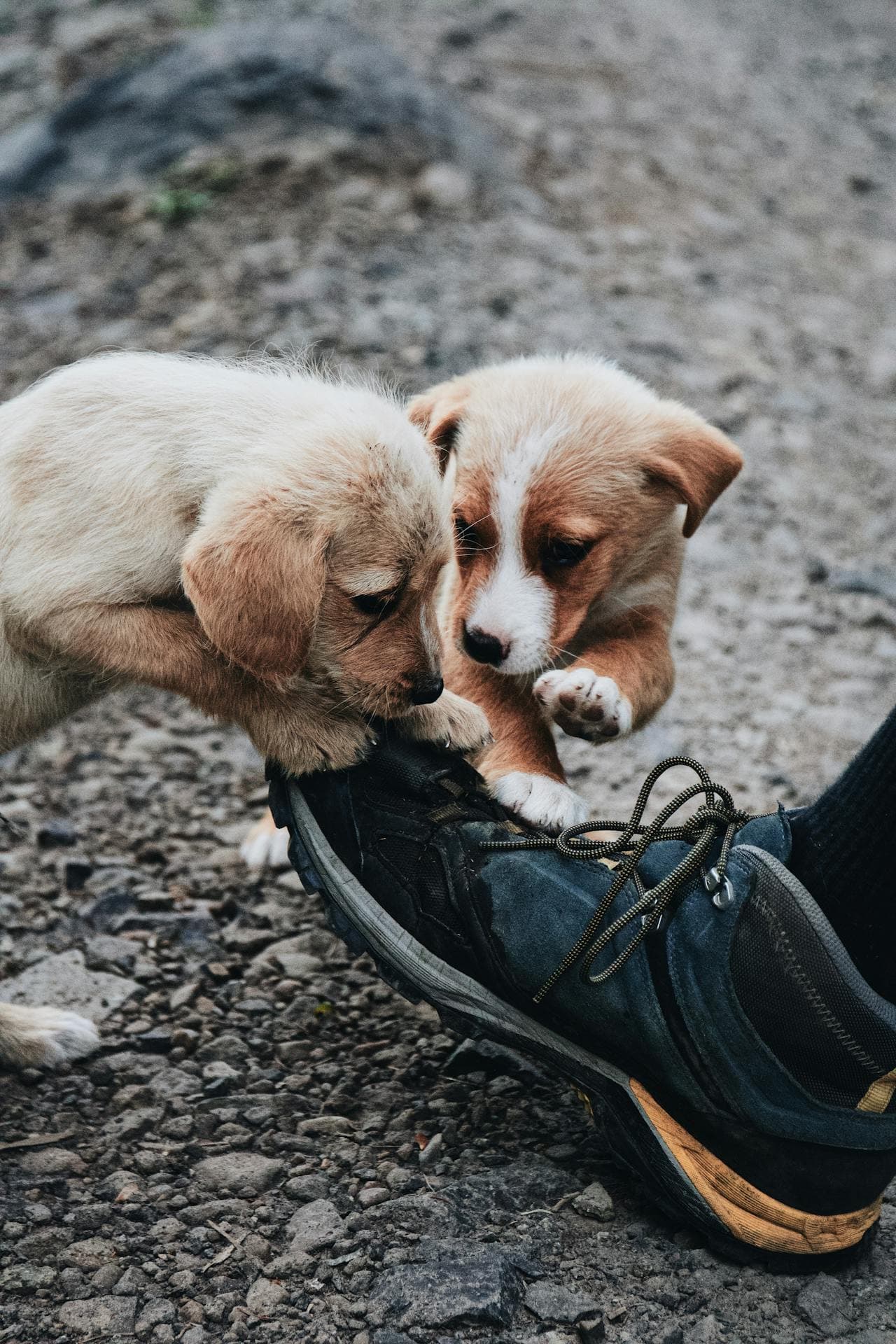
Dogs chew shoes for five core reasons: teething (puppies), boredom, anxiety, scent attraction (your shoes literally smell like you), and instinct. To stop a dog from chewing shoes, manage the environment (closed closet, shoes on shelves), increase exercise and enrichment, redirect to better chew toys, use bitter sprays as a deterrent, address underlying anxiety, and never punish after the fact. Below: the science behind why dogs target your sneakers, plus 10 proven ways to stop the chewing — including when to escalate to a certified trainer or vet behaviorist.
Why dogs chew shoes — the real reasons
Chewing is normal canine behavior. The question isn't "why does my dog chew?" — it's "why does my dog choose my Air Force 1s over the rubber Kong on the floor?" Five drivers do most of the work.
1. They smell like you
This is the biggest one and the most often overlooked. Shoes hold concentrated foot scent, plus everywhere you walked that day. To a dog, your shoes are a self-organizing scrapbook of your life. Chewing releases more scent. When dogs are missing their person — even just during a workday — they self-soothe by chewing items that smell most strongly of you. Underwear and shoes top the list because they have the highest sweat concentration.
2. Teething (puppies 3–6 months)
Between roughly 3 and 6 months of age, puppies lose 28 baby teeth and grow 42 adult teeth. The gums hurt. Pressure on a soft, springy surface — exactly the give of a sneaker tongue — feels good. Frozen wet washcloths and dental chews relieve the same urge in a way you'll approve of.
3. Boredom and pent-up energy
Under-exercised dogs are over-destructive dogs. The rule of thumb: most adult dogs need 30–60 minutes of real physical exercise plus 15–30 minutes of mental work daily. Working breeds (border collies, malinois, German shepherds) need significantly more. A dog that "won't stop chewing" often just hasn't gotten enough activity, and chewing is the only outlet available.
4. Separation anxiety
If the chewing happens almost exclusively when you leave — and it's paired with whining, pacing, accidents, or escape attempts — you're likely dealing with separation anxiety, not "bad behavior." The chewing is a panic response, not a choice. Punishment makes it dramatically worse.
5. Instinct and oral exploration
Dogs explore the world through their mouths. Many breeds were genetically selected to use their mouths for work — retrievers, terriers, herders. Asking them not to use their mouth at all is like asking a kid to stop touching things. The goal is redirection, not suppression.
10 ways to stop your dog from chewing shoes
1. Manage the environment first
This is the unglamorous answer that solves 50% of cases overnight: put the shoes away. Closed closet, over-the-door shoe organizer, shelf at chest height, mudroom with a door. A dog can't chew what they can't reach. Environmental management buys you time to address the underlying cause without losing more shoes.
2. Match exercise to your dog's actual needs
"He gets walked twice a day" rarely means enough. A 20-minute leashed sniff walk doesn't burn the same energy as 20 minutes of fetch, tug, or off-leash running. Try this for two weeks: add 20 minutes of higher-intensity activity (fetch in the yard, flirt pole, structured run) plus a 10-minute training session, every day. Most "destructive" dogs settle dramatically.
Need ideas? Our guide to dog walking games covers ways to make a regular walk much more enriching.
3. Rotate high-value chew toys
Leave 4–5 different chews available at a time, then swap them out every few days. Novelty matters as much as toughness. Worth keeping in the rotation:
- Kong Classic stuffed and frozen — peanut butter, plain yogurt, or wet food, frozen for hours of work.
- West Paw Toppl — easier for puzzle beginners, dishwasher-safe.
- Benebones, Nylabones — for serious chewers.
- Bully sticks, yak chews, collagen chews — long-lasting and palatable.
- Silicone chew toys — softer alternative that still holds up.
Avoid: rawhide (digestive risk), real bones (tooth fractures), antlers (tooth fractures), tennis balls for heavy chewers (the felt grinds enamel).
4. Use a taste deterrent
Bitter apple spray and Grannick's Bitter Apple are the most common. Spray the inside of cheap shoes (or old shoes you've designated as "training shoes") and leave them out as decoys. The dog approaches, tastes, recoils. Reapply every few days — the bitterness fades. Test deterrents on one shoe first; some leather and suede stain.
5. Add real mental enrichment
Mental work tires dogs faster than physical exercise. Add at least one of these to every day:
- Snuffle mat with kibble — turns a meal into 20 minutes of foraging.
- Lickimat with wet food or yogurt.
- Puzzle feeders (Outward Hound, Trixie, Nina Ottosson).
- Trick training sessions — even five minutes is meaningful.
- Scent games — hide treats around a room and cue "find it."
6. Redirect, don't punish
If you catch your dog in the act: a neutral interrupter ("ah-ah"), trade for an approved chew, praise enthusiastically when they take it. Never punish after the fact — dogs don't connect a delayed reprimand with the earlier behavior. They learn that you returning home is unpredictable and scary, which can worsen anxiety-driven chewing.
7. Use confinement strategically
A crate, exercise pen, or dog-proofed room is not a punishment — it's a safety boundary while you're not supervising. The space should contain water, a comfortable bed, and 2–3 approved chews. Many adult dogs eventually graduate to free roam; some never do, and that's fine.
For puppies, our puppy-proofing tips walk through how to set up a safe room they can't destroy.
8. Address anxiety directly
If chewing is anxiety-driven, no amount of exercise or chew rotation will fix it. Real interventions:
- Independence training — short, gradually-extended absences from a calm, non-emotional departure.
- Calming aids — Adaptil diffusers, Thundershirts, calming chews with L-theanine or chamomile.
- Music or white noise — research suggests reggae and soft rock reduce stress markers in shelter dogs.
- Veterinary behaviorist consultation if separation anxiety is severe. Medication combined with behavior modification has the strongest evidence base.
9. Increase predictability
Dogs thrive on routine. Inconsistent feeding times, random departures, and chaotic home energy elevate baseline cortisol — which shows up as chewing, barking, or pacing. Keep meals, walks, and bedtime within the same hour window each day.
10. Know when to call a trainer or vet
Escalate when:
- The dog has destroyed something dangerous (swallowed shoe parts, eaten foam, ingested batteries).
- Chewing is paired with self-injury (chewing paws raw, breaking teeth).
- The dog destroys crate or door frames trying to escape confinement.
- You've tried management + exercise + redirection consistently for 4–6 weeks with no improvement.
Start with a certified positive-reinforcement trainer (look for CPDT-KA, KPA-CTP, or IAABC credentials). If anxiety is the driver, ask your vet for a referral to a veterinary behaviorist (DACVB). Our overview of positive reinforcement training explains the approach to look for.
What NOT to do
- Don't rub the dog's nose in the chewed shoe. It doesn't work and damages trust.
- Don't give your dog an old shoe to chew "for fun." Dogs can't distinguish your $200 boots from the retired ones.
- Don't punish after the fact. A "guilty look" is appeasement to your anger, not understanding.
- Don't crate for hours as punishment. Crates are tools, not jail cells.
- Don't ignore patterns. If chewing only happens during storms, it's noise anxiety. If it spikes during your work-from-home shifts to commute, it's separation. Different drivers, different fixes.
When your dog has actually swallowed shoe pieces
This is a vet emergency if you see any of: vomiting, refusing food, lethargy, painful belly, no stool for 24+ hours, gagging or repeated swallowing. A swallowed shoelace or insole can cause intestinal blockage that requires surgery. Don't wait. Call your vet or the nearest emergency clinic immediately.
How long does the shoe-chewing phase last?
For teething puppies: the worst of it ends around 6–7 months, with intermittent flare-ups until 18 months when adult brain development finishes. For adult dogs, expect 4–8 weeks of consistent intervention to see chewing drop off, longer if anxiety is the driver. The variable that matters most isn't time — it's consistency. Every household member has to follow the same rules.
Frequently Asked Questions
Why does my dog chew shoes only when I leave the house?
That pattern strongly suggests separation anxiety or isolation distress. Your dog is self-soothing with the item that smells most like you. Standard chew-redirection won't fix it — you need to address the underlying anxiety with independence training, calming aids, and possibly a vet behaviorist.
Do bitter sprays actually work to stop chewing?
Yes, for many dogs — but not all. About 80% of dogs find bitter apple unpleasant. Some are unfazed. Test on one shoe, reapply every few days, and pair the spray with redirection to an approved chew. Bitter spray alone rarely fixes a chewing problem.
Can puppies be trained out of chewing shoes?
Yes, but expect the urge to chew to last through teething (3–6 months) and well into adolescence. Manage the environment, provide appropriate chew toys including frozen options for sore gums, and redirect any time you catch them. Most puppies are reliable by 12–18 months.
Is it okay to give my dog an old shoe to chew?
No. Dogs can't tell the difference between a "training shoe" and a $200 boot. Giving any shoe as a toy teaches them that shoes are an acceptable chew target. Always use purpose-built chew toys instead.
What chew toys are safest for heavy chewers?
Kong Extreme (black), Benebones, West Paw Hurley, and Goughnuts hold up to most aggressive chewers. Avoid antlers and real bones (tooth fractures), rawhide (digestive blockage), and tennis balls (enamel wear). Supervise the first session with any new chew.
My dog swallowed part of a shoe. What now?
Call your vet or emergency clinic immediately. Watch for vomiting, lethargy, refusal to eat, painful belly, or no stool for 24+ hours — all signs of possible intestinal blockage requiring surgery. Don't induce vomiting unless instructed.
When should I hire a trainer for chewing problems?
If you've tried environmental management, exercise increase, and redirection for 4–6 weeks consistently with no improvement, hire a certified positive-reinforcement trainer (CPDT-KA, KPA-CTP, or IAABC). If anxiety appears to be the driver, ask your vet for a referral to a veterinary behaviorist (DACVB).
Does scolding a dog for chewing shoes work?
Not after the fact. Dogs don't connect a delayed reprimand to the earlier behavior — they only learn that you become unpredictable. Punishment-based corrections often make anxiety-driven chewing worse. Interrupt only if you catch them mid-chew, then redirect.
Most dogs stop chewing shoes within a few weeks of consistent management, exercise, and redirection. If your dog is in the small percentage that doesn't respond — or if anxiety is the driver — a certified trainer or vet behaviorist will get you there.