
Are Seals Related to Dogs? The Surprising Science
Are seals related to dogs? Yes — distantly. Both belong to the order Carnivora and the “dog-like” suborder Caniformia, sharing a common ancestor from more than 50 million years ago. But seals are actually closer cousins to bears, weasels, and otters than to dogs, despite their puppy-like faces, expressive eyes, and bark-like calls.
Anyone who has watched a harbor seal flop onto a rock, roll over for a belly rub of sunshine, and bark at a passing boat has probably wondered whether they’re looking at a dog of the sea. The resemblance is real, and part of it comes from genuine shared ancestry. Here’s exactly how seals and dogs are connected on the tree of life — and where the family lines split.
Are Seals Related to Dogs? The Short Answer
Seals and dogs are both carnivorans, members of the biological order Carnivora. Within that order they sit in the same branch — Caniformia, the dog-like carnivorans. So on the grand family tree, yes, they’re relatives. But “related” here means something like distant cousins many times removed, not siblings. Their shared ancestor lived tens of millions of years ago, and the two groups have taken wildly different evolutionary paths since.
In short: a seal is not a type of dog, and a dog is not a type of seal. They’re both descendants of the same ancient carnivore lineage — the same way you’re related to a distant cousin you’ve never met.
The Family Tree: Carnivora and Caniformia
To see the connection, it helps to zoom out. The order Carnivora splits into two suborders: Feliformia (the “cat-like” carnivorans, including cats, hyenas, and mongooses) and Caniformia (the “dog-like” carnivorans). Dogs and seals both land on the Caniformia side of that split.
According to Caniformia classification, this suborder consists of “dog-like carnivorans” and includes dogs, bears, raccoons, mustelids (weasels and their relatives), and pinnipeds — the group that contains seals, sea lions, and walruses. So the reason a seal reminds you of a dog isn’t just imagination: they belong to the same major branch of carnivores.
The word for seals as a group is pinnipeds, meaning “fin-footed.” Pinnipedia includes three families: true seals (like the harbor seal), eared seals (sea lions and fur seals), and walruses.
Who Are a Seal’s Closest Relatives?
Here’s where the popular “sea dog” idea gets complicated. Even though seals share the Caniformia branch with dogs, their closest living relatives aren’t canines at all. According to the Encyclopaedia Britannica, “pinnipeds derived from a common bearlike ancestor,” placing them near the bear and musteloid part of the tree.
Pinniped research notes that seals’ closest living relatives are the musteloids — a group that includes weasels, otters, raccoons, and red pandas — from which they “diverged about 50 million years ago.” So if you ranked a seal’s cousins from closest to most distant, otters and weasels would come before bears, and dogs would sit further out still.
That’s a fun twist: the animal that looks the most like a wet Labrador on the beach is, genetically speaking, more of an otter’s relative than a retriever’s.
It helps to picture the timeline. Roughly 50 million years ago, one branch of dog-like carnivores began exploiting the water for food. Over millions of years, natural selection reshaped their bodies — legs became flippers, coats became blubber, and lungs and hearts adapted to diving — while a separate branch of that same ancestry stayed on land and eventually produced wolves and, much later, domestic dogs. Both groups are still “dog-like” carnivorans on paper; they simply chose very different addresses.
Why Do Seals Look and Act So Much Like Dogs?
If seals are closer to otters and bears, why do they seem so dog-like? Two forces are at work.
Shared ancestry. Because dogs and seals both descend from early Caniformia carnivores, they inherited some of the same basic toolkit: similar skull and tooth structures for a carnivorous diet, comparable brain wiring for problem-solving, and social, trainable temperaments. This is why marine parks can teach sea lions to follow cues much like a dog obeys commands, and why seals show the same curious, playful streak that makes dogs such good companions.
Convergent behavior. Some resemblances are coincidence — traits that evolved independently because they’re simply useful. A seal’s bark, its whiskered snout, and those big light-gathering eyes suit life hunting in dim, cold water, but they also happen to read as adorable and familiar to dog lovers. When two animals face similar pressures and land on similar solutions, biologists call it convergent evolution.
The playful, intelligent personality really may run in the family, though. Both seals and dogs are known for adaptability and problem-solving — traits that likely trace back to that shared carnivoran ancestry. If you enjoy these “how smart is my pet” questions, you might like our look at whether dogs are smarter than cats.
Are Seals “Sea Dogs”? Nicknames and Myths
Seals have been nicknamed “dogs of the sea” for centuries, and a group of seals is sometimes even called a “pod” or “colony” that behaves with dog-like social structure. Sailors historically noted the resemblance, and modern wildlife fans keep the comparison alive online.
But a few myths deserve correcting:
- Myth: Seals are just aquatic dogs. False — they’re a separate group (pinnipeds) that split from the dog lineage long ago.
- Myth: You can keep a seal like a pet dog. Absolutely not. Seals are wild marine mammals with specialized needs, and in the United States they’re federally protected under the Marine Mammal Protection Act.
- Myth: Seals and dogs can interbreed. No — they’re far too distantly related, separated by tens of millions of years of evolution.
How Seals and Dogs Are Actually Different
For all their shared branch on the tree, seals are built for a completely different world. The harbor seal, one of the most common pinnipeds along U.S. coasts, shows just how specialized these animals became: streamlined bodies, flippers instead of paws, a thick blubber layer for warmth, and the ability to dive and hold their breath far longer than any dog.
Key differences include:
- Limbs: Dogs have four weight-bearing legs; seals have flippers adapted for swimming, which makes them clumsy on land.
- Habitat: Dogs are fully terrestrial; seals spend most of their lives in the water and only haul out to rest, molt, or breed.
- Diet and hunting: Seals are expert underwater predators of fish and squid, using whiskers to sense prey in the dark.
- Body systems: Seals have physiological adaptations for deep diving that dogs simply don’t have, like the ability to slow their heart rate and store extra oxygen.
Interestingly, some cold-adapted dog breeds echo their wild carnivoran roots more than others. If you love thick-coated, ancient-looking breeds, our profile of the Alaskan Malamute is a fun companion read.
Frequently Asked Questions
Are seals more closely related to dogs or cats?
Dogs. Seals sit in the Caniformia (“dog-like”) suborder, the same branch as dogs, bears, and weasels — not the Feliformia (“cat-like”) branch that contains cats. So seals are decidedly on the dog side of the carnivore family tree, even though they’re not close relatives of either.
Are seals related to bears?
Yes, and fairly closely by pinniped standards. Britannica notes seals descended from a “bearlike ancestor,” and bears are among their nearer relatives on the Caniformia branch, along with the musteloids (otters, weasels, and raccoons).
Why do seals bark like dogs?
Barking is a form of vocal communication that suits social, coastal animals, and both seals and dogs evolved from social carnivores. The similar sound is partly shared ancestry and partly convergence — a useful signal that evolved to carry across noisy environments.
Can a dog and a seal be friends?
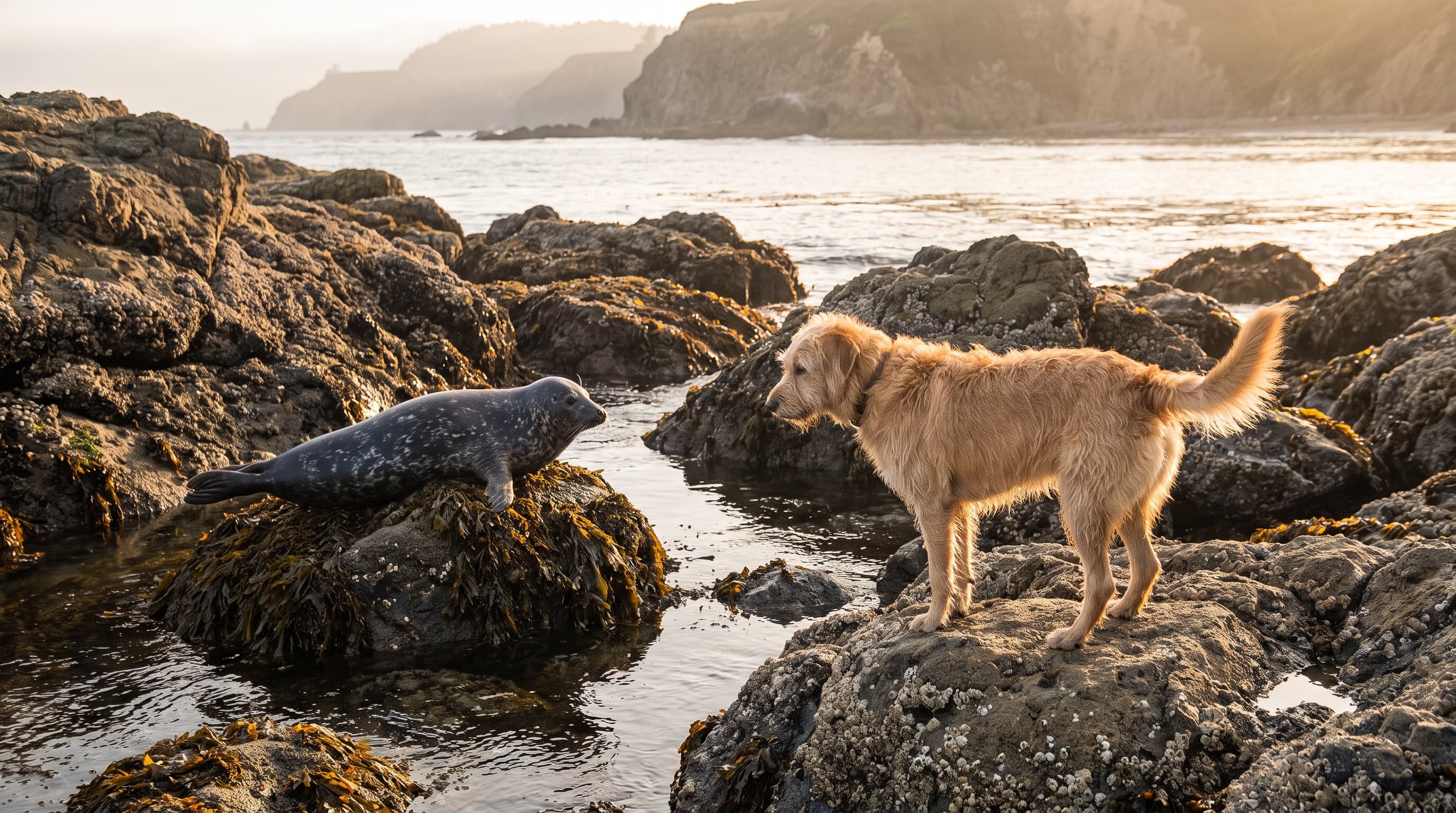
They may show curiosity toward each other, but seals are wild animals and should never be approached or handled. In the U.S. it’s illegal to disturb them. Keep dogs leashed and at a distance if you spot a seal hauled out on a beach.
What animal is a seal’s closest relative?
Genetic studies point to the musteloids — weasels, otters, raccoons, and red pandas — as seals’ closest living relatives, with bears close behind. Dogs are relatives too, but more distant ones.
Are walruses and sea lions related to dogs as well?
Yes. Walruses and sea lions are also pinnipeds within Caniformia, so they share the same distant connection to dogs that true seals do. All three belong to the “fin-footed” group that branched off the dog-like carnivore line.
The Bottom Line
Are seals related to dogs? Genuinely yes — they’re fellow travelers on the Caniformia branch of the carnivore family tree, sharing an ancestor from deep in the past. But their closest cousins are otters, weasels, and bears, and their puppy-dog charm is a mix of that shared heritage and a healthy dose of coincidence. Next time a seal barks at you from the surf, you can honestly call it a very, very distant cousin of your pup.
Love a good dog-science rabbit hole? Subscribe to the Daily Wag newsletter for more surprising answers about dogs, their wild relatives, and the science behind your pet’s quirks — and see whether dogs are actually ticklish while you’re at it.