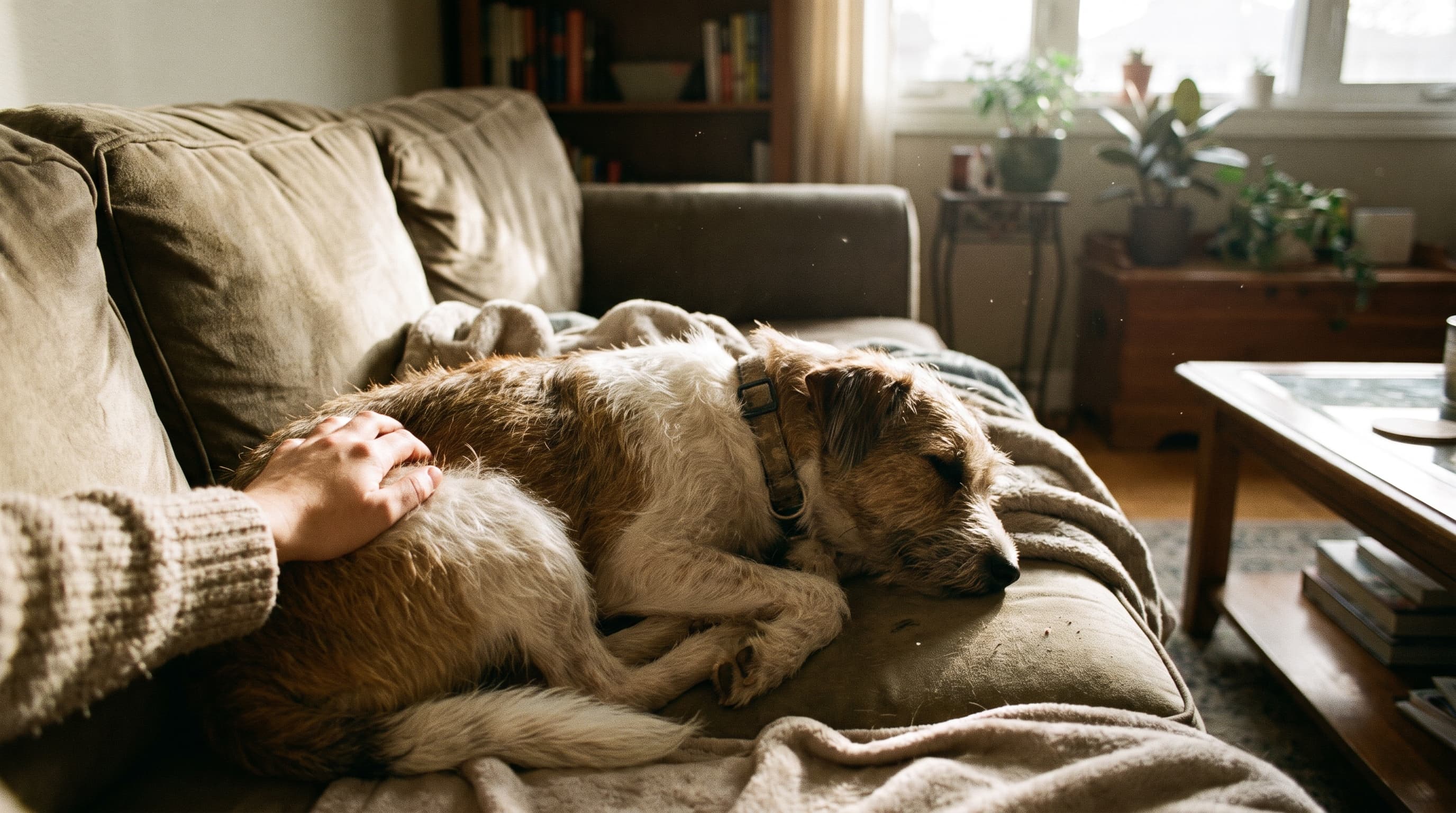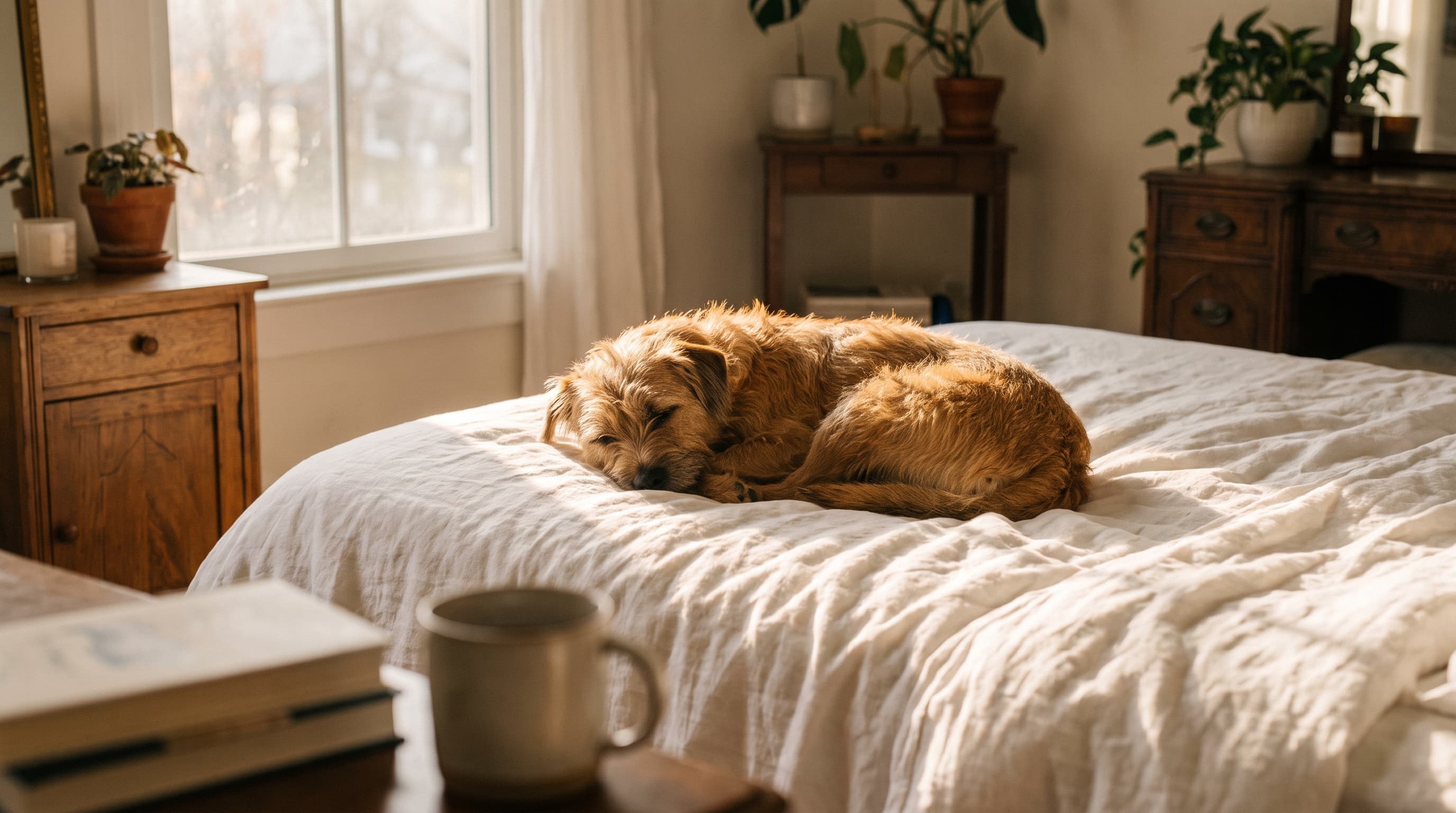

If you wake up groggy and shoot a side-eye at the dog curled against your knees, you are not alone. Nearly half of us invite a pet into the bed, and plenty of those people are convinced their four-legged roommate is the reason they feel wrecked by morning. But a new study out of the University of Toronto suggests the dog may be taking the blame for something it didn't do — and that, if anyone is the bad sleeper in the relationship, it might be you.
The research, published October 7 in the open-access journal PLOS One, put wrist monitors on people and collar monitors on their dogs and quietly recorded what actually happened overnight. The headline finding is the kind of thing that will make co-sleeping dog owners exhale: sharing a bed with your dog did not measurably hurt how long or how well the humans slept.
What the Toronto study actually measured
Instead of relying on how people thought they slept, the team tracked movement with the kind of activity monitors used in sleep research. Over four weeks, researchers followed 25 people and their 38 dogs, logging when each one stirred, shifted, and settled through the night. Humans wore the devices on their wrists; the dogs wore theirs on their collars.
That setup let the scientists do something a questionnaire can't: line up the exact moments a person moved against the exact moments their dog moved, night after night. When they did, one pattern jumped out — people and dogs are on a shared clock. "Our findings suggest that nighttime activity in humans and dogs is closely coupled," the authors wrote, noting that the pair tended to become active around the same time.
And the part everyone wants to hear: when the researchers compared owners who shared a bed with their dogs to those who didn't, co-sleeping "had no effect on sleep duration or efficiency in humans." Even owners who swore their dog disrupted their rest showed no measurable hit to their sleep.
Who is really waking whom?
The study's title asks the question outright: Who is disrupting whom? The honest answer is that it runs in both directions. But when the researchers looked at which sleeper tended to move first in a linked pair, it was usually the human. People more often started shifting before their dogs did, which hints that owners are disturbing their dogs' sleep at least as much as the reverse.
Lead author Ming Fei Li has been careful not to oversell it, and the paper calls the broader question "inconclusive." Moving first isn't proof you woke the dog — maybe you both responded to the same car door outside. Still, it's a humbling reframe for anyone who has spent years blaming the terrier for a rough night. Your dog may be lying there thinking the exact same thing about you.
Why your gut still says the dog wakes you up
Here's the nuance that keeps this from being a free pass. The monitors measured objective sleep — minutes awake, minutes asleep, how efficiently you cycled through the night. They did not measure the fuzzy, 3 a.m. feeling that your dog just ruined everything. The authors flagged that gap directly, writing that "there may be discrepancies between objective and subjective sleep measures."
There was one place the dog did seem to matter, and it showed up in how people felt. Owners with more than one dog reported worse sleep quality on a standard sleep questionnaire than owners with a single dog — a difference that appeared in their perceptions, not in the movement data. In other words, two dogs on the bed may not statistically shorten your sleep, but it sure can feel like it does. If you've ever been pinned to one corner of the mattress by a pile of snoring retrievers, that tracks.
The fine print you should know
Before you use this study to win an argument with your partner, read the limitations — the researchers were upfront about them.
- It's small. Twenty-five people and 38 dogs is a modest sample, enough to spot patterns but not to settle the question for every household.
- The dogs weren't typical. All of them were huskies and malamutes — big, active northern breeds. The authors caution that their "findings may not be generalizable" to a Chihuahua who burrows under the covers or a senior dog who needs midnight bathroom breaks.
- There was no dog-free control group. The study can say that adding a dog didn't appear to hurt sleep. It can't prove a dog improves it, despite how cozy that idea sounds.
So this isn't the final word. It's a well-designed nudge toward a more generous view of the animal on your duvet — and a reminder that our memories of a bad night are not always reliable witnesses.
So should your dog sleep in your bed?
There's no universal answer, and this study doesn't pretend to give one. Bed-sharing is a personal call that depends on your dog, your mattress real estate, and whether anyone in the house has allergies or asthma. But if the only thing holding you back was guilt that you were sabotaging your own sleep, the science just took some of the air out of that worry.
If you do share a bed — or you're thinking about it — a few practical moves keep everyone resting easier:
Set the rules before the lights go out
Dogs thrive on a predictable bedtime routine. A consistent last walk, a cue to hop up (or settle in their own bed nearby), and a calm wind-down help prevent the restless circling that actually does wake people up.
Give a big dog its own landing zone
A lot of "my dog ruins my sleep" complaints are really space complaints. A larger bed, or a dog bed placed right alongside yours, can keep you coupled on that shared clock without the 2 a.m. foot-to-face encounter.
Rule out the real culprits
If your dog is genuinely restless overnight — pacing, panting, needing out repeatedly — that's worth a conversation with your vet rather than a sleep statistic. Age-related changes, joint pain, and anxiety can all disrupt a dog's night, and those are fixable in ways that a movement tracker can't capture.
The bottom line
Co-sleeping with a dog is one of the most common and most quietly debated habits in American homes — one American Academy of Sleep Medicine survey found 46% of people share a bed with a pet, and 19% believe it makes their sleep worse. This new research won't end the debate, but it does shift it. The best available movement data says your dog probably isn't the sleep thief you've made it out to be. You two are simply on the same schedule — stirring together, settling together, and occasionally, apparently, waking each other up for no good reason at all.
For more science-backed takes on living well with your dog, from bedtime habits to behavior, keep up with Sidewalk Dog — we dig into the research so you and your best friend can both get a better night's sleep.