
The afternoon air says 86°F. The sidewalk under your dog's paws says 135°F. That 49-degree gap is the reason emergency vets brace for a rush every July — and with heat advisories stacking up across the country this week, it's the single most important number for dog owners to understand right now.
As temperatures spike from the Plains to New England, veterinarians are once again urging owners to rethink the daily walk. "The external temperature is so hot that pets can't regulate their internal body temperatures anymore," warns Dr. Amelia Eigerman of Veterinary Emergency Group. The good news: almost every heat injury a dog suffers in summer is preventable, and it takes about seven seconds to check.
The 7-Second Test That Prevents Burned Paws
Before any midday walk, press the back of your hand flat against the pavement and hold it there. The American Kennel Club's rule is blunt: "If it's too hot for your hand, it's too hot for your dog's paws," according to AKC guidance on hot pavement. If you can't keep your hand down comfortably for seven to ten seconds, neither can your dog — except your dog has no choice but to keep walking on it.
Why the surface runs so much hotter than the air is simple physics. Dark asphalt absorbs sunlight and radiates it back as heat. Citing data from the Journal of the American Medical Association, the AKC notes that when the air is just 86°F, asphalt can reach 135°F — hot enough to cause pain, blisters, and second-degree burns on a dog's paw pads. Dr. Jerry Klein, the AKC's chief veterinarian, puts it plainly: pavement and even artificial turf "can become incredibly hot and cause discomfort, blisters, and burn a dog's paw pads."
The animal-welfare group FOUR PAWS breaks the danger down further in its hot-asphalt guide:
- 77°F air → asphalt around 125°F
- 87°F air → asphalt around 143°F
- 95°F air → asphalt around 149°F
For context, skin begins to burn at around 118–120°F. That means on a merely "warm" 77-degree morning, a sun-baked sidewalk is already in the danger zone.
Signs your dog's paws are already hurting
Dogs are stoic, so the damage often shows up after the walk. Watch for limping, refusing to walk, licking or chewing at the feet, visibly red or peeling pads, or missing chunks of pad tissue. If you see blistering or raw skin, keep the paw clean and cool and call your vet — burned pads can become infected quickly.
Heatstroke: A True Emergency That Moves in Minutes
Scorched paws are painful, but heatstroke can be fatal. Cornell University's College of Veterinary Medicine is unequivocal that heatstroke "is a medical emergency and requires intensive critical care." A dog's normal body temperature runs 100.5–102.5°F; once it can no longer shed heat and climbs to roughly 105°F and above, organs begin to fail.
Dr. Klein explains the mechanism: "Heatstroke usually occurs when high ambient temperature overcomes the dog's ability to dissipate heat. The degree of damage is determined by how high a body temperature is reached and how long the animal is exposed." Translation: every minute counts.
Know the warning signs
Early signs include heavy or frantic panting, thick or sticky drool, bright red gums or tongue, a racing heart, and sudden restlessness or wobbliness. As it progresses you may see vomiting, diarrhea, pale or bluish gums, glassy eyes, staggering, and finally collapse or seizures. If you suspect heatstroke, move your dog to shade, offer small amounts of cool (not ice-cold) water, wet the belly and paws with cool water, and get to a vet immediately — call ahead so they're ready.
Some dogs are on a shorter clock
Flat-faced (brachycephalic) breeds — Bulldogs, French Bulldogs, Pugs, Boxers — struggle to cool themselves because panting is far less effective for them. Puppies, seniors, overweight dogs, black-coated dogs, and any dog with heart or airway issues also overheat faster. For these dogs, a "mild" summer day is anything but.
The Numbers Behind the Warnings
This isn't a hypothetical risk. As of July 8, 2026, PETA had already documented 51 companion animals that died from heat this year and 289 rescued from dangerous heat situations — and the group stresses those are only the cases that were reported. A car makes it worse fast: even with the windows cracked, an interior can climb more than 40°F hotter than the outside air within an hour. On an 85-degree day, that's well past the point of no return. The rule has no exceptions: never leave a dog in a parked car, not even for "just a minute."
Your Hot-Weather Walk Playbook
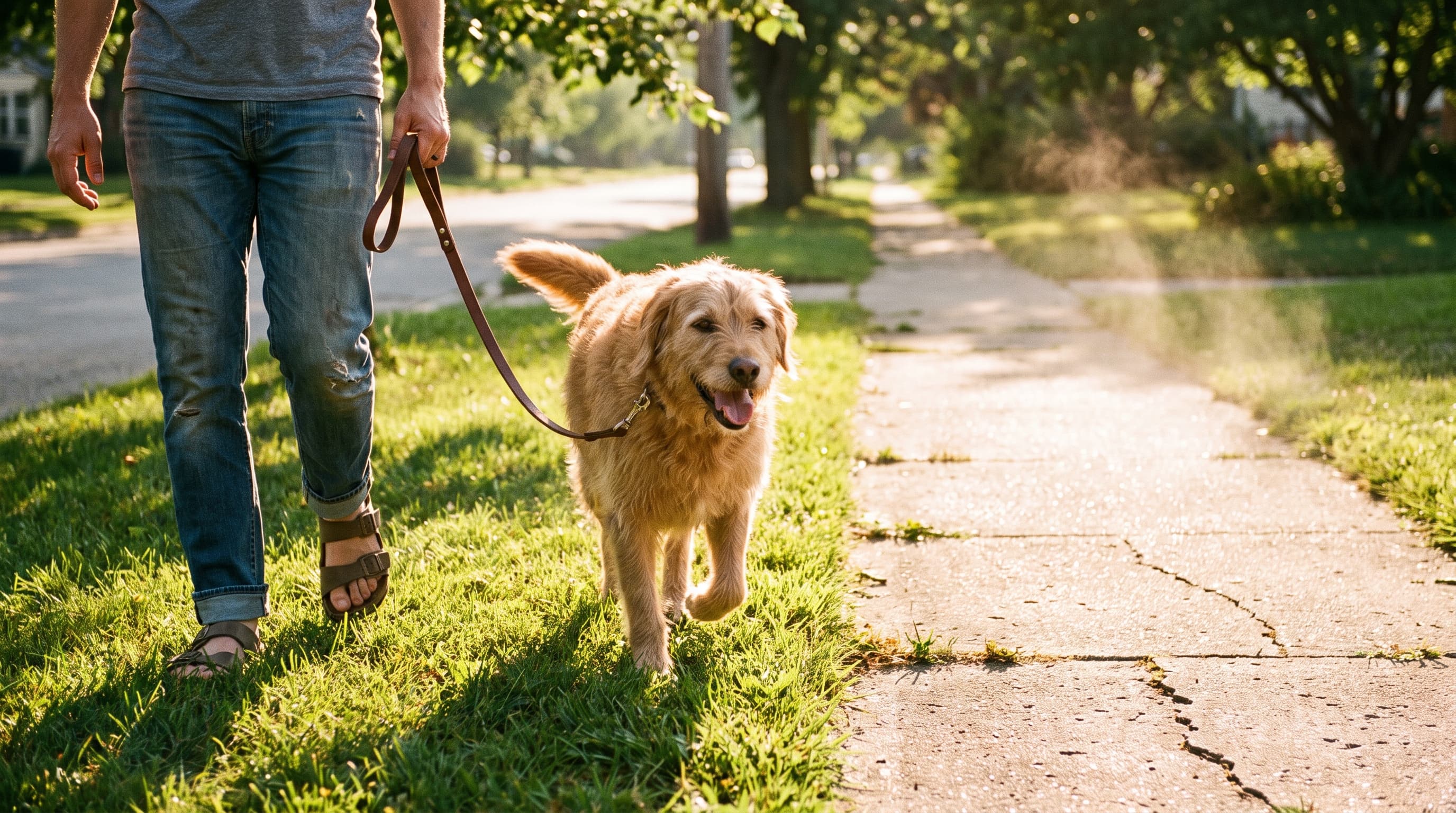
You don't have to cancel summer — you just have to move it around the sun.
- Walk early, walk late. Aim for before 8 a.m. and after sunset, when both air and pavement have cooled.
- Choose grass and shade. Route your dog over lawns and dirt trails instead of asphalt and concrete whenever possible.
- Do the 7-second test before every midday outing, no exceptions.
- Protect the paws. Dog booties or a paw wax add a real barrier on unavoidable hot stretches.
- Bring water everywhere. A collapsible bowl and a bottle should be as automatic as the leash.
- Swap the workout for enrichment. On extreme-heat days, trade the long walk for indoor sniff games, puzzle feeders, or basic training. A dog's nose tires out the brain and body without a single step on hot ground.
- Never leave a dog in a car. Ever.
Summer pests get busy in the heat too, so it's a smart time to double-check flea and tick coverage — our guide to homemade flea spray for dogs covers vet-aware options for the season.
The Bottom Line
The math is easy to remember: a 49-degree jump between the air and the asphalt is enough to turn an ordinary walk into an ER visit. This week's heat makes that gap wider than usual, but the fix costs nothing. Press your hand to the ground, count to seven, and let your dog tell you the rest. Shift the walk to the cool edges of the day, keep water close, and when in doubt, stay in.
For more seasonal safety tips, breed guides, and the occasional very good boy, keep it locked to Sidewalk Dog — and sign up for our newsletter so the next heat wave doesn't catch you or your pup off guard.