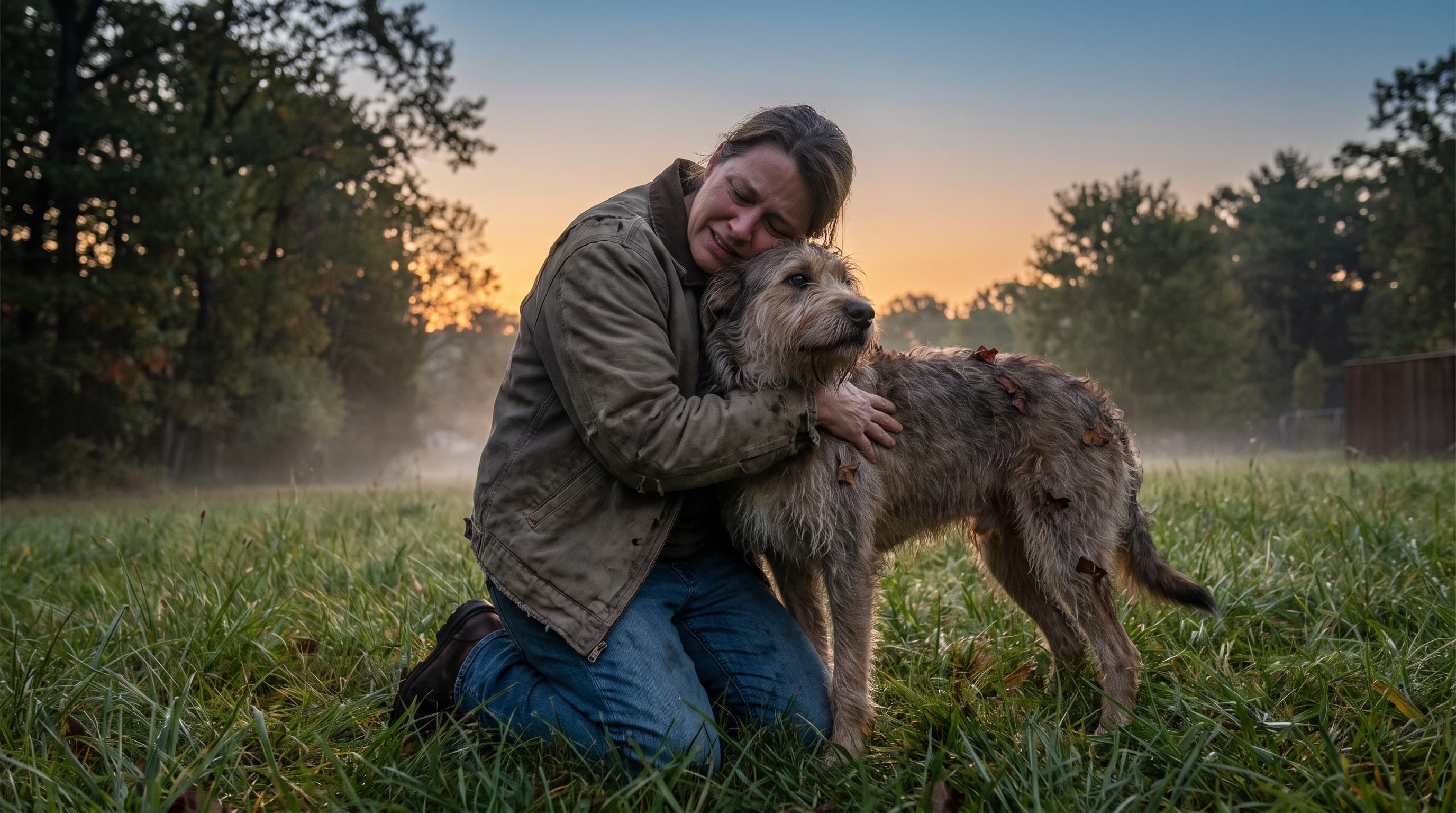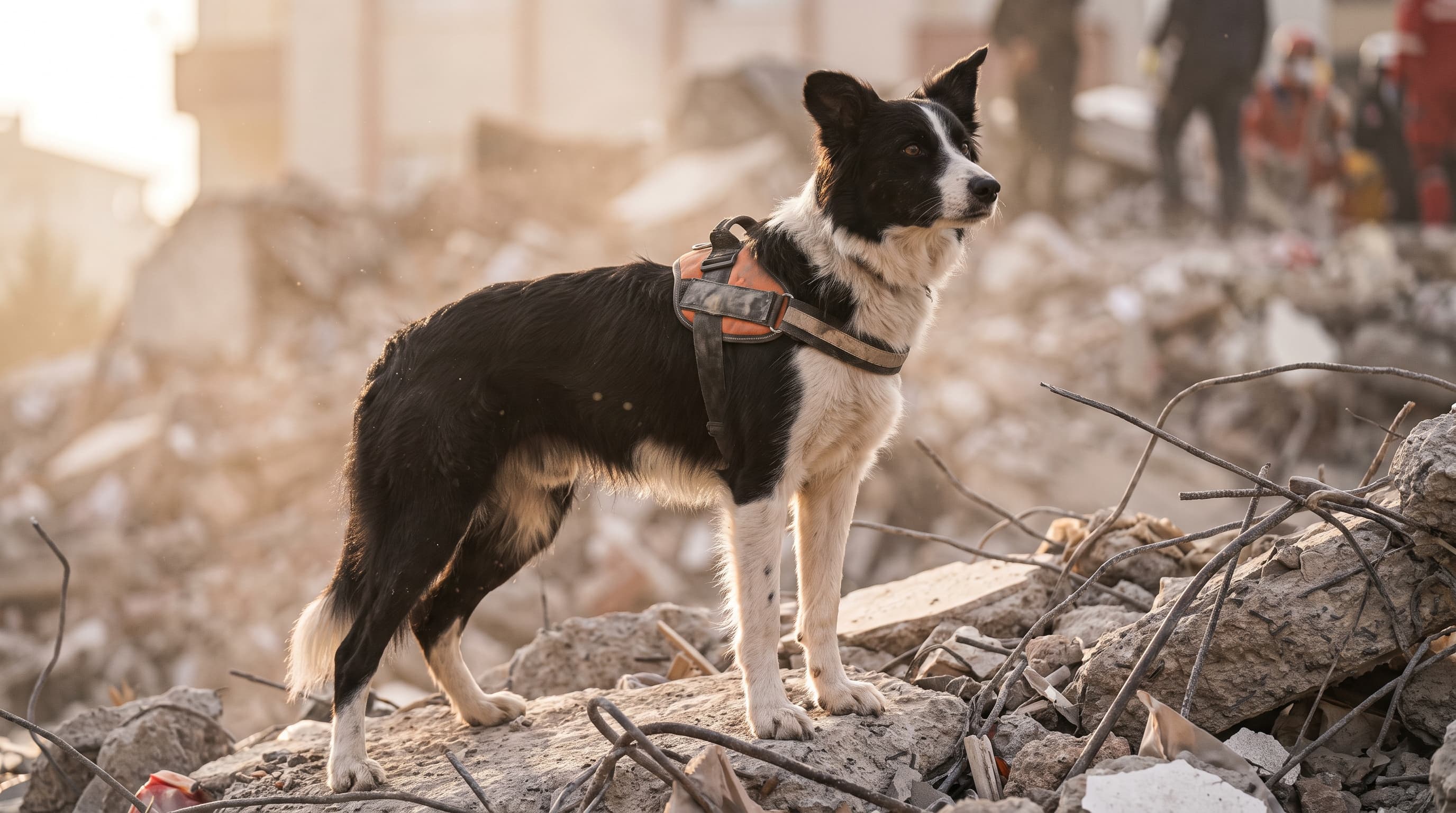

He was found as a puppy, starving and alone, wandering the streets of Caracas. Eight years later, that same dog crawled headfirst into the ruins of a collapsed apartment block and pulled a living, breathing person back into the daylight — one of at least two dozen he would reach before his handler finally called him home.
His name is Tsunami, and this summer he became the four-legged face of hope for a shattered country. As the world watched grainy rescue footage pour out of Venezuela, Tsunami — a lean, driven border collie — did what search-and-rescue dogs do better than any machine humans have ever built: he found the living among the dead. His story is extraordinary. But the instincts that made him a hero? Your dog on the couch right now shares more of them than you'd think.
From a Caracas Gutter to a National Hero
When two earthquakes measuring magnitude 7.2 and 7.5 struck Venezuela's northern coast on June 24, 2026, they flattened roughly 200 buildings across San Felipe, Caracas and the surrounding region. The human toll was staggering — nearly 3,000 people killed, thousands more injured, and tens of thousands displaced in the days that followed.
Into that chaos came the dogs. Venezuela's National Assembly President Jorge Rodríguez said some 137 search-and-rescue dogs took part in the operation, deployed alongside teams from more than 20 countries — Colombia, Spain, Argentina, Mexico, El Salvador, the Czech Republic, Jordan, Portugal, Slovakia and more. Each came with a name and a résumé: Bart, a Belgian Malinois from Argentina, pulled two children out alive. Dastan arrived with the Bogotá Fire Department. Orly and Balam came with the Mexican Red Cross.
But it was Tsunami who captured hearts. According to the Venezuelan government, "our four-legged rescuer managed to save 25 people from the rubble of buildings" — a number that climbed through the mission's first, frantic week. What made the story land wasn't just the count. It was where he started. As a puppy, Tsunami was found wandering the streets of the La Floresta neighborhood in Caracas, "extremely malnourished" after suffering "abandonment, hunger, and abuse," his rescuers said. A woman named Anita Vidal took him in, "recognized that he deserved a second chance," and set him on the path to the K-SAR ECID Disaster Canine Training Center, where handler Jorge Beens turned a discarded stray into a certified life-saver.
Venezuela's government later honored the dogs in a ceremony in the coastal state of La Guaira, granting them the title "Venezuela's Canine Heroes." Tsunami, now 8, is retiring. In the words of his unit, "he retires at the top of his game, proving his courage and giving everything in the field."
Why Dogs Beat Every Machine We've Built
There's a reason a dog, not a drone, is the first responder to squeeze into a collapsed stairwell. A dog's nose contains up to 300 million scent receptors, compared with roughly six million in ours, and the part of a dog's brain devoted to analyzing smell is proportionally about 40 times larger than a human's. That biology lets a trained dog detect the scent of a living person buried deep beneath concrete and steel — a task no thermal camera or listening device can reliably match in the noisy, dusty ruins of a disaster zone.
Search dogs typically specialize in one of two jobs: "live find" work, locating survivors, or human-remains detection. A live-find dog is trained to work a rubble pile methodically, then deliver a clear, trained alert — usually a sustained bark — the instant it pins down a human scent. Rambo, a Malinois deployed in Venezuela from El Salvador, does exactly that: he barks to signal a living person below. That single behavior, drilled thousands of times, is what turns an anxious pile of debris into a coordinate rescuers can dig toward.
The Traits That Get a Dog "Fired" Are the Ones That Save Lives
Here's the part every dog owner should sit with. The dogs that excel at this work are, very often, the same dogs that get surrendered to shelters. Tsunami was a street dog. And here in the United States, the model looks remarkably similar.
The National Disaster Search Dog Foundation, based in Santa Paula, California, recruits its recruits almost entirely from shelters and rescue groups. As the foundation puts it bluntly: "The traits that can make dogs unsuitable as family pets and land them in a shelter — intense energy and extreme drive — are exactly the qualities required in a Search Dog." The relentless retriever who never drops the ball, the herder who paces your living room at 10 p.m. still looking for a job — those dogs aren't broken. They're often just under-employed.
The foundation's pipeline is a year-plus of work: eight to ten months of evaluation and socialization at its national training center, a two-week bonding period pairing the dog with a firefighter or first-responder handler, and roughly a year of certification training toward FEMA or state standards — plus weekly rubble drills for life. FEMA maintains a national roster of certified detection canines ready to deploy with its urban search-and-rescue task forces, and a dog generally must be at least 18 months old to test, with re-certification required every few years.
The common breeds won't surprise anyone who's met a high-drive dog: Labrador and golden retrievers, German shepherds, Belgian Malinois and border collies like Tsunami. What matters more than the breed, trainers say, is the individual dog's "hunt drive" — an almost obsessive willingness to keep searching for a toy — and its athleticism on unstable ground.
What This Means for Your Very Good, Non-Heroic Dog
Most of our dogs will never see a rubble pile, and thank goodness for that. But the same nose and the same drive are sitting in your home, and they're happiest when they get to work. That instinct is why scent games are the single most underrated form of enrichment for a bored, busy dog.
You don't need a training center. Scatter your dog's kibble across the backyard and let them "hunt" breakfast. Hide a favorite toy in another room and send them to find it. Try a beginner "nose work" game — three cardboard boxes, a treat hidden in one, and a dog learning to tell you which. A few minutes of sniffing genuinely tires a dog more than a long walk, because you're finally asking the most powerful part of their brain to do its job. High-drive dogs especially — the ones bouncing off your walls — often calm dramatically once someone gives that engine a task.
And the deepest lesson of Tsunami's story is the simplest one: the "difficult" dog at your local shelter, the one too intense or too much for the family that gave him up, may be exactly the dog waiting for the right job — or the right person. Second chances, it turns out, save lives in both directions.
The Takeaway
Tsunami is heading into retirement with a nation's gratitude and a title no dog has worn before him. He began as a starving stray in a Caracas gutter and ended as the reason 25 families still have someone to hold. Somewhere between those two facts is the whole case for looking twice at the anxious, high-energy dog everyone else overlooked.
At Sidewalk Dog, we believe every dog deserves a job they love and a home that gets them. If Tsunami's story has you looking at your own restless pup a little differently tonight, start small: hide a treat, watch that nose go to work, and see the hero who's been on your couch all along. For more ways to channel your dog's instincts — and stories of dogs changing lives — explore Sidewalk Dog.