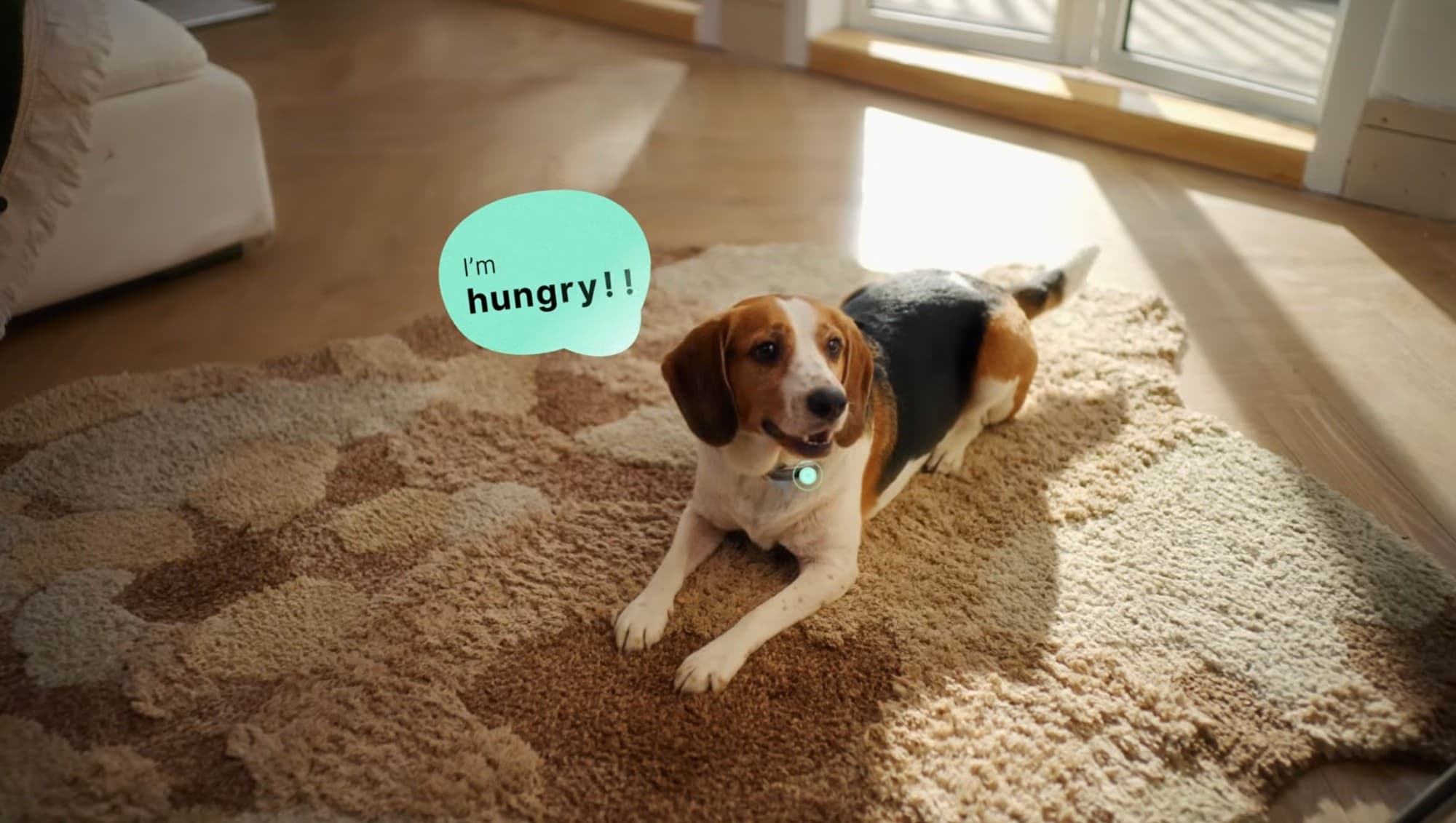

For as long as we’ve loved dogs, we’ve wished they could just tell us what they’re thinking. A Chinese startup says that wish now fits around your dog’s neck for about $118. Its AI-powered collar, PettiChat, claims it can turn your dog’s barks — and your cat’s meows — into readable sentences on your phone in roughly a second. More than 10,000 people have already preordered one. The promise is irresistible. The science is a lot more complicated.
What is PettiChat, exactly?
PettiChat is a 27-gram collar from a Hangzhou-based startup founded in early 2026. It pairs built-in microphones with motion sensors and accelerometers to capture both what your dog sounds like and how it’s moving, then runs that data through an AI model built on Alibaba Cloud’s Qwen large language model, trained on more than a million pet audio and behavior samples. The result, the company says, lands on your smartphone in about 1.2 seconds as a plain-English phrase like “I’m hungry” or “I want to play.”
You can see that pitch for yourself in PettiChat’s own Kickstarter video, which shows pets “captioned” with tidy phrases in real time:
It does a few other things, too. There’s GPS tracking, geo-fencing alerts if your dog wanders out of bounds, and a bidirectional mode that converts your voice into sounds meant to soothe your pet. At 799 yuan — about $118 — it launched at the end of May 2026 and crossed 10,000 preorders within weeks.
The headline figure is the one everyone keeps repeating: PettiChat says it is 94.6% accurate at identifying more than 20 emotional states and turning them into words.
Why experts aren’t buying the 95% claim
The video is charming, and the demo makes translation look effortless. The claim underneath it is another matter. That 94.6% accuracy figure is doing a lot of heavy lifting — and it comes entirely from the company’s own testing. There are, as critics have been quick to point out, no independent, peer-reviewed studies or public datasets behind it. When a viral post about the collar made the rounds on X, the platform’s own readers attached a Community Note flagging exactly that: the claim is “made by the manufacturer without independent verification or published studies.”
The deeper skepticism is about what “translation” even means here. Researchers and longtime dog folks argue the collar is really doing predictive mood classification — making an educated guess about your dog’s emotional state — and then dressing that guess up as a sentence. That’s a very different thing from genuine cross-species translation. A bark the AI labels “I’m hungry” could just as easily mean “the mail carrier is here” or “I heard a squirrel,” and the collar has no dependable way to know which unless it understands the entire situation your dog is in.
What the science actually says
Here’s the part the marketing skips: serious researchers are working on this, and their honest results are far more modest than 95%.
In a widely cited 2024 study, a team led by the University of Michigan took Wav2Vec2 — an AI model originally built to process human speech — and fed it barks, growls, and whimpers from 74 dogs. The model reached up to 70% accuracy across four tasks: gauging a dog’s rough emotional state (playful versus aggressive, say) plus its breed, age, and sex. “We wanted to see if we could leverage this ability to discern and interpret dog barks,” said lead researcher Artem Abzaliev. Impressive — but notice what it’s doing. It’s classifying, not translating. There are no sentences.
At the University of Texas at Arlington, computer scientist Kenny Zhu has assembled what he calls the world’s largest library of dog audio and video, transcribing roughly 50 hours of barks into syllables and spotting recurring patterns that line up with words like “cat,” “cage,” and “leash.” He has even found that vocal patterns shift with age — huskies, for instance, develop longer, more sophisticated barks as they mature. (If you’ve ever lived with one, you already knew they had opinions.) Yet Zhu is candid about how far off the dream remains. “The ultimate goal is to make a translator where you can talk freely with your pet,” he says — goal being the operative word.
Put plainly: the best-funded labs on the planet are still working on reliably telling a happy bark from an angry one. A consumer collar promising near-perfect, sentence-level translation is, to put it kindly, well ahead of the evidence.
We’ve been here before
If a talking-dog gadget feels familiar, it should. Back in 2002, the Japanese toymaker Takara released BowLingual, a handheld “dog translator” that matched barks to a handful of emotions and even earned its inventors an Ig Nobel Prize. The big difference today is that PettiChat uses generative AI to produce fresh phrases instead of pulling from a fixed list — which makes the output sound more convincing without necessarily making it more correct. Fluent and accurate are not the same thing, as anyone who has used a chatbot already knows.
You already own the best dog translator
Here’s the good news: you don’t need a collar to understand your dog. You need to watch your dog. Dogs communicate overwhelmingly through body language and context, and the signals are remarkably readable once you know what to look for:
- Loose and wiggly: a relaxed body, soft eyes, and an open, easy mouth usually mean a happy, comfortable dog.
- Stressed and unsure: a tucked tail, pinned-back ears, lip-licking, or yawning when nobody’s tired are classic signs of anxiety.
- Asking for space: a hard stare, stiff posture, or low growl is your dog setting a boundary. A growl is useful information, not a behavior to punish away.
- Context is everything: the same bark means different things at the front door, the food bowl, and the window.
A gadget that cheerfully announces “I’m happy!” while your dog is actually flashing stress signals isn’t just unhelpful — it could lead you to misread a moment that really matters. That’s the genuine risk hiding behind a confidently wrong translation.
So, should you buy one?
If you want a fun GPS tracker with a novelty feature, and you go in clear-eyed about the “translation,” PettiChat may scratch the itch. Just don’t treat its sentences as gospel — especially around anything involving fear, pain, or aggression. For those, nothing replaces a veterinarian or a certified behaviorist who can see your actual dog in your actual home.
The technology is genuinely exciting, and the science is moving quickly. Five years from now, “what is my dog saying?” may be a question AI can answer with real rigor. For now, the most reliable translator is still the one paying attention at the other end of the leash.
At Sidewalk Dog, we’re all about helping you understand and adventure with your pup — no gadget required. For more on decoding your dog’s behavior, finding dog-friendly spots near you, and the occasional good-news dog story, come hang out with us.