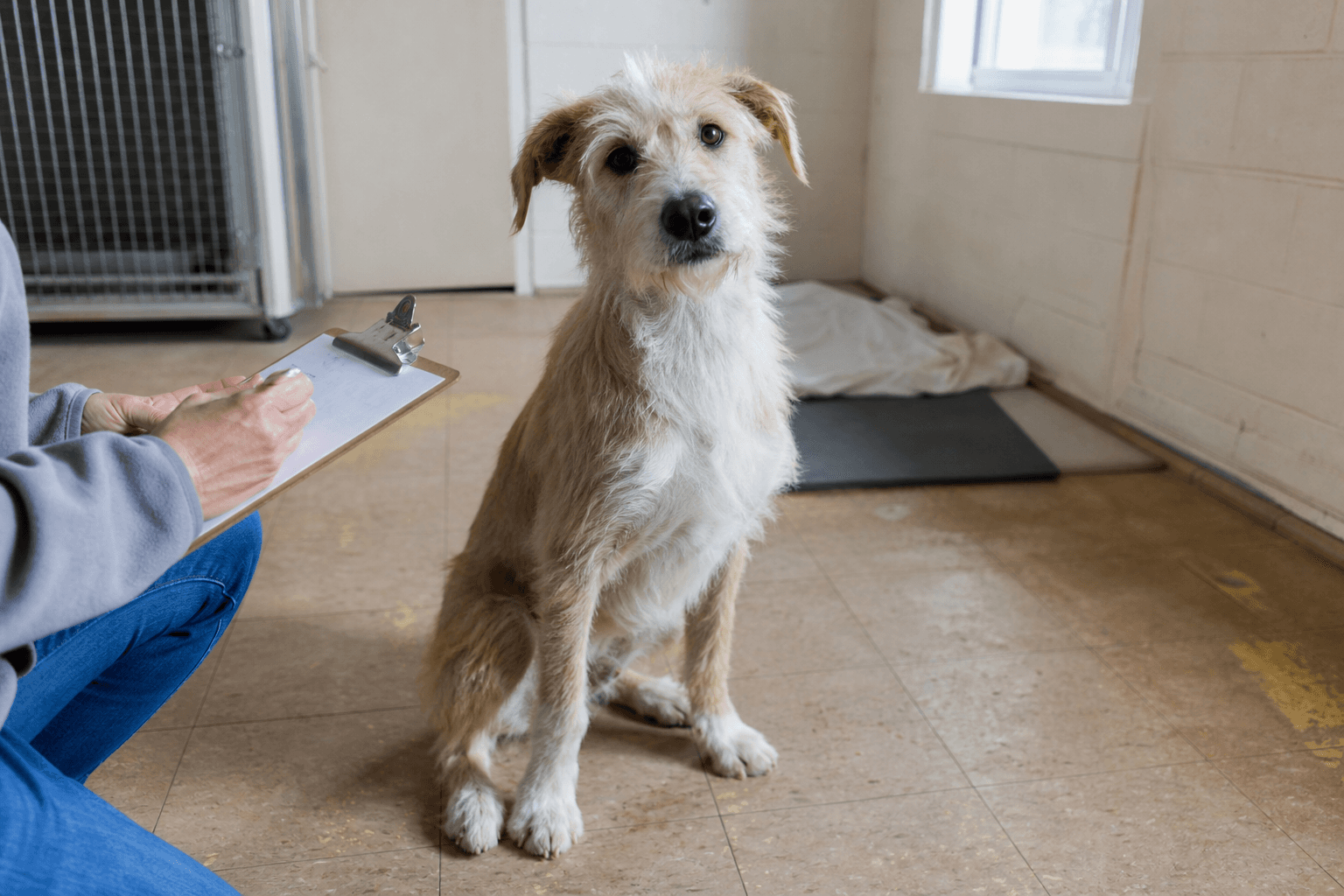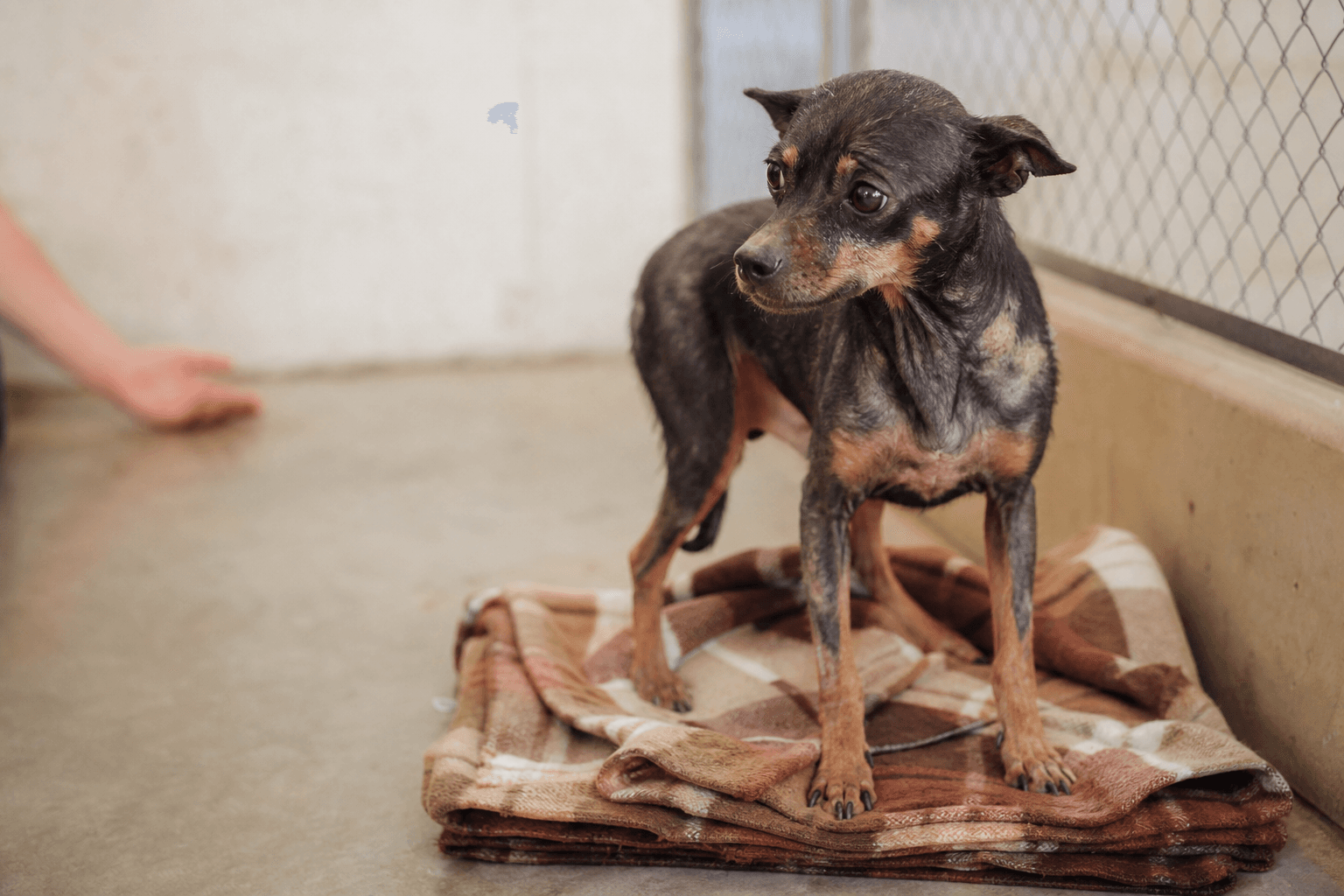

Over six days at the end of July, volunteers walked a five-acre wooded property near the Adair–Metcalfe county line in south-central Kentucky and kept finding dogs. In cages. Under parked vehicles. In two outbuildings. In the treeline behind the house. They had come expecting roughly 100 animals. The final count, after a "final sweep" on August 4, was 244 dogs — plus four cats.
It is one of the largest animal removals in recent Kentucky history, and the dogs from it are now scattered across rescue partners in Kentucky, Tennessee, Ohio and Pennsylvania. Which means something specific for the rest of us: over the next few months, a few hundred small dogs with very unusual histories are going to start appearing in adoption listings — many of them adorable, most of them Chihuahuas, Miniature Pinschers, Pomeranians and Boston Terriers, and nearly all of them carrying a set of behavioral needs that a normal shelter listing does not prepare you for.
Here is what actually happened, what the research says about dogs who come out of hoarding situations, and how to tell whether you're the right home for one.
What rescuers found in Breeding, Kentucky
Kelly Basham, director of operations for the New York–based nonprofit Guardians of Rescue, told the Courier Journal she got a "frantic" phone call on July 28 from a woman in the local rescue community. Three volunteers had gone out thinking it was a small situation and realized immediately it was far beyond what they could handle. Guardians of Rescue contacted Kentucky State Police, and the property owner voluntarily surrendered the animals.
The dogs ranged from four weeks to 15 years old. According to reporting from WDRB, WBKO and the Courier Journal, they were found with respiratory and eye infections, emaciation, internal and external parasites, ear mites, fleas, ticks and overgrown nails. Basham said every dog had mange — a skin disease caused by mites that burrow into the skin. Many had received little or no socialization with people.
The property owner told rescuers the animals were left behind after her mother, a dog breeder, died several months earlier. Basham said the owner was asked repeatedly how many dogs were on the property and "wasn't honest" — every time a group was loaded up, the team left thinking they knew how many remained, and then found more.
Kentucky State Police are investigating, and a trooper is working with the county attorney on potential charges. As of this writing, none have been filed.
Why a breeder's death turns into a hoarding case
This is the pattern worth understanding, because it repeats. Several animal welfare organizations estimate that roughly 250,000 animals a year are involved in hoarding situations in the United States. Baltimore County Animal Services alone told The Banner its hoarding complaints nearly doubled — from 26 in 2023 to 48 in 2025.
The ASPCA's working definition is not about a number of animals. It's about capacity: hoarding is "housing more animals than they can adequately and appropriately care for," measured by an inability to provide even minimal standards of nutrition, sanitation, shelter and veterinary care. Plenty of people live happily with five dogs. The diagnostic question is whether the animals' basic needs are being met — and whether the person can accurately say how many animals they have.
A breeding operation is uniquely vulnerable to collapsing into that. There are already a lot of intact animals on site, they reproduce, and when the person managing them dies or becomes ill, the population keeps growing while the care capacity drops to zero. The federal Animal Welfare Act licenses and inspects commercial breeders — but a home operation below the licensing thresholds, or one whose license lapses, falls entirely to local animal control and state law.
What the research says about hoarding-case dogs
This is the part that adoption listings rarely cover, and it's the most useful thing to know before you fill out an application.
A case-control study published in Applied Animal Behaviour Science compared 408 formerly hoarded dogs against a control sample of more than 11,000 pet dogs using the C-BARQ behavioral questionnaire. Formerly hoarded dogs scored significantly higher on:
- Fear — of strangers, of other dogs, and non-social fear (noises, novel objects)
- Sensitivity to touch
- Attachment and attention-seeking, which intensified after 2.5+ years in the new home
- Urinating and defecating when left alone
- Repetitive behaviors, particularly in dogs rehomed alongside other dogs
They scored significantly lower on aggression toward strangers, dog rivalry, trainability and excitability. That combination — very fearful, not very aggressive, hard to motivate with normal training — is the signature. These dogs mostly don't bite. They shut down.
A separate study found that dogs from adverse early environments (puppy mills, unlicensed breeders, hoarding cases) had measurably higher salivary cortisol than other shelter dogs, showed more fear behavior and less affiliative behavior with an unfamiliar person, and spent more time frozen or stationary. The researchers couldn't even complete a food-based cognitive task with them, because the dogs wouldn't move.
The genuinely hopeful data point: a behavioral rehabilitation program using desensitization and counterconditioning graduated 86% of extremely fearful dogs (380 of 441), with an average of 96 days and 78 treatment sessions per dog. Of those who graduated, 99% were adopted and 96% of adopters reported being satisfied. Extreme fear is treatable. It is just not treatable quickly, and not by accident.
Are you the right home for one of these dogs?
Not a moral test — a logistics test. Say yes to a hoarding-case dog if you can honestly check most of these:
- You have 6–12 months of patience, not 6 weeks. Progress is measured in a dog choosing to come three feet closer than yesterday.
- You have a second, confident dog, or access to one. Many undersocialized dogs learn "humans are fine" by watching another dog do it first. (Note the caveat from the research: dogs rehomed with other dogs showed more repetitive behaviors — a stable resident dog helps, a chaotic multi-dog household doesn't.)
- You can tolerate a long housetraining runway. A dog raised in a cage learned to eliminate where it sleeps. Assume months, use a consistent outdoor routine, and budget for an enzymatic cleaner and washable rugs.
- Your home is quiet-ish. Fewer novel stimuli, fewer strangers, no big rotating cast of guests for the first few months.
- Your fencing and leash setup are escape-proof. Panicked flight is the number one risk in the first two weeks. Use a well-fitted harness plus a martingale collar, double-clipped, and a physical fence rather than a door someone might leave ajar.
- You have a medical budget. These dogs come in with mange, parasites, dental disease and untreated infections. Even with rescue-covered intake care, expect follow-up vet visits.
And say no — with zero guilt — if you need a dog who can walk on a busy sidewalk next month, travel, tolerate a toddler's grabbing, or be left alone for nine hours on day one. Choosing a different dog is a kindness to this one.
The first two weeks, concretely
Set up one small "safe room" with a covered crate left open, water, and a bed. Don't reach into the crate. Sit on the floor at a distance, sideways, and read out loud so the dog learns your voice without being stared at. Toss high-value food — boiled chicken, not kibble — and walk away. Use a leash indoors for the first several days so you never have to grab the dog. Take potty breaks on leash in the yard, same door, same spot, same time. Let the dog set every pace.
If you can't adopt, here's what actually helps
Large seizures don't strain rescues at intake — they strain them three months later, when the donations have stopped and 200 dogs still need dentals and daily handling sessions. Concretely useful support: foster (the single biggest bottleneck), transport volunteering on relay legs between states, and unrestricted cash to the specific groups doing the medical work rather than to a national organization that isn't holding these dogs. In this case that includes Guardians of Rescue and Kentucky partners like The Arrow Fund, which took in six of the dogs, and FairyTails Pet Adoptions, which took 27.
How to report a situation like this in your own neighborhood
The Kentucky case reached 244 dogs because nobody with authority walked that property sooner. Signs worth a phone call: a persistent ammonia smell from outside the house, constant barking from multiple animals, an owner who won't say how many animals they have, refusing anyone entry, visible animals who are thin or have hair loss, and dogs kept in vehicles or outbuildings.
Call your local animal control first, or the humane society or SPCA if your county doesn't have one; use the police non-emergency line if there's no animal agency, and 911 if an animal is in immediate danger. Be factual and specific: exact address, approximate number and types of animals, what you actually observed ("thin, ribs visible, hair loss on both flanks" beats "looks neglected"), and dates and times. Photos taken from a public sidewalk or street strengthen a report — never trespass to get them. Write down who you spoke with and when, and follow up. Anonymous reports are accepted in most places, but cases are far more likely to be investigated and prosecuted when a named witness will stand behind the complaint.
One more thing: in 40 states plus D.C., "bond-or-forfeit" laws require an owner to post a bond covering the animals' care costs or surrender ownership outright. In a case involving hundreds of animals, the bond is unpayable, which is often how the dogs become legally adoptable fast. Early reporting is what makes that possible — and what keeps a case at 20 animals instead of 244.
The takeaway
The dogs from Breeding, Kentucky are going to be some of the most appealing listings in four states this fall: tiny, photogenic, and desperately overdue for a soft place to land. They will also be the dogs who hide behind the couch for a month. Both of those things are true at once, and the adopters who know that going in are the ones who make the 99% adoption-success statistic real.
At Sidewalk Dog, we spend most of our time on the fun stuff — patios, trails, and the best dog-friendly spots in your city. But the shy, still-learning dogs deserve those places too, eventually. If you bring one of these dogs home, start with an empty parking lot at dawn and work your way up. We'll be here with the patio list when you're ready.