
On Thursday, August 13, the U.S. Food and Drug Administration issued an emergency use authorization (EUA) for Simparica TRIO — the Zoetis chewable most dog owners already know as a monthly heartworm, flea, and tick preventive — allowing veterinarians to use it to treat New World screwworm (NWS) infestations in dogs and puppies.
If you just read the words "screwworm" and "emergency use authorization" in the same sentence and felt your stomach drop, take a breath. This is genuinely good news, and the FDA went out of its way to say so.
"We want dog owners to be informed, not alarmed," said Timothy Schell, PhD, director of the FDA's Center for Veterinary Medicine, in the agency's announcement. "The best thing to do is have a conversation with your veterinarian if you have concerns."
Still, this is the third screwworm-related authorization for dogs in about eight months, and that pattern is worth understanding. Here's what actually happened, who's realistically at risk, and the two-minute habit that matters more than any pill.
What the FDA actually authorized
Simparica TRIO combines three active ingredients: sarolaner (an isoxazoline-class parasiticide), moxidectin, and pyrantel. It's been fully FDA-approved since 2020 for heartworm prevention and for treating fleas, ticks, roundworms, and hookworms.
The EUA adds one narrow new use on top of that. Three details matter:
- Treatment only — not prevention. The FDA was explicit: Simparica TRIO is not authorized under this EUA to prevent screwworm infestation. Giving your dog their monthly chew is not a screwworm shield.
- Prescription only. As with the agency's other NWS authorizations, it stays behind a veterinarian's prescription for as long as the EUA is in effect.
- It's an emergency standard, not a full approval. An EUA means the FDA reviewed the totality of available evidence and concluded the product may be effective and that its known and potential benefits outweigh its risks. That's a lower bar than the substantial-evidence standard behind a full approval — appropriate for an outbreak, but worth knowing.
Simparica TRIO joins a growing shelf. In December 2025, the FDA conditionally approved Elanco's Credelio Quattro-CA1 (lotilaner, moxidectin, praziquantel, pyrantel) for screwworm myiasis in dogs and puppies at least 8 weeks old and 3.3 pounds — a five-year-maximum pathway that lets a sponsor market while it finishes collecting effectiveness data. In June 2026, nitenpyram got an emergency authorization for dogs and cats.
One safety note your vet will already be thinking about: sarolaner is an isoxazoline, a drug class associated in rare cases with neurologic effects including muscle tremors, incoordination, and seizures. Dogs with a seizure history deserve an explicit conversation before this or any isoxazoline goes in the bowl.
What New World screwworm actually is
New World screwworm (Cochliomyia hominivorax) is a fly whose females lay eggs at the edge of an open wound — or at a moist mucous membrane like a nose, mouth, ear, or a fresh spay incision — on any warm-blooded animal. The hatched larvae do something most maggots don't: they feed on living tissue, burrowing screw-like deeper into the wound rather than cleaning it.
The United States declared itself free of the parasite in 1966 after a decades-long eradication campaign built on the sterile insect technique — flooding the landscape with sterilized male flies so wild matings produce nothing. That barrier held in Panama's Darién Gap until 2023, when NWS broke north. It reached southern Mexico in late 2024.
On June 3, 2026, USDA-APHIS confirmed the first U.S. animal case of the current outbreak, in a calf in Zavala County, Texas.
How big is this, really?
Small, so far — and the numbers deserve to be said plainly, because "flesh-eating parasite" headlines do not self-calibrate.
- As of July 29, 2026, USDA-APHIS had confirmed 42 U.S. cases: 41 in Texas, 1 in New Mexico. Eleven remained active, all in Texas.
- Most cases have been livestock — cattle, sheep, goats. As of mid-July, only two confirmed U.S. cases involved dogs (one in Texas, one in New Mexico).
- There have been no locally acquired human cases in the U.S., and the CDC rates current risk to the public and animals here as very low.
- For scale, Central American countries and Mexico have reported more than 209,400 animal cases and 2,440 human cases. The U.S. count is a rounding error against that — which is exactly what the response is designed to keep it.
USDA has answered detections with expanded surveillance, sterile fly releases, quarantines, and animal movement controls, and on July 24 announced a phased reopening of selected southern livestock ports beginning August 24, contingent on Mexico holding up its end of a joint action plan.
Is your dog at risk? A short honest filter
For the overwhelming majority of American dogs, the answer is no — geography is doing the work. Risk climbs if your dog:
- Lives in or has traveled to an affected area of south and west Texas or southern New Mexico (USDA maintains county-level zone maps at screwworm.gov)
- Spends significant time outdoors, unsupervised, on ranch or rural land
- Has an open wound, a tick-bite site, a fresh surgical incision, or an ear or skin infection
- Has recently traveled from Mexico or Central America, or was imported from there
Suburban dogs in Minneapolis, Denver, or Chicago walking on sidewalks are not the population this authorization was written for.
The warning signs — and the two-minute habit that beats any drug
Texas A&M AgriLife Extension's companion-animal guidance is the clearest owner-facing checklist available, and it comes down to looking. Screwworm myiasis can be fatal in dogs and cats depending on location, severity, and how fast it's caught.
Do this:
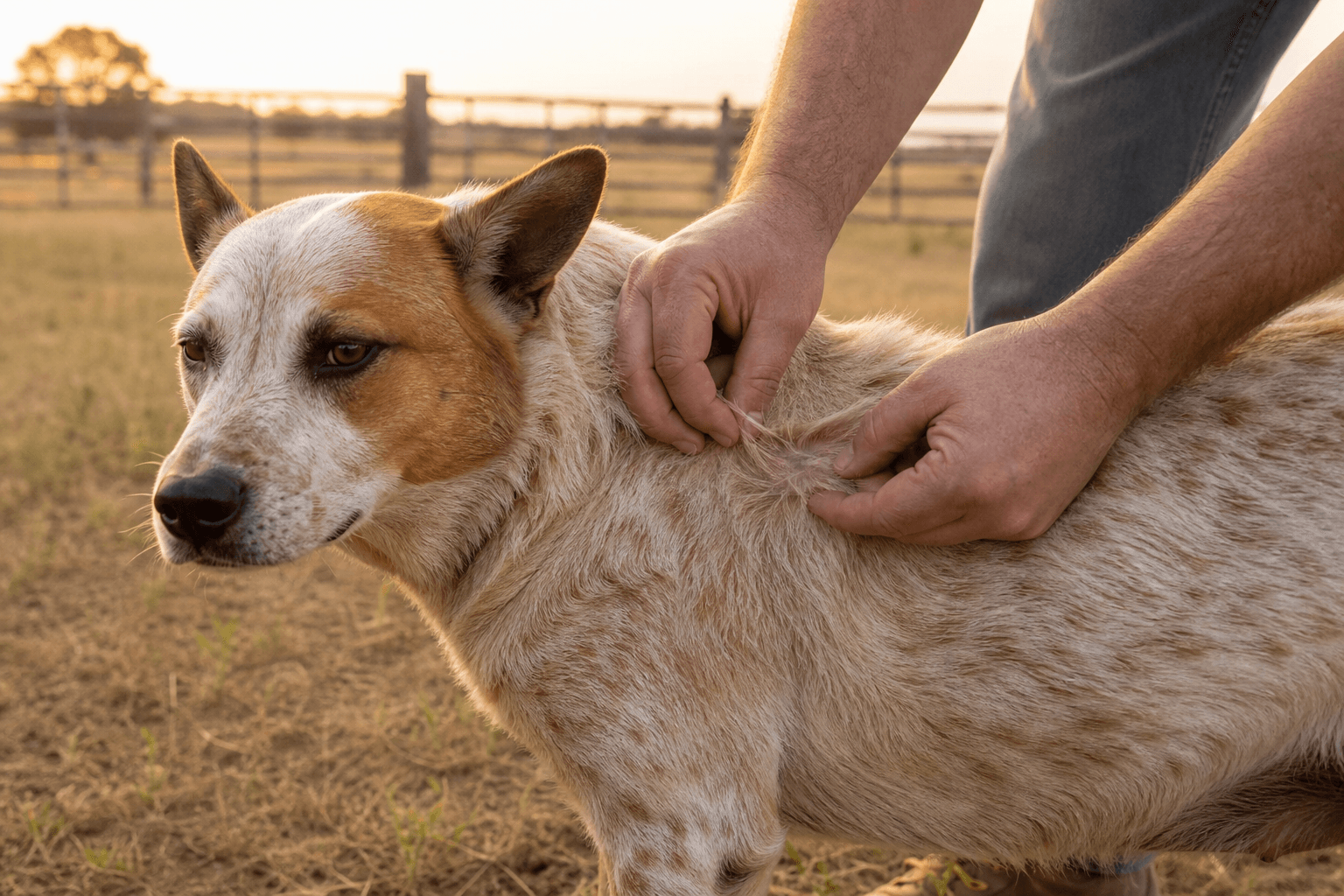
- Check your dog daily for new wounds — including old tick-attachment sites, which are classic entry points.
- Trust your nose. A distinctly foul odor from a wound is a red flag. So is a wound that's getting bigger, deeper, or draining instead of scabbing over.
- Look for larvae in wounds and around the nose, mouth, and ears.
- Watch behavior: obsessive licking at one spot, head shaking, limb shaking, lost appetite, lethargy, or new irritability.
- Cover and care for wounds — including spay/neuter incisions — and keep them clean while they heal.
- Audit the yard for injury sources: wire fencing, sharp vegetation, metal chains, broken gate hardware.
- Call your vet immediately if you suspect myiasis. Screwworm is a reportable condition; your vet contacts the state animal health official or USDA area veterinarian in charge.
Don't do this:
- Don't dig larvae out yourself. Removal usually needs a vet, often sedation, and every larva must be recovered — the specimens go into 70% ethanol for identification at a state lab or the National Veterinary Services Laboratories.
- Don't use over-the-counter fly sprays or livestock pour-ons on your dog. The labeled topical products are for livestock and only when larvae are present.
- Don't order screwworm drugs online. Every authorized option is prescription-only for a reason — dosing, weight minimums, and the isoxazoline seizure question all need a vet.
- Don't skip the vet because your dog is "on Simparica." Prevention is not what was authorized.
Traveling to Mexico with your dog? This one is new
This is the piece most owners have missed. Effective August 3, 2026, Mexico requires pet dogs traveling from the U.S. to carry a New World Screwworm Inspection Certificate, issued and signed by a USDA-accredited veterinarian within 5 days of arrival, per the AVMA. Notably, that form does not require APHIS endorsement — but the separate Veterinary Health Certificate for export does.
Coming the other way, dogs entering the U.S. from a screwworm-affected country need certification from an official government veterinarian that the dog was inspected within 5 days before shipment and is free of screwworm (or was treated and cleared). If you have a Labor Day or fall trip on the calendar, book that vet appointment now — five days is a tight window, and an unaccredited clinic can't sign it.
The bottom line
An emergency authorization sounds scarier than it is. What it actually means is that when a dog in Sutton County shows up with larvae in a wound, the veterinarian has a third legal, evidence-reviewed tool on the shelf instead of improvising. That's the system working early, not late.
Your job is smaller and more boring: run your hands over your dog after outdoor time, take wounds seriously, and get a certificate if you're crossing the border. For everyone else, this is a headline to understand — not a reason to change your Tuesday.
Want more plain-English breakdowns of the dog news that actually affects your walk? Sidewalk Dog covers it all — plus the best dog-friendly patios, parks, and trails in your city.