
Late Thursday night in Washington Park, Illinois, a 68-year-old East St. Louis man named James L. Gibson was killed by a group of loose dogs while on a break from work at a rental property. Washington Park Police were called at about 10:44 p.m. for a report of a bite; Gibson was pronounced dead at the scene at 11:35 p.m., according to St. Clair County Coroner Calvin Dye Sr. Officers who arrived shot several of the dogs when they turned on them, and the rest of the pack ran into nearby woods. Two hours before the fatal attack, police say another caller reported a woman bitten by what appeared to be the same group of dogs.
Neighbors told St. Louis-area outlets they had reported wandering dogs in that neighborhood for years. St. Clair County Animal Services director Ashley Jett said her office was still waiting on the police incident report the next day, and that the dogs were not in county custody.
It's a horrifying story, and it is also the kind of story that makes every dog owner tighten their grip on the leash. So let's do the useful thing with it. Below is what the national data actually shows about attacks like this one — and the concrete plan you should have in your head before a strange dog comes running at you and your dog.
The part of this story that isn't unusual
Two details in the Washington Park case reflect a broader national pattern.
Multi-dog attacks are overrepresented in the worst outcomes. In DogsBite.org's fatality tracking, 54% of the 63 dog bite fatalities the nonprofit recorded in 2023 involved more than one dog — and 64% of the 56 deaths recorded in 2022. Dogs behave differently in groups than they do alone: arousal is contagious, and a dog that would break off an encounter by itself may not when it's running with two or three others.
Attacks by dogs away from their own property are rising. DogsBite.org's 2005–2024 data set found off-property fatal attacks — a dog killing someone somewhere other than its own home — rose 87% between the pre-2020 five-year period and the years that followed, and fatal attacks by non-family dogs rose 66%. CDC WONDER death-certificate data recorded 127 fatal dog attacks in 2024, its highest single-year count on record. (Fatality counts vary by source, because CDC data comes from death certificates and nonprofit trackers rely on verified news reports and court records; treat any single figure as an estimate, not gospel.)
Adults, not just kids, are the majority of victims. In the 2023 data, 70% of victims were adults 30 or older. The image of dog attacks as purely a child-safety issue is out of date.
The everyday scale matters too: DogsBite.org's compilation of national figures puts serious dog bite injuries at roughly 1,000 emergency-department visits a day in the U.S., with about 12,480 hospitalizations a year. Most of those never make the news, and most involve one loose dog and one very startled person.
What almost never gets covered is the middle of the story — the enforcement gap. Many county animal control agencies, including St. Clair County's, publicly state that officers do not respond to routine stray-animal calls and prioritize bites and actively aggressive animals. That's not negligence so much as arithmetic: a small number of officers, a large county, and a complaint queue. It's also why "I called it in years ago" and "nothing happened" can both be true at once.
Your loose-dog plan: decide now, not then
Trainers who deal with this constantly all say the same thing: the reason people freeze is that they've never rehearsed. As Whole Dog Journal puts it, you and your dog stand the best chance of coming out unscathed if you have already visualized and practiced what you'd do. Here's the sequence experts consistently recommend.
1. See it early
Situational awareness is the whole ballgame. One earbud out, phone in your pocket, eyes up and scanning ahead, especially near fence lines, alleys, and open garages. Ten extra seconds of warning turns a crisis into a detour.
2. Read the body language
A dog with loose, bouncy movement, a relaxed open mouth, and a full-body tail wag is probably being obnoxiously friendly. A dog moving in with a hard stare, closed mouth, forward ears, stiff body, high tight tail, or a stalking freeze-and-go pattern is a different animal entirely. The AKC notes that a hard stare is a threat in dog language, and that sudden stillness often precedes a lunge. Don't be reassured by tail motion alone.
3. Create a barrier
Get something — anything — between the dogs. Step into an unlocked fenced yard or a dog-friendly business, put a parked car between you, or hop into a truck bed. Open an umbrella toward the oncoming dog. Hold your bag, jacket, or a bike sideways as a shield. Barriers work far better than speed.
4. Don't run, and don't yank your dog into the air
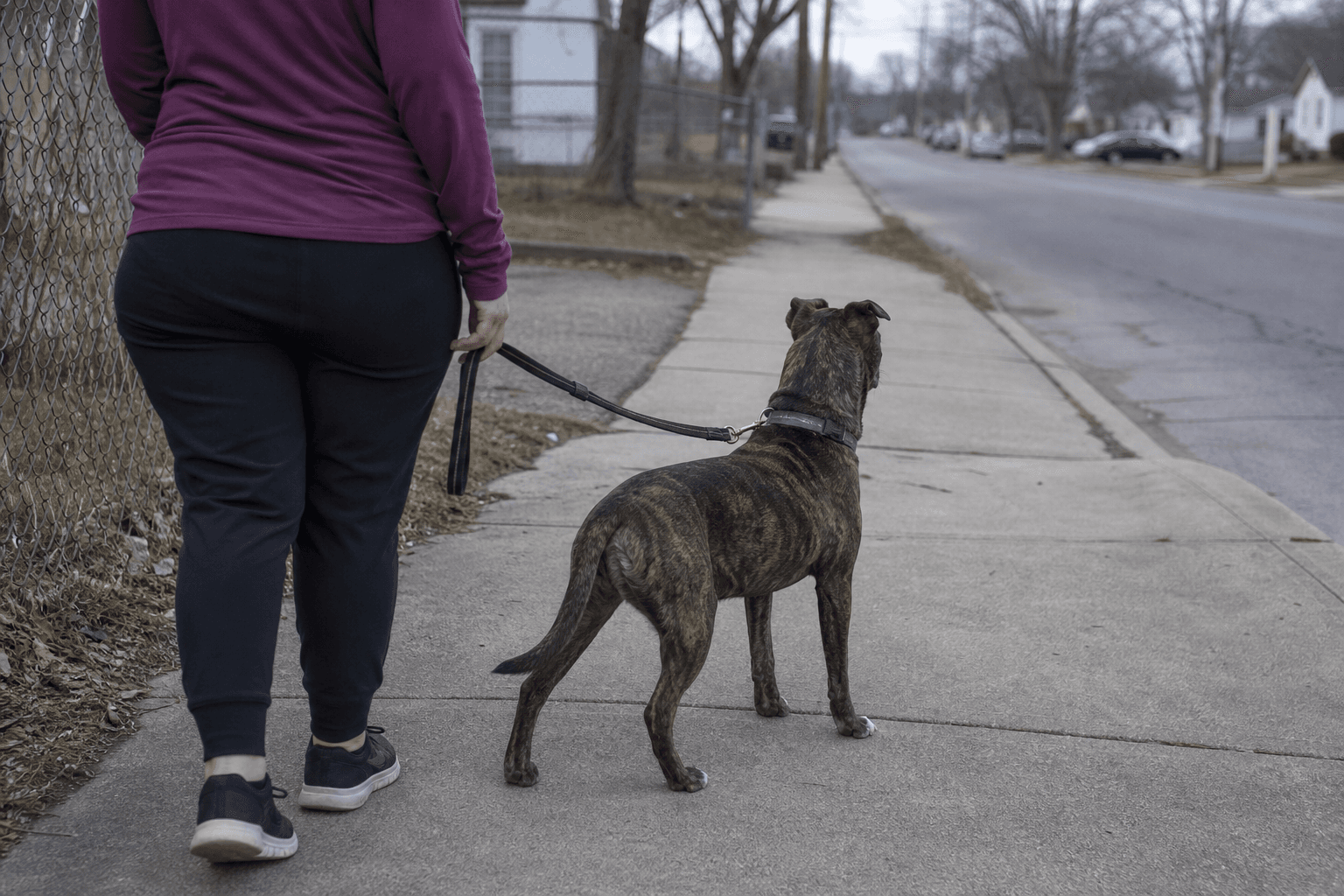
Running triggers chase. If your dog is small enough to lift, pick them up, turn your back to the approaching dog, and stand still and quiet — but understand that a lifted small dog can also become the focus, so a barrier is still better. Keep your leash short and loose rather than tight and high; a cranked-tight leash pulls your dog into a defensive posture and raises the odds of a fight.
5. Try to redirect before you try to repel
Veterinary behaviorists have long recommended tossing a handful of treats away from you and your dog to break the approaching dog's focus, sometimes paired with a cheerful "treats!" If the dog is committed rather than curious, switch to an authoritative, low, loud command — "GO HOME," "OFF," "SIT" — delivered like you mean it. Many loose pet dogs know those words.
6. Carry one deterrent, and know how to use it
The tools most commonly recommended by trainers and pet first-aid instructors, roughly in order of escalation:
- Free: your voice, an umbrella, a jacket, a water bottle, treats to scatter.
- Under $20: a compressed-air horn or an actual whistle — loud, startling, and hard to misuse.
- $15–$30: citronella spray (Spray Shield-type products), which many trainers prefer as a first chemical option because it interrupts without injuring and doesn't blow back the way pepper spray can.
- $20–$40: a sturdy walking stick or a "break stick" for owners who understand its limits. Pepper spray works but is genuinely risky in wind and in a tangle of bodies, including your own dog's face.
Whichever you pick, practice getting it out of your pocket one-handed while holding a leash. A deterrent buried at the bottom of a treat pouch is a decoration.
7. If a fight actually starts
Do not reach into it with your hands. The AKC's guidance is to distract first — air horn, banged metal, a hose or bucket of water, a blanket or jacket thrown over each dog's head so they can't see each other. If two adults are present and physical separation is unavoidable, the widely taught method is for each person to take a dog by the base of the tail or the back legs and pull backward and apart while moving in a circle, never toward each other, and never grabbing collars near the mouth. Then leash and separate immediately — dogs redirect.
8. Afterward: report it, and get your dog checked
Even if your dog seems fine, puncture wounds close over quickly and trap bacteria; abscesses and deeper crushing injuries often show up 12 to 48 hours later. Get a vet exam. Photograph injuries, note the time and exact location, and file a written report with animal control rather than only calling — a documented paper trail is what eventually forces a dangerous-dog case. If you were bitten, seek medical care and ask about rabies risk, since the vaccination status of a loose dog is usually unknown.
What this doesn't mean
It does not mean your neighborhood is dangerous, that a particular breed is coming for you, or that off-leash dogs are all threats. The overwhelming majority of loose-dog encounters end with a sheepish owner jogging up with a leash. This is about having a plan for a low-probability, high-consequence moment — the same reason you know where the fire extinguisher is.
It also doesn't mean the answer is to stop walking. Regular walks are one of the highest-value things you do for your dog's physical and behavioral health. Vary your routes, walk in daylight where you can, and if you have a nervous or reactive dog, consider training-focused decompression walks in low-traffic areas. If you'd rather stack the odds, our city guides are full of parks, trails, and fenced spaces where leash laws are actually enforced.
One question worth asking this week
If a strange dog came around the corner at a dead run tomorrow, what would you reach for? If you don't have an answer, that's the takeaway from Washington Park — not fear, just a plan, a deterrent in your pocket, and a route you've thought about twice.
For more practical, unhysterical dog-owner guidance — plus the best dog-friendly spots near you — follow along at Sidewalk Dog. We'll keep chasing down the stories that actually change how you walk out the door.