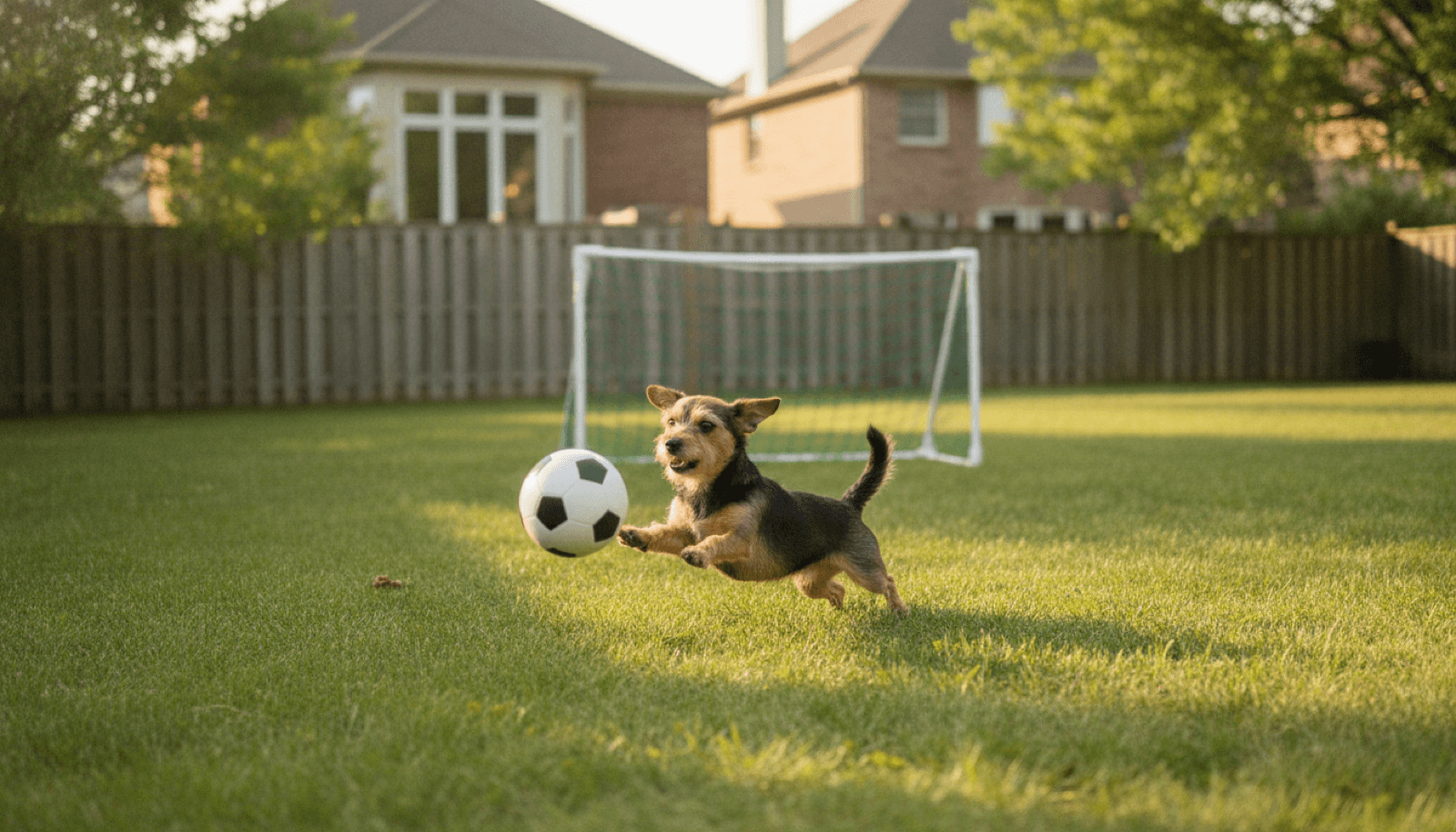

The 2026 FIFA World Cup kicks off on June 11, and the tournament's most charming goalkeeper won't be standing in any of the 16 host-city stadiums across the United States, Canada, and Mexico. He'll be in a backyard in Pennsylvania, diving paws-first across a pint-sized net. His name is Ronaldo, and he's a Chihuahua-dachshund mix with a vertical leap that has the internet — and now a few million soccer fans — completely smitten.
As the world's biggest sporting event spreads across North America from June 11 through July 19, Ronaldo the dog has become an unlikely mascot for the moment. And if your own pup turns into a four-legged tornado the instant a ball hits the grass, there's a good reason — the same instinct that made Ronaldo a viral sensation is wired into dogs everywhere.
Meet the goalkeeper who happens to be a dog
Ronaldo is a six-year-old Chihuahua-dachshund mix from the Lehigh Valley region of Pennsylvania, adopted from a South Florida litter in early 2020 and named — fittingly — after Portuguese soccer superstar Cristiano Ronaldo. His owners, Candida and Antonio Craveiro, noticed something unusual during family backyard barbecues: while everyone else was eating, Ronaldo was relentlessly chasing and stopping the soccer ball during games of keep-away.
Their son-in-law, Sam Katzman, who runs Ronaldo's social media, tried to coach the little dog into a striker who could dribble and score. Ronaldo had other ideas. "He pretty much just decided that he was a goalkeeper," Katzman told the Associated Press. Candida Craveiro put it even more plainly: "He's totally addicted to soccer balls. He has a natural talent to play ball."
The family started posting clips of his acrobatic saves on TikTok back in 2022. The videos — Ronaldo leaping, sliding, and snatching shots out of the air with his mouth — have since racked up millions of views, with the buzz building as World Cup fever swept the host nations. A dog named after the sport's most famous No. 7, going viral right as the planet's attention turns to soccer — the timing could not be more perfect.
Why your dog loves a ball as much as Ronaldo does
Ronaldo's obsession isn't a quirky one-off. It's instinct, and it traces all the way back to the wolf. According to vet-reviewed guidance from Dogster, the number one reason dogs go bonkers for balls is prey drive — the inherited urge to find, chase, and catch moving prey. A ball's erratic, unpredictable bounce mimics the darting movement of a fleeing rabbit or squirrel, switching on a primal "must catch it" circuit in your dog's brain.
There's a feel-good chemical reward at work, too. Every time your dog locks onto a rolling ball and gives chase, the reward centers of the brain release dopamine — the same neurotransmitter tied to pleasure and motivation in humans. That hit is why a game of fetch can feel less like a casual activity and more like an addiction your dog simply cannot put down. For Ronaldo, the soccer net is essentially the world's best dopamine dispenser.
Not every dog is ball-crazy — and that's normal
If your dog looks at a tennis ball like it's a confusing piece of modern art, don't worry. Ball obsession varies enormously from dog to dog, shaped by breed history, individual personality, early experiences, and even health. Breeds developed for hunting and retrieving — think Labradors, Border Collies, and spaniels — tend to come pre-loaded with a high prey drive and an outsized love of fetch. Other dogs would rather sniff, dig, or nap.
What makes Ronaldo such a delight is that he defies the stereotype. Chihuahuas and dachshunds aren't the breeds most people picture diving across a goal line. But dachshunds were bred to hunt, and that scrappy, tenacious prey drive clearly runs deep in this little goalkeeper. It's proof that drive and talent aren't reserved for the usual sporting breeds.
When a love of fetch tips into a problem
There's a line between healthy enthusiasm and unhealthy fixation. Some "ball-crazy" dogs become genuinely stressed or anxious when they can't get their fix, pacing, whining, or refusing to settle. As behavior experts told Kinship, a dog that borders on compulsive ball behavior may even forego food or other play — and when it spills into shadow-chasing or staring at wall reflections, that's when it can become genuinely unhealthy.
If your dog can't disengage from a ball — to eat, to rest, to greet people — or seems distressed without one, it's worth a conversation with your veterinarian. In most cases, the fix is structure: scheduled play sessions with a clear start and stop, plenty of other forms of enrichment, and teaching a solid "drop it" and "all done" cue. For the vast majority of dogs, though, ball love is a joy, not a disorder.
How to play soccer with your dog — safely
Inspired to coach your own backyard goalkeeper before the first whistle of the World Cup? A few simple precautions keep the game fun and injury-free.
Size the ball to your dog. A ball that's too small is a serious choking hazard — it can lodge in the back of the throat and block the airway. A good rule of thumb: the ball should be wider than your dog's jaw, large enough to sit just behind the canine teeth without slipping down. For toy and small breeds like Ronaldo, that means roughly a 1.5–2 inch ball; medium dogs do well with 2.5–3 inches, and large breeds need 3.5 inches or more.
Be cautious with tennis balls. They're the classic fetch toy, but the American Kennel Club warns that a compressed tennis ball can collapse and lodge in a dog's throat, and the abrasive fuzz can wear down tooth enamel or, if swallowed, cause intestinal blockages. Choose a sturdy rubber ball sized correctly for your dog, and swap out anything that's cracked or chewed apart.
Supervise and warm up. Always watch active ball play so you can step in at the first sign of trouble, and inspect toys regularly for wear. Cornell's Riney Canine Health Center recommends easing into vigorous fetch the same way a human athlete would — a short warm-up and a cool-down — to protect joints and muscles, especially for long-backed dogs like dachshunds and for any senior pup. Keep sessions short on hot summer days, and bring water.
From there, it's all about reading your dog. Some will happily chase and return; others, like Ronaldo, will appoint themselves keeper and refuse to give the ball back. Lean into whatever your dog loves. The goal — pun fully intended — is a tired, happy dog.
Your backyard is a World Cup venue, too
Ronaldo's rise is a reminder that the best part of any dog isn't a pedigree or a trophy — it's the pure, goofy joy they bring to an ordinary afternoon in the yard. You don't need a stadium or a viral following to have that. You just need a ball, a patch of grass, and a few free minutes.
If channeling all that energy into a backyard sport sounds appealing, you're in good company — we've written about how backyard dog agility became one of the fastest-growing canine sports in America, and the same principles apply to a homemade soccer match. At Sidewalk Dog, we're all about the dog-friendly adventures, big and small, that make life with a pup more fun. So this summer, while the world watches the pros, set up a little net of your own and see what your goalkeeper can do. Cristiano may have the trophies, but Ronaldo the dog has something better — a backyard, a ball, and a family that adores him.