
Last spring, a Border Collie named Prove-It tore through a Westminster course in 29.81 seconds with zero faults, took the 2026 Masters Agility Championship, and reminded a few million viewers that dogs can fly. Two months later, the AKC National Agility Championship aired on ESPN2, dropping the sport into living rooms it doesn’t usually reach. And in November, the United States Dog Agility Association will celebrate forty years since the very first official trial was held in Houston in 1986.
It is, in other words, a big year for dog agility — and not just at the elite level. Tunnels, weave poles, and homemade jumps are quietly showing up in backyards across the country, picked up by owners who have no intention of ever stepping into a competition ring.
Here’s what’s behind the boom, and a no-pressure way to try it yourself this weekend.
Why agility is having its biggest year since 1986
USDAA’s 40th anniversary season is the headline story. The organization’s inaugural event was held November 9–10, 1986, in Houston, Texas, and the celebrations will culminate at the Cynosport World Games at Tucson’s Kino Sports Complex on November 11–15, 2026 — exactly forty years from the founding date.
Between now and then, regional championships are stacking up. The Rocky Mountain Regional runs May 29–31 in Kaysville, Utah. The South Central Regional just wrapped earlier this month in Greenville, Texas. Cynosport Local Qualifying Events have been running since September 2025.
The mainstream-media side has matched the momentum. Prove-It’s Westminster win, handled by veteran agility competitor Amber McCune of Bedford, New Hampshire, was televised in primetime as part of the 150th Westminster Kennel Club Dog Show. Westminster donates $5,000 in the winner’s honor to the AKC training club of their choice or to the AKC Humane Fund. Two months later, the AKC National Agility Championship — held March 20–22 at Galway Downs in Temecula, California — aired on ESPN2 on May 10 at 10 a.m. ET, the largest single broadcast window the sport gets all year.
When a dog sport keeps appearing in major-network sports blocks and prime-time dog shows, weekend Googling follows. And so does backyard equipment.
What the numbers actually say
Agility is consistently described by the AKC and USDAA as one of the fastest-growing dog sports in the United States, and the data backs up the velocity. According to the AKC’s agility program, the sport now sees over one million entries per year. A few more numbers worth sitting with, from the AKC’s most recent participant survey:
- The most recent National Championship featured 912 dogs and 750 exhibitors representing 88 different breeds.
- Mixed-breed dogs make up 7% of competitors at the National level — agility was one of the first AKC sports to formally welcome them.
- Border Collies are nearly 25% of competitors; Shetland Sheepdogs another 14%. The rest is a riot of breeds, from Pembroke Welsh Corgis to Vizslas to Icelandic Sheepdogs (yes — Leslie Ems-Walker’s Icelandic Sheepdog Luke won the 16-inch Regular class at the 2026 Nationals).
- 32% of National competitors were entering for the first time. 58% of competing teams had trained a year or less before showing up.
That last stat is the one to underline if you’re a hesitant dog owner reading this. Agility is full of newcomers. The community wants more of them.
How to start agility in your own backyard
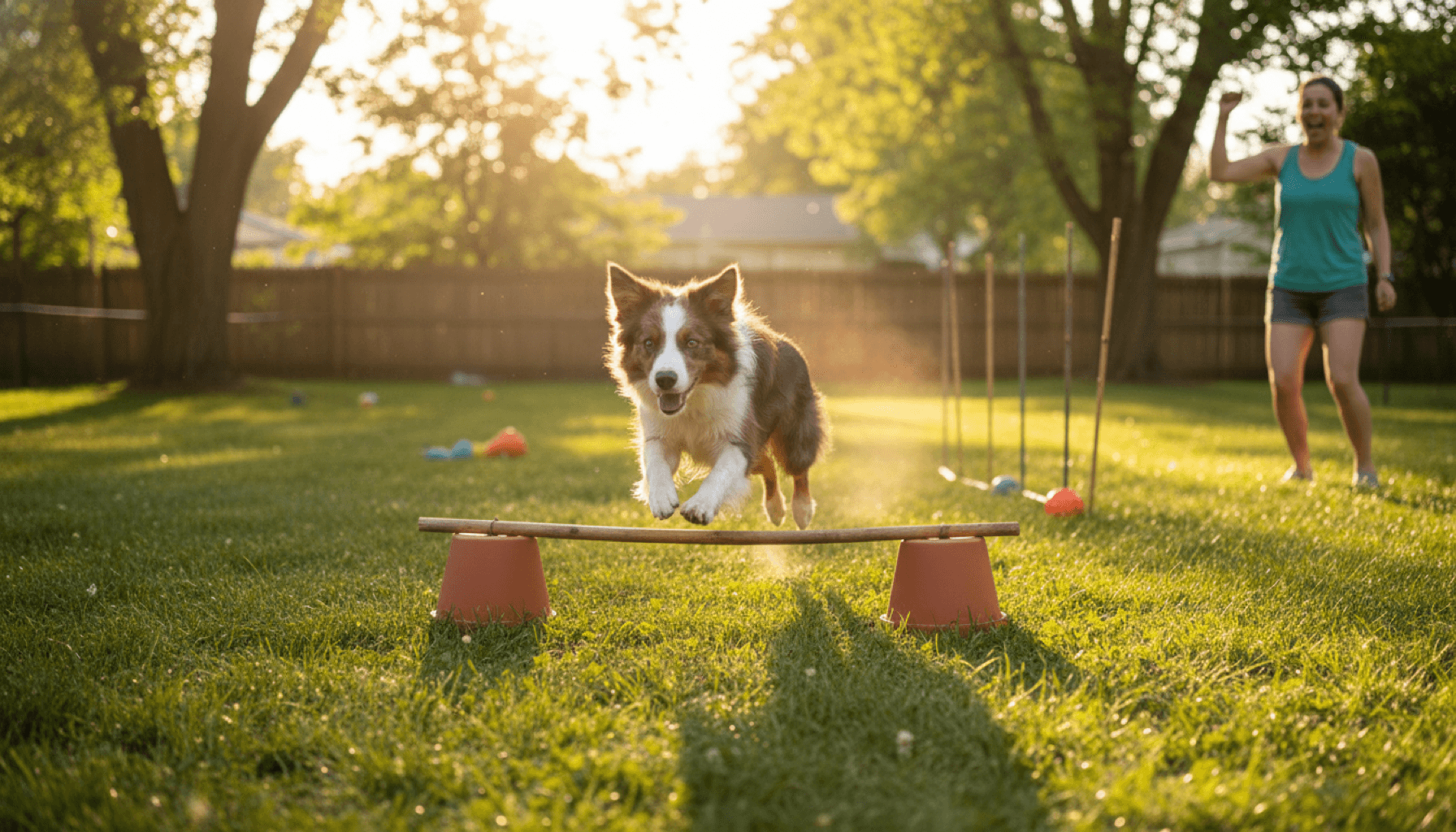
You don’t need an arena or a championship-track dog. You need a flat patch of grass, a handful of household objects, and ten focused minutes a day. Here’s the AKC’s home-training framework, simplified.
Equipment you almost certainly already own
- Jumps: A broomstick balanced on two flower pots, two stacks of books, or two folding chairs.
- Tunnel: A blanket draped over two chairs makes a perfectly serviceable starter tunnel.
- Weave poles: Six tomato stakes pushed into the lawn, spaced 24 inches apart.
- Pause table: A sturdy upside-down plastic storage tote.
- Balance board: A piece of plywood resting on a half-buried brick.
That’s the whole starter kit. Total cost: roughly zero.
Skills to build first
Senior AKC Agility Field Representative Arlene Spooner tells owners the most important rule is simple: “Keep it fun and stop before your dog loses interest.”
Spooner and the AKC recommend building agility on three foundation skills before you touch an obstacle:
- Attention on cue. Teach a rock-solid “watch me” in quiet settings, then graduate to the backyard with low-grade distractions.
- Nose targeting and body awareness. Spins, bows, weaving through your legs, and backing up all teach a dog where its feet are — the prerequisite to weave poles and contact obstacles.
- Two-sided handling. Practice walking, jogging, and finally running with your dog on both your left and your right. In a real agility run, your dog needs to follow your line whichever side you’re on.
Five to ten minutes a session, twice a day, is plenty. Short sessions are the agility coach’s gospel: stop while your dog is still asking for more.
Safety rules that matter most
A backyard agility setup is mostly safe, but a few rules separate a fun afternoon from a limping vet visit:
- Set jumps at walking height — never competition height — especially for puppies under 18 months whose growth plates are still closing.
- Use jump bars that fall freely if struck. A wedged broomstick is an injury waiting to happen.
- Avoid slippery grass after rain and slick concrete patios for jumping work.
- Don’t force a dog through a tunnel or onto an obstacle. Use a high-value treat to lure, and let them choose.
- Introduce moving equipment gradually — a wobble board before a seesaw, never the reverse.
Best breeds, and the better answer
If you Googled “best agility breeds” this week, you saw a leaderboard topped by Border Collies, Shelties, and Australian Shepherds — and they really do dominate the rankings. Prove-It is a Border Collie. Of Westminster’s 13 all-time Masters Agility titles, 10 have gone to Border Collies.
But the better question is what kind of dog enjoys it. Agility is exercise, mental work, and team-building rolled into one. Mixed-breed rescues, Pembroke Corgis, Vizslas, Poodles, and American Eskimo Dogs all show up at trials. The 2026 Nationals saw Sam Chew’s Vizsla, Cosmo, win the 24-inch Regular class. Marco Giavoni’s Sheltie BET took the 8-inch Preferred title. Peter Wirth’s Pembroke Welsh Corgi Welly cleared the 8-inch Regular course in 35.137 seconds. There is no breed gatekeeping at the local level.
If your dog likes to chase, problem-solve, and check in with you, agility will probably click.
How to find a class — or a trial to watch
The simplest next step is to find a class near you and treat it like a six-week trial run:
- AKC Agility hub: akc.org/sports/agility lists club-affiliated training centers by state and explains the title ladder from beginner Trick Dog all the way up to Master Agility Champion (MACH).
- USDAA member clubs: usdaa.com maintains a directory of clubs running Starters, Advanced, and Cynosport-track events nationwide.
- Local USDAA regional: The Rocky Mountain Regional on May 29–31 in Kaysville, Utah, is open to spectators. Most regional trials are.
- Cynosport World Games: The headline event of USDAA’s anniversary year runs November 11–15, 2026, in Tucson — worth a road trip if you fall in love with the sport this summer.
Many clubs run intro classes specifically for first-time owners and dogs without competition experience. You don’t sign up for a trial first. You sign up for a Saturday morning class and see if your dog comes home tired and grinning.
The Sidewalk Dog take
Forty years in, agility has earned its ESPN slot. The much bigger story is that it has also earned its place in suburban backyards, in front-yard PVC tunnels, and at the local training club’s Tuesday-night drop-in.
The barrier to entry is a broomstick and ten minutes. The ceiling, if you and your dog catch the bug, is the floor of an arena in Tucson in November.
For more on dog activities that double as bonding, browse our other guides on dog-friendly cities, weekend events, and breed-specific training plans on Sidewalk Dog. And if you have a story about your own first agility class — whether your dog nailed the tunnel or sat down on the start line and refused to move — we’d love to hear it.