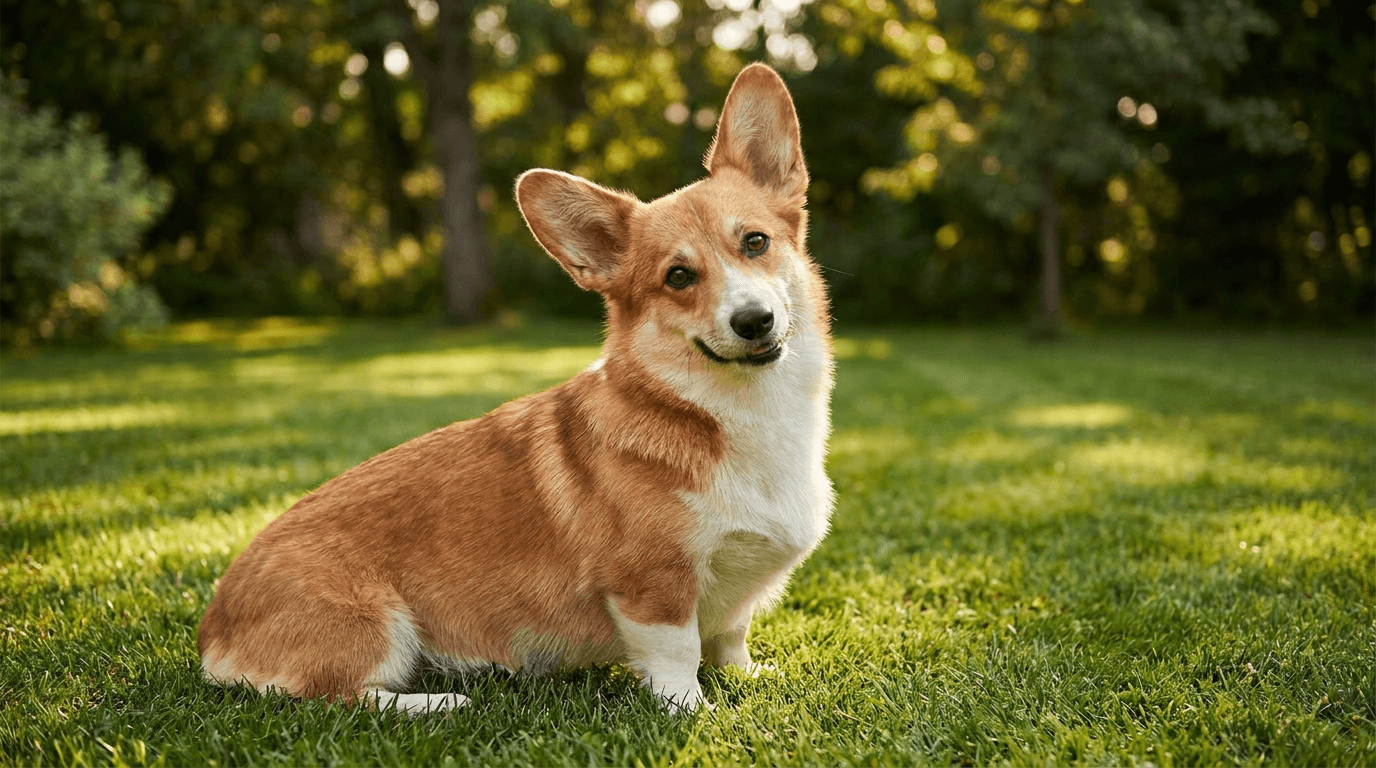

The Pembroke Welsh Corgi is a small, sturdy Welsh herding breed that stands 10–12 inches tall and weighs 22–30 pounds, instantly recognizable by its long low body, short legs, fox-like face, and oversized upright ears. Bred for centuries in Wales to herd cattle by nipping at heels and ducking kicks, the Pembroke is a member of the AKC Herding Group and one of the world's most popular companion dogs — famously the favored breed of the late Queen Elizabeth II, who owned more than 30 of them over her 70-year reign.
Pembroke Welsh Corgi at a Glance
The fast facts most prospective owners ask about first:
- Other names: Pembroke, Welsh Corgi, Pem, PWC
- Breed group: AKC Herding Group (recognized 1934)
- Weight: 22–30 lbs (males 25–30, females 22–28)
- Height: 10–12 inches at the shoulder
- Lifespan: 12–13 years
- Coat: Medium-length double coat with weather-resistant outer guard hairs and dense undercoat
- Shedding: Moderate to heavy — daily during seasonal blowouts, weekly otherwise
- Energy level: High — needs 60+ minutes of activity per day
- Good with kids: Yes, with respectful older children; may herd toddlers
- Good with other pets: Generally yes; herding instinct may trigger chase behavior
- Apartment-friendly: Yes, with committed daily exercise and barking management
- Origin: Pembrokeshire, Wales
Appearance
The Pembroke is unmistakable. A grown dog stands no taller than the top of an average adult's calf, yet packs the bone, muscle, and presence of a much larger working herder into that small frame. The breed's silhouette — long, low, with a foxy face peeking out from between two oversized upright ears — has become one of the most recognizable in dog photography.
Body: The Pembroke is moderately long, low to the ground, and surprisingly heavy for its size. The official AKC breed standard describes the build as "low-set, strong, sturdily built and active, giving an impression of substance and stamina in a small space." The chest is deep and broad, the legs are short but straight, and the topline is firm and level.
Head and face: The head is foxy in shape and appearance, with a moderately wide skull, slightly rounded between the ears, and a tapering muzzle. The eyes are oval, medium-sized, and warm brown. The ears are erect, firm, medium-sized, and slightly rounded at the tip — Pembrokes are famous for those big upright ears, which can look almost cartoonishly large on a puppy.
Tail: Pembrokes are born with naturally short tails or had them docked historically — both because of working tradition and breed standard. Today many countries have banned docking, so increasing numbers of Pembrokes are seen with natural tails. The presence of a tail does not change the breed: a tailed Pembroke is still a Pembroke.
Coat: A medium-length double coat — a coarse, weather-resistant outer layer over a soft, insulating undercoat. The coat lies flat against the body and is slightly longer around the neck (forming a ruff), chest, and back of the legs (forming "pants" or feathering).
Color: Pembrokes come in four AKC-recognized colors: red (the classic and most common), sable (red with black-tipped guard hairs), fawn (lighter tan), and black and tan (also called tri-color). All four colors typically appear with white markings on the legs, chest, neck, muzzle, and a blaze on the face.
Pembroke vs Cardigan Welsh Corgi
This is the question almost every new Corgi enthusiast asks: what's the difference between a Pembroke Welsh Corgi and a Cardigan Welsh Corgi? They're often grouped together as "corgis," but they're two genetically distinct breeds with separate histories.
Tail: The single fastest way to tell them apart. Cardigans have long, full, fox-like tails. Pembrokes have very short tails — either naturally bobbed or historically docked. If you see a long sweeping tail, it's a Cardigan.
Size: Cardigans are notably larger and heavier-boned. A male Cardigan can weigh up to 38 pounds; a male Pembroke tops out around 30. Cardigans are also longer relative to their height.
Ears: Both breeds have upright ears, but Cardigan ears are larger, more rounded, and set wider apart. Pembroke ears are medium-sized, more pointed, and held closer to the top of the head.
Coat colors: Pembrokes come in four colors (red, sable, fawn, black and tan), all with white markings. Cardigans have a much broader palette — including brindle, blue merle, and black-and-white in addition to red and sable.
Temperament: Pembrokes are generally more outgoing, extroverted, and energetic. Cardigans tend to be more reserved, watchful, and slightly calmer — though both breeds are intelligent herders with strong personalities.
History: The two breeds don't share a common ancestor. The Cardigan is one of the oldest breeds in the British Isles, dating back roughly 3,000 years from the Welsh county of Cardiganshire. The Pembroke is younger, brought to Pembrokeshire by Flemish weavers and influenced by Nordic Spitz breeds. They were considered varieties of one breed until 1934, when the AKC officially recognized them as separate breeds.
History
The Pembroke Welsh Corgi has been herding cattle in the Welsh countryside for over a thousand years. The name "corgi" likely derives from the Welsh cor ("dwarf") and ci ("dog") — literally "dwarf dog." The breed's low stature was a working advantage: a Corgi could nip at the heels of cattle to drive them and then duck low to avoid the kick that followed.
Pembrokes were the workhorse of small Welsh farms. They drove cattle to market, kept the barnyard free of vermin, watched over children, and slept by the hearth at night. Their compact size meant they ate less than larger herding breeds — an important consideration for subsistence farmers.
The breed's transformation from working dog to international celebrity began in 1933, when King George VI (then the Duke of York) gave a Pembroke Welsh Corgi named Dookie to his daughters, the future Queen Elizabeth II and Princess Margaret. Elizabeth was just seven years old and instantly devoted. When she became Queen in 1952, the royal Corgis came with her — and over the next 70 years she owned more than 30 of them, along with several Pembroke-Dachshund crosses known as Dorgis. The Queen's lifelong devotion gave the breed unmatched global visibility.
The AKC recognized the Pembroke Welsh Corgi as a separate breed from the Cardigan in 1934. Today the Pembroke ranks consistently in the AKC's top 15 most popular breeds in the United States, with the breed parent club being the Pembroke Welsh Corgi Club of America.
Temperament & Personality
The Pembroke is a paradox in a small package: a working herder with the confidence of a much larger dog, paired with the cuddly affection of a lap companion. Owners often describe their Pembrokes as "big dogs in small bodies."
With family: Pembrokes are devoted, affectionate, and people-oriented. They want to be where their people are — usually underfoot, often vocally commenting on the household's activities. They form strong bonds with the whole family rather than fixating on one person.
With children: Pembrokes are excellent with respectful older children. They're sturdy enough to handle play, smart enough to engage with games, and patient enough to tolerate the noise of a busy household. With toddlers and young kids, however, the herding instinct can kick in: a Pembroke may attempt to "herd" running children by nipping at their ankles. This is rarely aggressive — it's the same instinct used on cattle — but it requires training and supervision.
With other pets: Generally good, especially when raised together. The herding drive can lead Pembrokes to chase cats, smaller dogs, or even chickens. Early socialization helps, and most Pembrokes do well in multi-pet households when introductions are managed carefully.
Alone time: Pembrokes handle moderate alone time better than many companion breeds, though they're not built for 10-hour workdays without a midday break. They thrive in households where someone is home much of the day or that arrange dog walkers, daycare, or a companion pet.
Watchdog ability: Excellent — possibly too excellent. Pembrokes are alert barkers who will announce every doorbell, delivery driver, squirrel, and passing dog with conviction. Their bark is surprisingly deep for their size. This makes them outstanding watchdogs (though poor guard dogs given their size) but a real consideration for apartment dwellers with thin walls. Early bark training is essential.
Health
The Pembroke Welsh Corgi has a typical lifespan of 12–13 years, with many individuals living longer with good care. The breed's distinctive dwarfism (achondroplasia — short legs from cartilage development) is built into its identity but also drives several of its most significant health concerns.
- Degenerative myelopathy (DM): The most serious breed-specific concern. DM is a progressive spinal cord disease that causes gradual hind-limb weakness and eventual paralysis, typically emerging around age 11. Pembroke Welsh Corgis have one of the highest known genetic risks for DM of any breed — Embark data shows about 26% of tested Pembrokes are at-risk and another 41% are carriers. There is no cure, but symptoms can be managed with physical therapy and mobility aids. Reputable breeders DNA-test parents for the SOD1 mutation and pair carriers carefully.
- Intervertebral disc disease (IVDD): Pembrokes' long backs and short legs put extra stress on the spinal discs. Disc rupture or herniation can cause sudden pain, weakness, or paralysis. Keeping the dog at a lean weight, avoiding stairs and jumping, and using ramps are the best preventive measures.
- Hip dysplasia: Despite the short legs, Pembrokes can develop hip joint malformation. Look for breeders who screen parents through OFA or PennHIP evaluations.
- Von Willebrand's disease: An inherited blood-clotting disorder. DNA tests are available and reputable breeders screen for it.
- Eye conditions: Progressive retinal atrophy, cataracts, and persistent pupillary membranes occur in the breed. Annual ophthalmologic exams are recommended.
- Obesity: Pembrokes love food and gain weight easily. Even a couple of extra pounds is dangerous on a back already prone to disc disease. Strict portion control is essential.
- Epilepsy: Occurs in some lines. Onset is typically between ages 1 and 5.
Recommended health tests per the Pembroke Welsh Corgi Club of America include hip evaluations, eye exams, von Willebrand's DNA test, and the DM (SOD1) DNA test. Ask breeders for documentation of these screenings on both parents.
Exercise Needs
Don't let the short legs fool you. The Pembroke is a working herding dog with serious stamina, and underexercised Pembrokes channel that energy into barking, digging, and household chaos. Plan for 60+ minutes of dedicated activity per day, mixing physical exercise with mental work.
- Two solid walks per day (30 minutes each), at a brisk pace
- Off-leash romps in a securely fenced area when possible
- Fetch games (most Pembrokes are obsessed with balls)
- Puzzle toys and food-dispensing games to engage the working mind
- Herding sports, agility, rally, or dog sports — Pembrokes excel at all of them
Watch for heat. Pembrokes have a heavy double coat and can overheat quickly on hot or humid days. Walk early or late in summer, carry water, and watch for excessive panting. In winter, their coat handles cold well, though belly snow can be uncomfortable on the short legs.
A note on stairs and jumping: Pembrokes' long backs make them vulnerable to disc injury. Discourage repeated stair climbing, jumping off furniture, and rough wrestling with larger dogs. Many owners use ramps to access couches and cars.
Training
The Pembroke Welsh Corgi ranks #11 on canine psychologist Stanley Coren's intelligence list — placing it among the most trainable breeds in the world. Combined with strong food motivation and a genuine desire to please, this makes the Pembroke a joy to train. The challenge isn't capability — it's the breed's independent streak.
What works: Short, upbeat, positive-reinforcement sessions with high-value treats. Pembrokes learn cues quickly, often within a handful of repetitions, and excel at obedience, agility, rally, herding trials, and trick training. Clicker training works exceptionally well.
What doesn't: Harsh corrections or yelling. Pembrokes are sensitive to tone — they'll either shut down or get stubborn under pressure. Trust matters with this breed.
Common challenges:
- Excessive barking: Probably the #1 complaint about Pembrokes. Address early with a calm "quiet" cue, redirection, and never rewarding the barking with attention. Pembrokes who never learn bark control can become genuine noise problems in shared housing.
- Herding behavior: Pembrokes may chase or nip at running children, joggers, cars, or anything else moving. Channel this into appropriate outlets (herding balls, fetch, treibball) rather than suppressing it entirely.
- Stubborn streak: When a Pembroke decides he doesn't want to do something, he can dig in. Make training fun and the food rewards good enough to overcome the resistance.
- Resource guarding: Some Pembrokes guard food, toys, or favorite spots. Address early with positive trades and never punish growling.
Early socialization between 8 and 16 weeks is essential. Expose puppies to a wide variety of people, dogs, environments, sounds, and surfaces. Pembrokes who miss this window can become reserved or reactive as adults.
Grooming
If there's one thing every Pembroke owner agrees on, it's the shedding. The breed's double coat sheds moderately year-round and dramatically twice a year during seasonal "coat blows," when the dense undercoat releases in clumps over the course of two to three weeks. Owners affectionately call this "the corgi snowstorm."
Weekly maintenance:
- Brush thoroughly with a slicker brush and undercoat rake (a tool like a Furminator or de-shedding rake is non-negotiable for this breed)
- Check ears for wax buildup or moisture
- Brush teeth with dog-safe toothpaste
Daily during shedding seasons (spring/fall):
- 20+ minutes of brushing with both a slicker and an undercoat rake
- Consider a high-velocity dryer to blow loose undercoat free (game-changer for Corgi owners)
Every 4–8 weeks:
- Full bath with a dog-safe shampoo
- Nail trim (or sooner if you hear clicking on hard floors)
Never shave a Pembroke. The double coat regulates temperature in both heat and cold; shaving it can damage the coat's ability to regrow properly and offers no real comfort benefit. Brushing — not shaving — is the right strategy.
Nutrition
Diet is non-negotiable with this breed. Pembrokes are notorious chow hounds, and the combination of food drive, low activity tolerance when underexercised, and a long back vulnerable to injury makes weight management the single most important factor in long-term Pembroke health.
Feed a high-quality complete dog food appropriate for the dog's life stage (puppy, adult, senior). Look for:
- Real animal protein as the first ingredient
- Moderate fat content (Pembrokes don't need a high-fat diet unless very active)
- Joint-supporting ingredients like glucosamine and chondroitin (especially important given the spine and hip risk)
- An AAFCO statement confirming the food is nutritionally complete
Portion guide: Adult Pembrokes typically eat about ¾ to 1¼ cups of dry food per day, split into two meals. The exact amount depends on weight, age, metabolism, and activity. Use a measuring cup — never free-feed — and weigh the dog monthly to catch creep early. You should be able to feel ribs easily under a thin layer of fat. If the waist disappears or the belly hangs, cut portions immediately.
Treats and table scraps: Keep treats to 10% of daily calories or less. Pembrokes will absolutely accept a piece of broccoli or carrot instead of a high-calorie biscuit. The breed is also prone to begging — be firm about not feeding from the table, especially with multiple family members involved.
Foods to avoid: Grapes, raisins, chocolate, onions, garlic, xylitol, macadamia nuts, and cooked bones. The American Veterinary Medical Association (AVMA) maintains current guidance on toxic foods and human medications.
Is the Pembroke Welsh Corgi Right for You?
The Pembroke is a great fit if you:
- Want a smart, trainable companion with a big personality
- Can commit to 60+ minutes of daily exercise
- Don't mind moderate to heavy shedding and weekly brushing
- Have a stable household routine (Pembrokes thrive on consistency)
- Are willing to address barking proactively
- Have older children or none at home (or accept that herding nipping needs training)
- Enjoy dog sports, training, or working with a dog
The Pembroke is probably not for you if:
- You want a quiet, low-energy lap dog
- You can't tolerate shedding under any circumstance
- You're gone 10+ hours a day with no plan for company
- You have very young children and no patience for managing herding behavior
- You live in a no-pet building or somewhere bark complaints are a serious issue
- You won't enforce diet portions (this breed will eat itself into a back injury)
Finding a Pembroke Welsh Corgi
Reputable breeders: Start with the Pembroke Welsh Corgi Club of America breeder directory. Look for breeders who DNA-test parents for degenerative myelopathy and von Willebrand's, perform OFA hip evaluations, complete CERF or OFA eye exams, raise puppies in their home, let you meet the dam, and offer a written health guarantee. Expect to pay $1,800–$3,500 for a well-bred Pembroke puppy and to wait months on a list with a reputable breeder.
Rescue: Purebred and mixed Pembrokes show up regularly in rescue, often surrendered when their barking or exercise needs overwhelm unprepared owners. Search "Pembroke Welsh Corgi rescue" plus your region, or check Petfinder for "corgi" listings. Many adult rescues come already trained and house-broken — an advantage for first-time owners. Adoption fees typically run $200–$500.
Red flags to avoid: Breeders who can't show DM and vWD test results, sellers offering "miniature" or "teacup" Pembrokes (not a recognized variety — usually runts or undersized dogs with health problems), puppies shipped without an in-person meeting, and any breeder selling multiple unrelated breeds at scale. Pet store puppies almost always come from commercial breeding operations.
Cost of Ownership
Initial costs:
- Puppy from a reputable breeder: $1,800–$3,500
- Rescue adoption: $200–$500
- Initial vet visit + vaccinations: $250–$500
- Spay/neuter: $300–$600
- Supplies (crate, bed, bowls, leash, harness, brushes, undercoat rake, toys): $400–$700
Annual ongoing costs:
- Food: $400–$700
- Routine vet care: $400–$700
- Pet insurance: $400–$800 (worth pricing out given DM and IVDD risk)
- Grooming supplies or occasional professional grooming: $100–$400
- Dental cleanings: $400–$800 (annual professional cleaning recommended)
- Treats, toys, training classes: $300–$500
Plan for roughly $2,500–$4,500 in year one and $2,000–$3,500 per year ongoing. Emergency vet bills can run $3,000–$10,000+ for spinal surgery if IVDD strikes — pet insurance is genuinely worth pricing for this breed.
Frequently Asked Questions
What's the difference between a Pembroke and a Cardigan Welsh Corgi?
The fastest way to tell them apart is the tail: Cardigans have long, full tails, while Pembrokes have very short tails (either naturally bobbed or historically docked). Cardigans are also slightly larger and heavier, with bigger more rounded ears and a wider range of coat colors including brindle and blue merle. The two breeds don't share a common ancestor — they're genetically distinct despite both being Welsh herders.
Do all Pembroke Welsh Corgis have tails?
Pembrokes are often born with naturally short or bobbed tails, and traditionally any longer tails were docked shortly after birth. Today many countries (including most of Europe, Australia, and parts of the US) restrict or ban docking, so a growing number of Pembrokes are now seen with natural full or partial tails. A tailed Pembroke is still a Pembroke — the tail status doesn't change the breed.
Are Pembroke Welsh Corgis good apartment dogs?
Yes, with two big caveats: they need 60+ minutes of daily exercise, and their alert-barking habit needs serious training from puppyhood. Pembrokes adapt well to apartments physically — they're small and don't need a yard — but the barking can become a real issue in shared housing. Owners who commit to long walks, training classes, and bark control do beautifully with Pembrokes in apartments.
How much do Pembroke Welsh Corgis shed?
A lot. Pembrokes have a thick double coat and shed moderately year-round, with two heavy seasonal "coat blows" each year (spring and fall) that release the undercoat in clumps for two to three weeks. Expect dog hair on your floors, furniture, and clothing constantly. Weekly brushing — daily during coat blows — and an undercoat rake or de-shedding tool are essential. Pembrokes are not a good fit for anyone who can't tolerate dog hair.
Why did Queen Elizabeth II love Pembroke Welsh Corgis?
Queen Elizabeth II's love for the breed began at age seven, in 1933, when her father gave her a Pembroke named Dookie. Over her lifetime she owned more than 30 Pembrokes (and several Pembroke-Dachshund crosses known as Dorgis), keeping them as constant companions throughout her 70-year reign. The Queen's devotion gave the Pembroke unmatched international visibility — the breed is sometimes still called "the royal corgi" because of her.
How long do Pembroke Welsh Corgis live?
The typical lifespan is 12–13 years, with many Pembrokes living into their mid-teens with good care. Weight management is the single biggest lever — overweight Pembrokes are at much higher risk for IVDD, diabetes, and joint disease. Annual vet care, dental hygiene, and exercise also matter significantly.
Are Pembroke Welsh Corgis good with kids?
Generally yes, with respectful older children. Pembrokes are sturdy, playful, and patient enough to handle a busy family household. The main caveat is the herding instinct — Pembrokes may nip at the ankles of running children, just as they would with cattle. This isn't aggression but it requires training and supervision, especially with toddlers. Families with very young kids should be prepared to manage this consistently.
How much does a Pembroke Welsh Corgi cost?
Expect $1,800–$3,500 for a well-bred Pembroke puppy from a reputable breeder, or $200–$500 from rescue. Annual ongoing costs typically run $2,000–$3,500 including food, vet care, insurance, grooming supplies, and routine expenses. Pet insurance is genuinely worth considering for this breed given the IVDD and DM risk — back surgery alone can cost $5,000–$10,000+.
Do Pembroke Welsh Corgis bark a lot?
Yes — Pembrokes are notorious alert-barkers. They'll announce doorbells, deliveries, passing dogs, squirrels, and pretty much anything else that moves. Their bark is surprisingly deep for their size. This makes them excellent watchdogs but a serious consideration for apartment dwellers or anyone with close neighbors. Early training on a "quiet" cue and consistent management make a big difference; left untrained, the barking can become extreme.
Are Pembroke Welsh Corgis easy to train?
Yes — Pembrokes rank #11 on Stanley Coren's canine intelligence list and are highly food-motivated. They learn quickly with positive reinforcement and excel at obedience, agility, rally, and herding sports. The catch is their independent streak: when a Pembroke decides he'd rather not, he can dig in. Short, fun, treat-driven sessions work best. Avoid harsh corrections — they shut down or get stubborn.
If the Pembroke isn't quite the right fit, consider its close relatives and crosses: the Dorgi (Pembroke × Dachshund, the Queen's other favorite), the Aussie Corgi (Pembroke × Australian Shepherd), the Corgidor (Pembroke × Labrador), or the equally smart and biddable Border Collie if you want a larger herding breed with similar intensity.