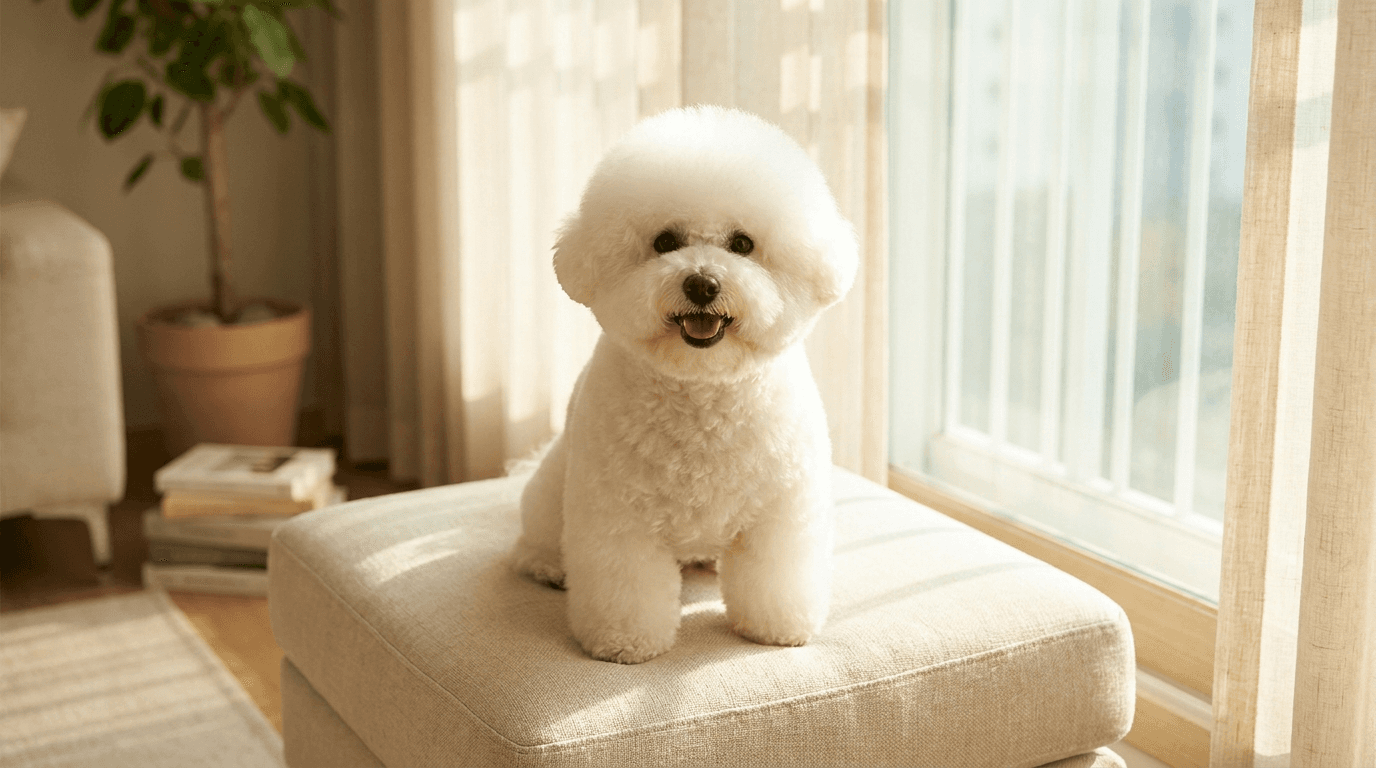

The Bichon Frise is a small, cheerful companion breed from the Mediterranean, weighing 12–18 pounds and standing 9.5–11.5 inches tall. Recognized by the American Kennel Club in the Non-Sporting Group, the Bichon is famous for its puffy white "powder puff" coat, low-shedding double coat that's friendlier than most to allergy-prone owners, and an unshakably sunny temperament. It's one of the most apartment-friendly purebreds in the AKC catalog — and one of the more grooming-intensive.
Bichon Frise at a Glance
The fast facts most prospective owners ask about first:
- Breed group: AKC Non-Sporting Group (recognized 1973)
- Weight: 12–18 pounds
- Height: 9.5–11.5 inches at the shoulder
- Lifespan: 14–15 years (often 15+ with good care)
- Coat: White double coat — soft undercoat with a curly, coarser outer coat
- Shedding: Low — shed hair tends to get caught in the curls rather than fall
- Hypoallergenic-leaning: Yes, often tolerated by people with mild dog allergies
- Energy level: Medium — playful indoors with a daily walk requirement
- Good with kids: Excellent with respectful children; fragile with rough toddlers
- Good with other pets: Very sociable, generally great with dogs and cats
- Apartment-friendly: Yes — one of the better small breeds for city living
- Watchdog: Alert barker, but too friendly to be a true guardian
Appearance
The Bichon Frise is built like a cotton ball that decided to become a dog. The breed standard calls for a compact, sturdy body slightly longer than tall, with a plumed tail that curls gracefully over the back rather than straight up.
Body: Small but never fragile. A well-built Bichon has a level topline, a deep chest, and well-muscled legs hidden beneath the coat. The overall silhouette in show grooming is rounded and balanced — the breed standard literally describes the head as a feature meant to be "in keeping" with the rest of the dog.
Head and face: Round dark eyes set in a softly rounded skull, with black "halos" of pigmented skin around the eyes that intensify the breed's bright, inquisitive expression. The muzzle is medium length — not snubby like a Pekingese, not pointed like a terrier. The nose is solidly black. Drop ears are set high and covered in long, flowing hair that blends into the head coat.
Coat: This is the breed's defining feature. The Bichon has a true double coat: a soft, dense undercoat plus a coarser, curly outer coat. When properly brushed and groomed, the coat stands away from the body and gives the famous "powder puff" silhouette. It feels velvety to the touch — almost springy when pressed.
Color: Always white. AKC standard allows shadings of buff, cream, or apricot around the ears or on the body, but the dominant color is unambiguously white. Anything more pigmented disqualifies a dog from the show ring.
History
The Bichon Frise traces its origins to the Mediterranean basin, almost certainly descending from the same ancestral water-spaniel-type dogs that gave rise to the Maltese, Havanese, and Bolognese. The breed's name in French — Bichon à poil frisé, "curly-haired lap dog" — describes both its appearance and its primary historical purpose.
The most cited origin story places the breed on Tenerife in the Canary Islands as early as the 14th century, where it was a favorite of Spanish and Italian sailors who carried the dogs as trade goods and companions on Mediterranean voyages. From there, Bichons spread across Europe, becoming favorites of French and Italian nobility through the Renaissance. King Henry III of France famously carried his Bichon everywhere in a tray-like basket suspended from his neck by ribbons.
After the French Revolution, the breed's fortunes collapsed with those of the aristocracy. Bichons largely disappeared from noble households and resurfaced as street performers — accompanying organ grinders, traveling circuses, and beggars who taught them tricks for tips. The breed's natural cheerfulness and quick mind made it well-suited to that life, but it nearly went extinct by the early 20th century.
Belgian and French breeders rescued the breed in the 1930s, establishing a formal standard in 1933. American servicemembers brought Bichons home after World War II, and the breed was admitted to the AKC's Miscellaneous Class in 1971 and the full Non-Sporting Group in 1973. Today the Bichon ranks among the more popular small companion breeds in the United States, with a small but devoted breeding community concentrated in clubs like the Bichon Frise Club of America.
Temperament & Personality
If there is one word in every honest description of the Bichon Frise, it's "cheerful." The AKC standard explicitly calls out the breed's "merry temperament" as the hallmark trait — it's part of what judges score in the show ring.
With family: Bichons bond intensely with their humans and want to be involved in everything. They follow family members from room to room, climb into laps without invitation, and generally treat the household as a single pack with themselves at the center of the affection. They're not single-person dogs the way some terrier breeds are — most Bichons love everyone in the family roughly equally.
With children: Excellent with respectful kids old enough to understand that a small dog can be hurt by rough play. The Bichon's natural patience and playful streak make them genuinely fun companions for children who want to teach tricks, play fetch indoors, or include the dog in imaginative games. Toddlers who grab, squeeze, or fall on a small dog are a poor match — not because the Bichon is snappy, but because the dog's small frame is easily injured.
With other pets: One of the breed's standout traits. Bichons are sociable to a fault, generally getting along well with other dogs (regardless of size), cats, and even small animals like rabbits when properly introduced. The breed has very little prey drive and isn't possessive of food, toys, or territory with other animals.
Alone time: This is the breed's biggest weakness. Bichons are highly prone to separation anxiety and don't do well left alone for long stretches. Households where someone is home most of the day — or that can arrange daycare, dog walkers, or a companion pet — are a much better fit than two-career households where the dog is alone 9–10 hours.
Watchdog ability: Bichons are alert barkers — they'll announce the doorbell, deliveries, and passing dogs reliably. But once a stranger is invited in, the Bichon's response is typically tail-wagging enthusiasm rather than suspicion. They're not protection dogs and shouldn't be expected to be.
Health
Bichons are generally healthy and long-lived, with a 14–15 year average lifespan that often stretches longer with good care. The breed does carry several inherited and breed-typical conditions that owners should know about and that reputable breeders screen for:
- Skin and food allergies: Bichons are roughly 30% more likely than the average dog to develop skin disorders. Signs include itching, paw chewing, recurring ear infections, hot spots, and hair thinning. Workups for the right diet and environmental allergens are often part of caring for a Bichon long-term.
- Bladder stones: Bichons have an elevated risk of urinary calculi, particularly calcium oxalate stones. Symptoms include straining to urinate, blood in urine, frequent small urinations, and accidents. Diet management and adequate water intake reduce risk.
- Hip dysplasia: Less common than in large breeds but still occurs. Symptoms include limping, stiffness after rest, or reluctance to jump. Reputable breeders screen breeding stock with OFA or PennHIP evaluation.
- Patellar luxation: Kneecap displacement, common in small breeds. Symptoms include intermittent skipping or briefly holding up a back leg mid-stride. Mild cases are managed conservatively; severe cases need surgery.
- Juvenile cataracts: The breed's most concerning eye condition, sometimes developing as early as 6 months. Watch for cloudiness in the eye, bumping into objects, or hesitation in low light. Surgery can restore vision when caught early.
- Corneal dystrophy: An opaque area in the center of the cornea, sometimes appearing as early as age 2. Often cosmetic, but should be monitored.
- Dental disease: Like most small breeds, Bichons have crowded teeth and are prone to plaque, gingivitis, and eventual tooth loss without dental care. Daily brushing and annual professional cleanings extend lifespan significantly.
- Ear infections: The combination of hanging ears, hair growing inside the ear canal, and the breed's allergic tendency makes ear infections one of the most common reasons Bichons end up at the vet.
- Cushing's disease: Hormonal disorder caused by excess cortisol, more common in older Bichons. Symptoms include increased thirst, urination, appetite, and a pot-bellied appearance.
The breed's longevity assumes good preventive care: annual vet checkups (twice yearly for seniors), routine dental work, weight management, and parasite prevention. Pet insurance is worth pricing out for a breed with this many potential allergy and dental costs.
Exercise Needs
Bichons are medium-energy dogs disguised as fluffy lap warmers. They aren't athletes, but they need real activity to stay happy and prevent destructive behaviors. Plan for 30–45 minutes of activity per day, split into a couple of sessions:
- One or two daily walks (15–20 minutes each) at an easy pace
- Indoor play sessions — Bichons love fetch, tug, and the famous "Bichon Blitz" zoomies that erupt without warning
- Backyard play if you have one, but always supervised — small white dogs are visible to predators like coyotes and birds of prey
- Trick training sessions, which double as mental exercise and bonding time
Bichons make excellent apartment dogs because most of their exercise can happen indoors. A determined Bichon can wear themselves out chasing a rolling treat across a kitchen floor. But skipping the daily walk leads to barking, chewing, and the pent-up energy that owners often mistake for stubbornness.
Watch heat carefully. The Bichon's dense double coat is well-suited to mild and cool weather but limits cooling efficiency in summer. Walk early morning or evening in hot weather, provide shade and water, and never leave a Bichon outdoors unattended on a hot day.
Training
Bichons are smart and eager to please, which makes them easier to train than the reputation of "small fluffy dog" might suggest. The breed's history as street performers and circus dogs is no accident — Bichons genuinely enjoy learning tricks and showing off.
What works: Short, upbeat positive-reinforcement sessions with high-value food rewards. Bichons respond beautifully to clicker training, hand signals, and verbal praise. They pick up basic cues (sit, down, come, stay) within a few sessions and can be taught an impressive trick repertoire with patience.
What doesn't: Harsh corrections, yelling, or any kind of physical punishment. Bichons are sensitive dogs that shut down quickly under pressure and can become anxious or fearful with heavy-handed handling. The breed's natural cheerfulness disappears fast in a household that uses correction-based methods.
Common training challenges:
- House training: Often the slowest part of raising a Bichon. Small bladders combined with the breed's reluctance to potty in rain or snow can extend the timeline to 4–6 months or longer. Consistency, frequent outdoor trips, and a backup pee-pad strategy help. Some Bichon owners successfully use pads as a permanent secondary option for bad weather.
- Separation anxiety: Address from day one with gradual alone-time training. Don't make a fuss leaving or returning, and use puzzle toys and food enrichment during departures to build a positive association.
- Alert barking: Train a "quiet" cue early and reward calm behavior. Once the breed locks into reactive barking at every passerby, it's much harder to unlearn.
- Small-dog syndrome: Without consistent boundaries, Bichons can become demanding and bossy. Treat them like a real dog with the same rules a Labrador would have, just at the right scale.
Early socialization between 8 and 16 weeks is critical. Expose the puppy to a wide variety of people, dog sizes, surfaces, sounds, and environments to produce the confident, friendly adult Bichons are known for.
Grooming
This is the big one. The Bichon Frise is one of the most grooming-intensive breeds in the AKC catalog, and there is no low-maintenance version of the dog. Prospective owners who can't commit to the schedule (or the budget) should consider a different breed.
Daily:
- Brush teeth with dog-safe toothpaste — non-negotiable for a small breed
- Wipe around the eyes with a damp cloth to manage tear stains (white coat makes any staining obvious)
- Quick coat check for tangles, debris, or dampness
3–4 times per week:
- Thorough brushing with a soft slicker brush and metal comb, working in sections down to the skin
- Skipping this is the #1 cause of matting, which once severe can require shaving the dog down
Every 4–6 weeks:
- Professional grooming — full bath, blow-out, hand-scissoring of the signature "powder puff" cut, and trimming around eyes, paws, and sanitary areas
- Many owners opt for a shorter "puppy cut" between show-style trims to ease daily maintenance
- Nail trims (or earlier if you hear clicking on hard floors)
Every 1–2 weeks:
- Ear check and cleaning, including plucking or trimming hair that grows inside the canal
- Skipping this leads to the chronic ear infections Bichons are infamous for
As needed:
- Tear stain wipes — daily for some dogs, occasional for others
- Anal gland expression — handled at most grooming appointments
- Touch-up trims around the face and paws between full grooms
The financial commitment is significant: budget $600–$1,200 per year for professional grooming if you don't DIY, plus another $100–$200/year for at-home tools, shampoos, and tear-stain products. Some experienced owners learn to do full grooms at home with clippers and shears, which saves significantly but takes practice and the right equipment ($300–$600 for a starter setup).
Nutrition
Bichons do best on a high-quality small-breed dry food formulated for their size, metabolism, and skin/coat sensitivity. Look for:
- Real animal protein as the first ingredient (chicken, turkey, lamb, fish)
- Limited cheap fillers like corn, wheat, and soy — relevant given the breed's allergy profile
- Small-breed kibble size that small jaws can chew comfortably
- Omega-3 and omega-6 fatty acids for skin and coat health
- Adequate moisture content if your dog is prone to bladder stones (canned food or kibble topped with broth helps)
Portion guide: A typical adult Bichon (12–18 lbs) eats roughly ½ to 1 cup of dry food per day, split into two meals. Adjust based on weight, activity level, and treats. Puppies under 6 months need 3–4 smaller meals daily.
Foods to avoid: Grapes, raisins, chocolate, onions, garlic, xylitol (in many peanut butters and gums), macadamia nuts, cooked bones, and large amounts of high-oxalate foods like spinach if your dog is stone-prone.
Weight management: Bichons gain weight quickly on treat-heavy diets. Even an extra pound or two is significant on a 15-pound dog and stresses joints, the heart, and the metabolism. Use a measuring cup (or kitchen scale) to portion food, limit treats to 10% of daily calories, and weigh the dog every couple of months.
Is the Bichon Frise Right for You?
The Bichon Frise is a great fit if you:
- Want a small, cheerful companion that's good with everyone
- Live in an apartment, condo, or small home
- Need a low-shedding option for allergies (with the caveat that no dog is truly hypoallergenic)
- Are home most of the day or can arrange company
- Have older children, no children, or kids old enough to handle a small dog gently
- Can commit to grooming every 4–6 weeks plus daily brushing
- Want a dog that loves trick training and learning
The Bichon Frise is probably not for you if:
- You're gone 9+ hours a day with no plan for company
- You want a low-maintenance grooming routine
- You have toddlers or very young children
- You're looking for a watchdog or protection dog
- You want a quiet dog that never alert-barks
- You're not budgeting for ongoing grooming and potential allergy/dental costs
- You travel frequently without your dog
Finding a Bichon Frise
Reputable breeders: Start with the Bichon Frise Club of America's breeder referral program. A reputable Bichon breeder will health-test both parents (hips, eyes, patellas at minimum), raise puppies in their home rather than a kennel, let you meet at least the mother, provide a written health guarantee, and ask you as many questions as you ask them. Avoid breeders who have multiple breeds available, ship puppies sight-unseen, or sell through pet stores.
Rescue: Bichons land in rescue more often than you might think — usually because their grooming needs caught the original owner by surprise. National rescues like Small Paws Rescue specialize in Bichons and Bichon-mix dogs. Petfinder.com lists Bichons in rescue across the US, often as adults with known temperaments — a real advantage for first-time small-dog owners.
Red flags to avoid: Suspiciously low prices, sellers who pressure you to "decide today," breeders who can't answer health-testing questions, and anyone marketing "teacup Bichons" or non-white coat colors as a premium product. The standard Bichon is small enough — there's no legitimate "teacup" variety, and pigmented coats are a sign the dog isn't to standard.
Cost of Ownership
Initial costs:
- Puppy from a reputable breeder: $1,200–$2,500
- Rescue adoption: $200–$500
- Initial vet visits + vaccinations: $200–$400
- Spay/neuter: $250–$600
- Supplies (crate, bed, bowls, leash, collar, toys, grooming basics): $300–$600
Annual ongoing costs:
- Food: $250–$500
- Routine vet care: $300–$600
- Professional grooming: $600–$1,200 (the biggest line item after food)
- Pet insurance: $300–$600
- Dental cleanings: $400–$800 (annual professional cleaning recommended)
- Treats, toys, miscellaneous: $200–$400
Plan for roughly $2,400–$4,500 in year one and $2,000–$4,000 per year ongoing. Bichons are not a budget breed — the grooming alone exceeds the total annual cost of many short-coated breeds. Emergency vet bills can add $1,000–$5,000+ in a single incident; pet insurance is genuinely worth pricing out given the breed's allergy, dental, and bladder stone risks.
Frequently Asked Questions
How long does a Bichon Frise live?
Bichons typically live 14–15 years, and many reach 15 or beyond with good preventive care. Weight management, dental health, and early treatment of allergies and bladder issues are the biggest levers for extending lifespan.
Are Bichon Frises hypoallergenic?
No dog is truly hypoallergenic, but Bichons shed very little and produce less loose dander than most breeds because their dead hair gets trapped in the curly coat rather than falling. People with mild to moderate dog allergies often tolerate Bichons well; severe allergy sufferers should spend time with the specific dog before committing.
How big do Bichon Frises get?
Adult Bichons typically weigh 12–18 pounds and stand 9.5–11.5 inches tall at the shoulder. Both sexes fall in roughly the same size range — there's no large size difference between males and females like there is in many breeds.
Are Bichon Frises good with kids?
Yes, with the right kids. Bichons are patient, playful, and rarely snappy, which makes them excellent companions for children old enough to handle a small dog gently. Toddlers who grab, squeeze, or fall on the dog are a poor match — not because the Bichon is aggressive, but because the dog is easily injured.
Do Bichon Frises bark a lot?
Bichons are reliable alert barkers — they'll announce the doorbell, deliveries, and passing dogs. They're not chronic yappers if their needs are met, but boredom, separation anxiety, or lack of exercise will quickly produce a noisy Bichon. Training a "quiet" cue early helps significantly.
How much grooming does a Bichon Frise need?
A lot. Plan on daily brushing or every-other-day at minimum, plus professional grooming every 4–6 weeks. Skipping brushing leads to matting that often requires shaving the dog down. Budget $600–$1,200/year for professional grooming if you don't DIY at home.
Can Bichon Frises be left alone?
Not for long stretches. Bichons are prone to separation anxiety and don't do well alone for 8+ hours regularly. Most adult Bichons can handle 4–6 hours alone if properly exercised. Longer days require a dog walker, daycare, or a companion pet to prevent destructive behavior and excessive barking.
Are Bichon Frises easy to train?
Yes for tricks and obedience, no for house training. Bichons are smart, eager to please, and respond brilliantly to positive reinforcement — they pick up cues quickly and love trick training. House training is the slow part, often taking 4–6 months due to small bladders and reluctance to potty in bad weather.
How much does a Bichon Frise cost?
Expect $1,200–$2,500 from a reputable breeder, or $200–$500 through rescue. Annual ongoing costs run roughly $2,000–$4,000 — Bichons are not a budget breed, primarily because professional grooming runs $600–$1,200 per year on top of food, vet care, and dental.
Bichon Frise vs Maltese vs Havanese — which is right for me?
All three are small, white-coated (or partly so), low-shedding companion breeds from the same Mediterranean ancestor. The Bichon is the most outgoing and consistently cheerful, the Maltese is the most petite and elegant with the silkiest coat, and the Havanese is the most playful and slightly more energetic. Grooming needs are similar across the three. Pick the Bichon for sunny temperament, the Maltese for compact size, and the Havanese for trainability and playfulness.
If the Bichon Frise isn't quite the right fit, consider one of the breed's popular crossbreeds: the Bichpoo (Bichon × Poodle), the Cavachon (Bichon × Cavalier King Charles), the Shichon (Bichon × Shih Tzu), or other small low-shedding companions like the Maltipoo and Havanese for similar size with different personality blends.