
The Cardigan Welsh Corgi is the older, slightly larger sibling of the Pembroke Welsh Corgi — a low-slung herding dog from Wales known for its long fluffy fox-brush tail, big rounded ears, and a wider color palette that includes brindle and blue merle. Recognized by the American Kennel Club in 1935 and a member of the Herding Group, the Cardigan is an ancient breed brought to Wales by the Celts thousands of years ago. They're intelligent, devoted, slightly more reserved than Pembrokes, and best suited to active households that can give them daily exercise and mental work. Related reading: Corgi Dachshund Mix (Dorgi).
Cardigan Welsh Corgi at a Glance
The fast facts most prospective owners ask about first:
- Other names: Cardigan Corgi, Cardi, Welsh Corgi (Cardigan), the "tailed corgi"
- Origin: Cardiganshire, Wales
- Weight: 25–34 lbs (females), 30–38 lbs (males)
- Height: 10.5–12.5 inches at the shoulder
- Lifespan: 12–15 years (some live to 17)
- AKC Group: Herding Group (recognized 1935)
- Coat: Dense medium-length double coat with full fox-brush tail
- Shedding: Moderate to heavy — daily during seasonal "coat blows"
- Energy level: Moderate to high — 60+ minutes of daily exercise
- Good with kids: Yes, especially when raised together
- Good with other pets: Yes, with early socialization; may herd
- Apartment-friendly: Yes, with adequate daily exercise
- Trainability: High — intelligent, food-motivated, slightly independent
Appearance
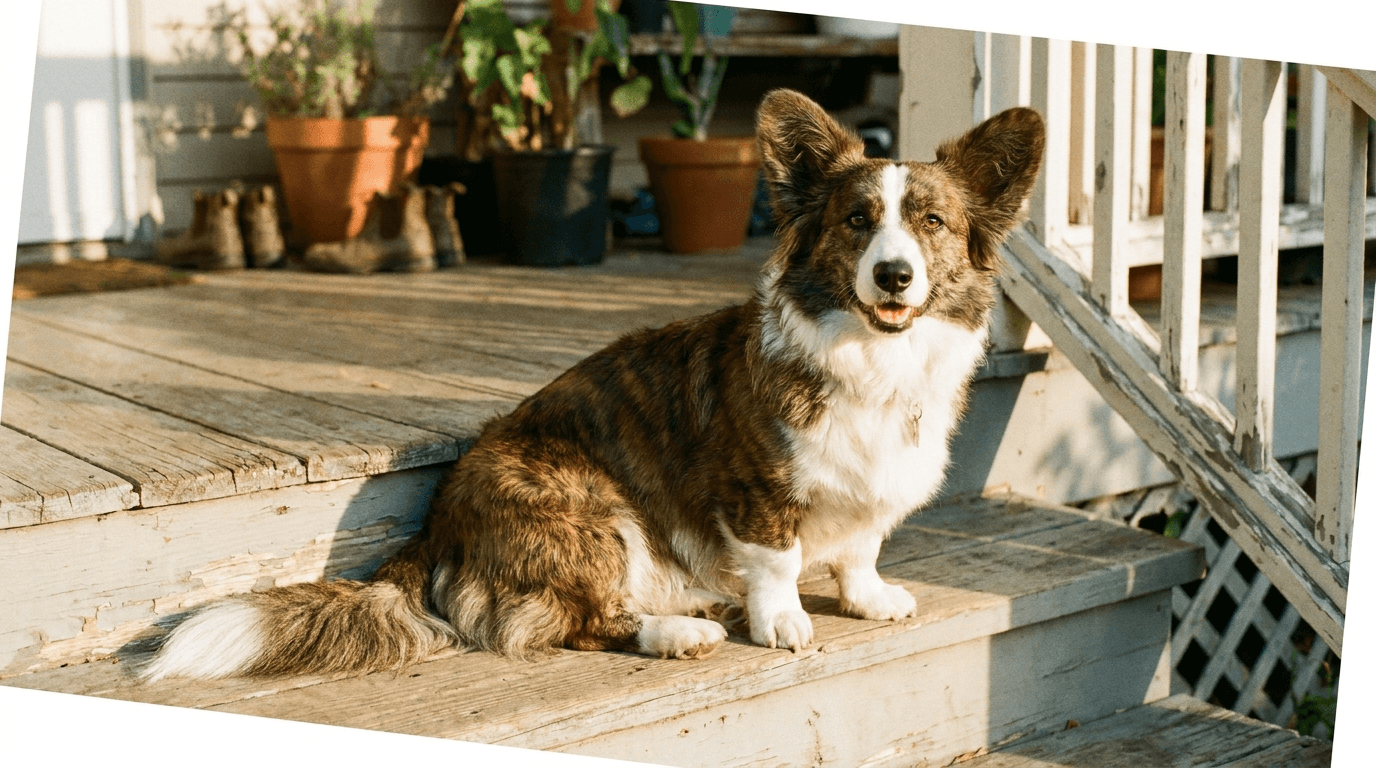
The Cardigan Welsh Corgi has one of the most recognizable silhouettes in the dog world — a long, low body on short legs, a deep chest, and a luxuriant fox-like tail that flows behind in motion. They're built like a small working dog stretched horizontally, with surprising substance for their height.
Body: Long and low to the ground, with a deep, broad chest and well-sprung ribs. The body is noticeably longer than tall, with a level topline and powerful hindquarters. Adult Cardigans typically weigh 25 to 38 pounds — substantially heavier and more substantial than Pembrokes, despite similar shoulder height.
Head and face: The Cardigan's head is moderately wide and flat between the ears, tapering to a fox-like muzzle. The ears are large, rounded at the tips, and carried erect — bigger and more rounded than a Pembroke's pointed ears. Eyes are medium-sized, oval, and dark, though blue merle Cardigans may have one or both blue or partially blue eyes.
Tail: This is the defining feature. The Cardigan has a long, low-set tail carried like a fox's brush — full, fluffy, and reaching almost to the ground. The tail should flow naturally and never be docked. If a corgi has a tail, it's almost certainly a Cardigan.
Coat: Dense, weather-resistant double coat of medium length. The outer coat is harsh-textured and slightly coarse; the undercoat is soft and dense. Cardigans shed year-round and heavily during seasonal coat changes in spring and fall.
Color: Cardigans come in a wider color palette than Pembrokes. AKC-accepted colors include all shades of red, sable, and brindle; black with or without tan or brindle points; and blue merle with or without tan or brindle points. White markings on the chest, neck, legs, and as a blaze on the face are common. Brindle and blue merle are particularly associated with the breed.
Cardigan vs Pembroke Welsh Corgi
This is the question every Cardigan owner gets asked. The two corgi breeds look similar at a glance but are genetically distinct breeds with different histories, slightly different temperaments, and several reliable visual differences.
Tail: The single easiest tell. Cardigans have a long, full fox-brush tail. Pembrokes are typically born with a naturally short tail or have their tails docked at birth (where docking is legal). If the corgi has a tail, it's a Cardigan.
Size: Cardigans are noticeably heavier and more substantial. A typical Cardigan weighs 25 to 38 pounds; a typical Pembroke weighs 24 to 30 pounds. Cardigans also tend to have a deeper chest and a longer body.
Ears: Cardigan ears are larger, rounded at the tips, and set wider apart. Pembroke ears are smaller and more pointed.
Color: Pembrokes are most commonly red, sable, fawn, or tri-color (black, white, tan). Cardigans add brindle and blue merle to the palette — colors not accepted in the Pembroke standard.
History: Cardigans are the older breed, brought to Wales by the Celts roughly 3,000 years ago. Pembrokes arrived later, traditionally credited to Flemish weavers around the 12th century. The two breeds were classified together in the UK until 1934, when they were officially recognized as separate breeds.
Temperament: Cardigans tend to be slightly more reserved, watchful, and thoughtful than Pembrokes. Pembrokes are typically more outgoing and quicker to assume strangers are new best friends. Both are devoted to family, intelligent, and excellent watchdogs — but the Cardigan's natural reserve makes them a little more discerning. Cardigans are often described as the slightly calmer, more independent of the two.
If you want a corgi but lean toward a quieter, more watchful temperament — and you appreciate the visual drama of that long sweeping tail — the Cardigan is your dog.
History
The Cardigan Welsh Corgi is one of the oldest dog breeds in the British Isles. According to the Cardigan Welsh Corgi Club of America, the breed was brought to Cardiganshire, Wales, by Celtic tribes migrating from Central Europe around 1200 B.C. — making the Cardigan substantially older than the Pembroke, which appeared in Wales centuries later.
Cardigans likely descend from Teckel-type dogs (the same family that gave rise to the Dachshund), brought to the British Isles by the Celts and adapted over millennia for cattle work in the rugged Welsh countryside. Their job was to drive cattle by nipping at their heels, then duck low to avoid the inevitable kick. Their long, low body and quick reflexes were practical adaptations, not aesthetic choices.
The breed gained particular value to Welsh tenant farmers under a peculiarity of British property law. When the Crown allowed crofters only a few acres of farmland surrounding their homes, the Cardigan's herding skill — driving cattle ahead of the herd to graze the unfenced common land, then bringing them home before night — became essential. A reliable corgi could mean the difference between a family eating and not.
For centuries the Cardigan and Pembroke were considered one breed. They were shown together at British dog shows in the early 20th century, but breeders increasingly recognized that the two were genetically and behaviorally distinct. The Kennel Club (UK) split them in 1934. The American Kennel Club followed in 1935, recognizing the Cardigan Welsh Corgi as a separate breed in the Working Group. They were later moved to the Herding Group, where they remain today.
The Cardigan has never reached the popularity of its Pembroke cousin — Queen Elizabeth II's lifelong devotion to Pembrokes gave that breed a celebrity Cardigans never matched. Today the Cardigan is the rarer of the two, which means waitlists at reputable breeders are often long.
Temperament & Personality
The Cardigan Welsh Corgi is intelligent, devoted, watchful, and slightly more reserved than the Pembroke. They're the dog that sits back and observes before deciding what to do — measured rather than impulsive.
With family: Cardigans bond deeply with their people and want to be involved in everything. They're affectionate without being clingy and sensitive to the household's mood. A Cardigan will quietly follow you from room to room, settle near your feet, and look up when something interesting happens.
With children: Cardigans generally do well with kids, especially when raised together. They're sturdy enough to handle the rough-and-tumble of family life and patient enough to tolerate the chaos. As with all herding breeds, watch for nipping at the heels of running children — it's a herding instinct, not aggression, but it should be redirected early.
With strangers: This is where the Cardigan-Pembroke difference shows most clearly. Cardigans are politely reserved with new people. They're not unfriendly, but they don't assume every stranger is a friend. This natural watchfulness makes them excellent alert dogs — they'll bark to announce visitors but settle once the family signals it's fine.
With other dogs and pets: Cardigans generally get along well with other dogs and with cats or smaller pets they're raised with. Their herding instinct may surface around fast-moving small animals, so early socialization helps. Two Cardigans together can be a delight; some Cardigans are dog-selective, particularly with same-sex dogs.
Independence: Cardigans are a touch more independent than Pembrokes. They'll choose to come when called, rather than racing to your side at every opportunity. This isn't stubbornness so much as the considered, thinking nature of a working herder — a dog bred to make decisions in the field.
Vocalization: Cardigans bark, but generally with purpose. They alert at the door, announce arrivals, and protest when bored. They're not typically nuisance barkers if their exercise and mental needs are met.
Health
Cardigan Welsh Corgis are generally a hardy, long-lived breed, with most living 12 to 15 years and some reaching 17. Their unique low-slung body shape does come with predictable orthopedic risks, and there are a handful of breed-specific genetic conditions that responsible breeders screen for.
Intervertebral Disc Disease (IVDD): The Cardigan's long back and short legs put extra stress on the spine. IVDD — a degenerative disc condition that can cause pain, weakness, or paralysis — is one of the most significant breed-specific risks. Keeping Cardigans at a lean body weight and discouraging jumping from furniture or stairs are the most important preventive steps.
Hip dysplasia: An inherited malformation of the hip joint that can lead to arthritis and lameness. Reputable Cardigan breeders screen breeding stock with OFA or PennHIP evaluations.
Degenerative Myelopathy (DM): A progressive spinal cord disease that causes gradual loss of coordination and hind-end weakness in older dogs. There's a reliable DNA test for the underlying mutation, and responsible breeders screen to avoid producing affected puppies.
Progressive Retinal Atrophy (PRA): An inherited degeneration of the retina that leads to gradual vision loss. DNA tests are available, and the Cardigan Welsh Corgi Club of America recommends annual eye exams for breeding dogs.
Other eye conditions: Cataracts and persistent pupillary membranes occasionally occur in the breed.
Methemoglobin reductase deficiency: A red-blood-cell condition that occurs at higher frequency in Cardigans than in most breeds, though it's typically mild.
Obesity: Cardigans love food. Their compact build, moderate energy, and stout appetite make weight gain easy, and excess weight directly increases the risk of IVDD, hip problems, and joint disease. Weight management is one of the single most important things a Cardigan owner can do for their dog's long-term health.
Buy from a breeder who tests for hips, eyes, DM, and PRA, and who can show you health clearances on both parents.
Exercise Needs
Don't be fooled by the short legs. Cardigans were bred to spend their days driving cattle across Welsh hills, and they retain that working stamina. They need at least 60 minutes of daily exercise — a brisk walk, a play session in the yard, a hike on a cool day, or a structured activity like agility, herding, or rally.
Mental exercise matters just as much as physical exercise. A Cardigan that's only walked but never asked to think will start finding their own entertainment — usually in the form of barking, digging, or herding the family cat. Food puzzles, training games, scent work, and trick training give their working brain something to do.
Two practical cautions: avoid repetitive jumping (off couches, in and out of cars) until you've taught a controlled "wait" and "down," and don't let a young Cardigan over-exert on slick floors or stairs while their joints are still developing.
Cardigans do well in agility and herding trials, and many take to dock diving, rally obedience, and tracking. They're not the fastest dogs in the ring, but they're focused, sharp, and surprisingly athletic for their proportions.
Training
Cardigans are intelligent, eager to work with their people, and motivated by food. They learn quickly and retain training well. They're also a touch more independent than Pembrokes — a Cardigan may pause to consider whether your request actually makes sense before complying. This isn't defiance; it's the thinking nature of a working dog.
What works: Positive reinforcement methods — food rewards, praise, clicker training. Short, varied training sessions hold their attention better than long drills. Group classes are a great socialization tool and an outlet for their problem-solving brain.
What doesn't: Harsh corrections, repetition without reward, or training that doesn't engage their head. A bored Cardigan will tune out; a stressed Cardigan will shut down.
Socialization: Start early. Expose your Cardigan puppy to new people, dogs, sounds, surfaces, and environments during their critical socialization window (roughly 3 to 16 weeks). Cardigans' natural reserve can tip into wariness if they're undersocialized.
Specific cues worth prioritizing: A reliable recall, a polite leash walk, "leave it" for picking up things off the ground, and a controlled "wait" before jumping off furniture or running through doors. The wait cue can quite literally save their back.
Grooming
The Cardigan's double coat is weather-resistant and surprisingly easy to maintain — most of the time. The complication is shedding.
Routine brushing: Two to three brushings a week with a slicker brush and an undercoat rake will keep the coat healthy and reduce loose hair around the house.
Seasonal coat blows: Twice a year — typically spring and fall — Cardigans blow their undercoat in dramatic fashion. During these weeks, daily brushing is essential to manage the volume of loose hair. Some owners use a high-velocity dryer or visit a professional groomer for a thorough deshedding bath.
Bathing: Every 4 to 8 weeks, or as needed. Cardigans don't have a strong doggy odor and don't require frequent baths.
Nails: Trim every 3 to 4 weeks. Cardigans can develop long quicks if nail care is neglected, which makes future trims painful.
Ears, teeth, eyes: Check ears weekly and clean as needed. Brush teeth several times a week — small dogs are prone to dental disease. Wipe around the eyes if any tear staining appears, particularly on lighter dogs.
Plan on shedding being a fact of life. A Cardigan is not the right choice if hair on your clothes, couch, and floor would drive you up the wall.
Nutrition
Feed a high-quality complete-and-balanced food appropriate for the dog's age, weight, and activity level. Most adult Cardigans do well on 1 to 1.5 cups of dry food per day, split into two meals.
Weight management is the single most important nutritional decision a Cardigan owner makes. Cardigans are food-motivated and prone to weight gain, and excess weight directly increases the risk of IVDD, hip disease, and joint problems. Measure meals. Track treats. Adjust portions if you can't easily feel the dog's ribs through a light layer of fat.
Many Cardigan owners use a portion of the daily kibble allotment as training rewards, which keeps total calories under control. Avoid table scraps and limit high-calorie treats.
If you're unsure whether your Cardigan is at a healthy weight, ask your vet to evaluate body condition score at the next visit — a lean Cardigan is a healthier and longer-lived Cardigan.
Is the Cardigan Welsh Corgi Right for You?
The Cardigan is a wonderful dog for the right home — and a difficult fit for the wrong one. Some honest pros and cons:
Pros:
- Intelligent, devoted, and trainable
- Adaptable to apartment or rural life if exercise needs are met
- Sturdy build that holds up to family life
- Excellent watchdog without excessive barking
- Long-lived — often 12 to 15 healthy years
- Striking, memorable appearance
Cons:
- Sheds heavily — especially during seasonal coat blows
- Prone to back problems if allowed to become overweight or to jump repeatedly
- Needs real daily exercise and mental work
- Natural herding instinct can lead to nipping if not redirected
- Rare in the U.S. — expect a waitlist for a quality puppy
- Reserved with strangers — early socialization is non-negotiable
A Cardigan thrives in a home that wants a thinking, working partner — not just a couch dog. If you're committed to daily exercise, weight management, and ongoing training, the Cardigan will reward you with one of the most loyal and capable dogs you'll ever live with.
Finding a Cardigan Welsh Corgi
Reputable breeders: Start with the Cardigan Welsh Corgi Club of America breeder directory. A good Cardigan breeder will:
- Test breeding stock for hips, eyes, degenerative myelopathy, and PRA
- Show you health clearances on both parents
- Raise puppies in the home with significant early socialization
- Ask you as many questions as you ask them
- Be available for the life of the dog and take any of their puppies back if needed
Expect a waitlist of several months to over a year for a well-bred Cardigan puppy. The breed's rarity means quality breeders are usually booked far in advance.
Rescue: Cardigans turn up in rescue less often than Pembrokes, but they do appear. Look for the CWCCA Rescue Trust, regional Cardigan rescue groups, and all-breed corgi rescues. Adopting an adult Cardigan is a wonderful option for owners who want to skip the puppy phase.
Red flags: Backyard breeders selling Cardigan puppies through Craigslist or pet-store-style websites are common. Avoid any breeder who can't provide health clearances, won't let you meet the parents, or is selling multiple breeds. "Designer corgi mixes" sold at premium prices are typically poorly bred and not health-tested.
Cost of Ownership
Puppy price: $1,500 to $3,000 from a reputable breeder. Show-quality Cardigans from notable kennels can run higher.
First-year costs: Plan on $1,500 to $2,500 beyond the purchase price for vaccinations, spay or neuter, initial vet visits, crate, bed, food, collar, leash, training classes, and routine supplies.
Annual costs: $1,200 to $2,500 per year for food, routine veterinary care, preventatives, grooming supplies, and treats. Pet insurance for a Cardigan typically runs $35 to $70 per month — worth strong consideration given the breed's IVDD risk.
Lifetime cost: Over a 12 to 15 year lifespan, expect to invest $15,000 to $30,000 in food, vet care, and supplies. Major medical events — IVDD surgery, for example — can run $5,000 to $10,000 or more.
Frequently Asked Questions
What's the difference between a Cardigan and a Pembroke Welsh Corgi?
Cardigans are the older breed and slightly larger (25–38 lbs vs. 24–30 lbs). The biggest visual differences: Cardigans have a long, full fox-brush tail; Pembrokes typically have no tail. Cardigan ears are larger and rounded; Pembroke ears are smaller and pointed. Cardigans come in more colors, including brindle and blue merle. Temperamentally, Cardigans are slightly more reserved and watchful; Pembrokes are more outgoing.
Do all Cardigan Welsh Corgis have tails?
Yes. Cardigan Welsh Corgis are born with long, full fox-brush tails, and the breed standard calls for the tail to be left natural. A corgi without a tail is almost certainly a Pembroke. If you see a corgi with a long fluffy tail, it's a Cardigan.
Are Cardigan Welsh Corgis hypoallergenic?
No. Cardigans have a dense double coat and shed moderately year-round, with heavy seasonal coat blows in spring and fall. They are not a good choice for households with significant dog allergies.
How long do Cardigan Welsh Corgis live?
12 to 15 years on average, with some reaching 17. Cardigans are a generally long-lived breed when kept at a healthy weight and given consistent veterinary care.
Are Cardigan Welsh Corgis good apartment dogs?
Yes, with the right exercise routine. Cardigans adapt well to apartment life as long as they get at least 60 minutes of daily physical exercise and meaningful mental stimulation. They're not high-strung indoors, but they need real outlets for their working-dog energy.
Do Cardigan Welsh Corgis bark a lot?
Cardigans bark, but usually with purpose. They make excellent alert dogs and will announce visitors, unusual sounds, or perceived threats. They're typically not nuisance barkers if their exercise and enrichment needs are met. Boredom is the most common cause of excessive barking.
Are Cardigan Welsh Corgis good with kids?
Generally yes, especially when raised with children. Cardigans are sturdy enough to handle family life and patient with respectful kids. Watch for nipping at the heels of running children — it's a herding instinct, not aggression, and should be redirected early through training.
How much does a Cardigan Welsh Corgi puppy cost?
Expect to pay $1,500 to $3,000 for a well-bred Cardigan puppy from a health-tested breeder. Show-quality puppies from notable kennels can cost more. Adoption fees through Cardigan rescue typically run $300 to $600.
Are Cardigan Welsh Corgis rare?
Compared to the Pembroke Welsh Corgi, yes. The Cardigan never gained the celebrity boost the Pembroke received from Queen Elizabeth II's lifelong devotion to the breed. Quality Cardigan breeders typically have waitlists of several months to over a year.
Can Cardigan Welsh Corgis be left alone?
Most adult Cardigans tolerate being alone for 4 to 6 hours, provided they've been exercised first. They're a moderately independent breed that doesn't suffer from severe separation anxiety as often as some smaller toy breeds. Crate training, puzzle feeders, and a midday walk make longer absences manageable.
Related Reading
Curious about other corgi mixes and corgi-adjacent breeds? Read our breed guides on the Dorgi (Corgi × Dachshund), the Aussie Corgi (Corgi × Australian Shepherd), and the Corgidor (Corgi × Labrador) — three popular corgi crosses that each blend the herding instincts of the corgi with another working breed.
The Bottom Line
The Cardigan Welsh Corgi is one of dogdom's quiet treasures — an ancient working herder with a thinking mind, a devoted heart, and a body shaped by 3,000 years of doing real work in the Welsh hills. They're not the right dog for every home. They shed, they need real exercise, they don't blindly trust strangers, and their long backs demand careful weight management for life. But for the household that wants a smart, loyal, watchful companion with one of the most distinctive looks in the dog world — and that magnificent fox-brush tail — the Cardigan is hard to beat.