
The Aussie Corgi: Complete Guide to the Australian Shepherd Corgi Mix
An aussie corgi, nicknamed the "Auggie," is a designer crossbreed between the Australian Shepherd and the Pembroke Welsh Corgi. This small-to-medium herding mix stands 10 to 13 inches, weighs roughly 20 to 45 pounds, and pairs a long corgi-style body with a dense double coat. Expect a highly intelligent, energetic, affectionate dog with strong herding instincts.
What Is an Aussie Corgi? At a Glance
The Aussie Corgi is a first-generation hybrid, meaning most puppies come from one purebred Australian Shepherd parent and one purebred Pembroke Welsh Corgi parent. Because it is a mixed breed, the Aussie Corgi is not recognized by the American Kennel Club (AKC) as a standardized breed. It can, however, be enrolled with designer-dog registries such as the American Canine Hybrid Club (ACHC) and the Designer Breed Registry, which track hybrid lineage rather than enforce a conformation standard. That lack of a rigid standard is why two Auggies from the same litter can look noticeably different from one another.
Both parent breeds are working herders, so the Aussie Corgi arrives with a strong job-oriented brain in a compact frame. Here is the quick snapshot:
- Size: Small to medium
- Weight: ~20–45 lbs
- Height: ~10–13 inches at the shoulder
- Lifespan: ~12–15 years
- Coat: Medium-length double coat that sheds year-round
- Colors: Black, brown, tan, white, red, and merle (often in combination)
- Energy: High — bred from two working herders
- Best for: Active owners who can provide daily exercise and mental work
If you want the parent-breed detail behind these traits, the AKC profiles for the Australian Shepherd and the Pembroke Welsh Corgi are the best starting points.
Appearance & Size
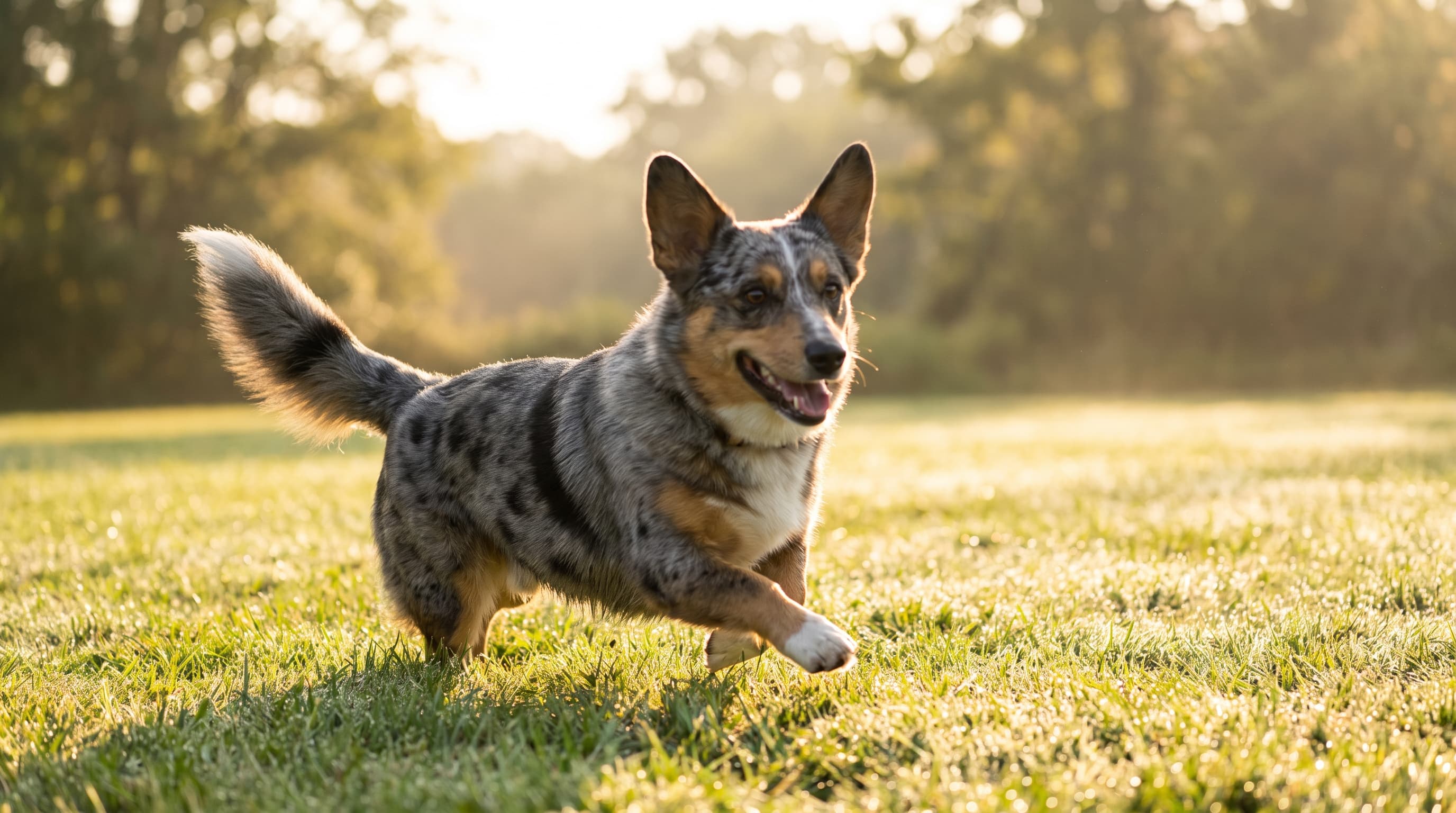
The classic Aussie Corgi look is a corgi-proportioned body — long back, deep chest, and short-to-medium legs — topped with the more refined, expressive head of an Australian Shepherd. Ears may stand erect like a corgi's, flop, or land somewhere in between. Tails vary widely: some Auggies inherit the naturally short or bobbed tail seen in many Australian Shepherds, while others carry the fuller tail more common in corgis. For a closer look at why tail length varies so much in this family of dogs, see our guide to the corgi with a tail.
Coat color is where the Aussie Corgi really shows off. Common shades include black, brown, tan, white, and red, frequently blended into tricolor or bicolor patterns. Many Auggies inherit the striking merle pattern from the Australian Shepherd side — a marbled mix of dark and light patches, sometimes paired with blue or heterochromatic (two-colored) eyes. A responsible breeder never pairs two merle parents together, because merle-to-merle breeding carries a well-documented risk of deafness and eye defects in the puppies.
The double coat is medium in length: a softer insulating undercoat beneath a weather-resistant outer coat. This construction keeps the Aussie Corgi comfortable in both cool and warm climates, but it also means steady shedding and heavier seasonal "blowouts" in spring and fall.
Temperament & Personality
Aussie Corgis are bright, busy, people-oriented dogs. Both parent breeds rank among the smartest and most trainable herders, and the mix inherits that quick, problem-solving mind. An Auggie wants to be involved in whatever the household is doing and typically bonds closely with its family. That loyalty makes them affectionate companions, but it can tip into separation anxiety if they are left alone too long without stimulation.
Two herding traits show up in nearly every Aussie Corgi and are worth planning for:
- Vocalness: Corgis in particular are known "talkers." Without direction, an Aussie Corgi may bark at movement, visitors, or boredom. Early "quiet" cues and adequate exercise keep barking manageable.
- Nipping and herding at heels: Herding dogs instinctively move livestock by nipping at heels. In a home, that instinct can transfer to children, other pets, or running feet. This is normal behavior, not aggression, and it responds well to redirection and early training.
With proper socialization from puppyhood, Aussie Corgis are generally good with children and other dogs. They do best in homes that treat their intelligence as a feature to channel rather than a nuisance to suppress. A bored, under-exercised Auggie will invent its own jobs — usually ones you will not enjoy, like reorganizing the trash or herding the cat.
Exercise & Energy Needs
This is a high-energy dog in a deceptively small package. Plan on at least 60 minutes of active exercise per day, split across walks, fetch, and off-leash play in a secure area. But physical exercise alone is not enough for a herding mix — mental work is just as important. Puzzle feeders, scent games, trick training, and structured activities like agility, rally, or canine "treibball" (herding oversized balls) give the Aussie Corgi's working brain an outlet.
A useful rule of thumb: a tired body plus a tired mind equals a calm, well-behaved Auggie. Owners who provide only backyard access without engagement often report barking, digging, and destructive chewing — all classic signs of an intelligent dog with unmet needs. Because of the corgi-derived long back, favor low-impact activities and avoid repetitive high jumping or stair-heavy routines, especially in puppies whose joints are still developing.
Training & Herding Instincts
Aussie Corgis are a joy to train precisely because they are so smart and eager to work with their people. They respond best to positive reinforcement — treats, praise, and play — delivered in short, upbeat sessions. Harsh corrections tend to backfire with sensitive herders, damaging the trust that makes training effective in the first place.
Prioritize these from day one:
- Socialization: Expose your puppy to varied people, dogs, sounds, and environments during the critical early months to prevent wariness later.
- Impulse control: Cues like "leave it," "settle," and a solid recall channel the herding drive productively.
- Redirecting nipping: Teach an alternative behavior (fetch a toy, target your hand) whenever the heeling instinct kicks in.
- Bark management: Reward quiet, and avoid unintentionally reinforcing barking with attention.
Because the herding instinct is hardwired, you will not "train it out" of an Aussie Corgi — the goal is to give it an acceptable channel. Dog sports that mimic working tasks are ideal. Many owners find their Auggie thrives with a "job," whether that is fetching the newspaper, learning a long trick repertoire, or competing in agility.
Grooming & Shedding
The Aussie Corgi's double coat requires consistent, moderate grooming. Plan on brushing two to three times per week, increasing to daily during the twice-yearly shedding seasons when the undercoat "blows." A slicker brush plus an undercoat rake handles most of the loose hair and helps prevent mats behind the ears and on the hindquarters.
Bathe only as needed — roughly every one to two months — since over-bathing strips the coat's natural oils. Never shave a double coat; it disrupts the coat's insulating and cooling function and can grow back patchy. Round out the routine with regular nail trims, weekly ear checks (especially for floppy-eared Auggies, which trap more moisture), and dental care several times a week. This is a moderate-shedding dog, not a hypoallergenic one, so budget time for vacuuming and lint rollers.
Health & Lifespan
Aussie Corgis are generally healthy and typically live 12 to 15 years, but as a hybrid of two breeds with known predispositions, they can inherit health issues from either side. Buying from a breeder who health-tests both parents is the single best way to reduce risk. Watch for:
- Hip dysplasia: A malformation of the hip joint common in both parent breeds. The AKC's overview of hip dysplasia in dogs explains how weight management and screening help. Ask breeders for OFA or PennHIP hip evaluations.
- Intervertebral disc disease (IVDD): The long, low corgi-style back raises the risk of spinal disc problems. Learn the warning signs and prevention basics in this veterinary guide to IVDD. Keeping your Auggie lean, using ramps instead of jumps, and supporting the back when lifting all help protect the spine.
- Eye conditions: Both parent breeds can pass on inherited eye disease, including progressive retinal atrophy (PRA), which gradually leads to blindness. Cataracts and collie eye anomaly are also seen in Australian Shepherd lines. A responsible breeder screens for these.
- MDR1 drug sensitivity: Many herding breeds, including the Australian Shepherd, carry the MDR1 gene mutation, which causes dangerous reactions to certain common medications (some dewormers, sedatives, and chemotherapy drugs). Washington State University's veterinary pharmacology lab — the group that discovered the mutation — offers a simple cheek-swab test. Every Aussie Corgi owner should ask about MDR1 status and share it with their vet before any medication is prescribed.
This section is general education, not veterinary advice. It is not a substitute for diagnosis or treatment. Always consult a licensed veterinarian about your individual dog's health, screening, and any medication decisions.
Cost & Finding a Puppy
Expect to pay roughly $500 to $1,500 for an Aussie Corgi puppy from a breeder, with price varying by region, coat color (merle often commands a premium), and how thoroughly the parents were health-tested. Be cautious of prices that seem too good to be true — bargain "designer" puppies frequently come from operations that skip health screening entirely, which can cost far more in vet bills later.
When choosing a source, prioritize breeders who:
- Health-test both parents for hips, eyes, and (critically) MDR1 status;
- Never breed merle-to-merle;
- Let you meet at least the mother and see the puppies' living conditions;
- Provide health guarantees and are transparent about the parent breeds.
Because Aussie Corgis are surrendered when unprepared owners underestimate their energy, adoption is well worth considering. Check breed-specific rescues for Australian Shepherds and Pembroke Welsh Corgis, as well as general shelters, where mixes like the Auggie regularly appear at a fraction of breeder prices. Beyond purchase price, budget for ongoing costs: quality food, routine veterinary care, grooming tools, training classes, and pet insurance, which many owners find worthwhile given the hereditary risks above.
Curious how the Aussie Corgi's corgi side compares to its cousin? Our profile of the Cardigan Welsh Corgi breaks down the differences between the two corgi breeds that shape mixes like this one.
Nutrition Basics
Feed a high-quality diet formulated for the Aussie Corgi's life stage (puppy, adult, senior) and activity level. Because the long-backed corgi build makes extra weight especially hard on the spine and joints, portion control is essential — measure meals rather than free-feeding, and account for training treats in the daily total. Most adults do well on two measured meals a day. Keep fresh water available, and ask your veterinarian to help you set a target body condition and adjust portions as your dog ages or its exercise level changes.
Is the Aussie Corgi Right for You?
The Aussie Corgi is an outstanding companion for the right home — and a genuine handful for the wrong one. Consider an Auggie if you are an active person or family who enjoys training, wants a dog that participates in daily life, and can commit to real physical and mental exercise. This dog rewards engagement with loyalty, cleverness, and a big personality in a portable size.
Think twice if you work long hours away from home, prefer a low-energy lap dog, or cannot commit to consistent grooming and training. An under-stimulated Aussie Corgi tends to bark, nip, and find destructive outlets for its energy. Apartment living can work, but only if you meet the exercise and mental-work needs; a yard is not a substitute for engagement. Match your lifestyle to the breed honestly, and the Aussie Corgi will likely be one of the most rewarding dogs you ever own.
Frequently Asked Questions
How big do Aussie Corgis get?
Most Aussie Corgis stand about 10 to 13 inches at the shoulder and weigh roughly 20 to 45 pounds, placing them in the small-to-medium range. Adult size depends on which parent a given dog takes after; Auggies favoring the Australian Shepherd side tend to be larger and longer-legged.
Do Aussie Corgis shed a lot?
Yes. The medium double coat sheds steadily year-round and heavily during the twice-yearly shedding seasons in spring and fall. Brushing two to three times a week (daily during heavy sheds) manages the loose hair. They are not hypoallergenic.
Are Aussie Corgis good family dogs?
They can be excellent family dogs when properly socialized and exercised. They are affectionate, loyal, and playful with children. The main thing to manage is the inherited herding instinct, which can lead to nipping at heels — early training redirects this behavior effectively.
How much exercise does an Aussie Corgi need?
Plan on at least 60 minutes of active exercise daily, plus mental enrichment like puzzle toys, trick training, or dog sports. As a mix of two working herders, an Aussie Corgi needs a job to do; physical exercise alone rarely satisfies them.
How much does an Aussie Corgi cost?
Puppies typically run $500 to $1,500 from a breeder, with merle coats and thoroughly health-tested parents at the higher end. Adoption through shelters or breed rescues usually costs far less. Remember to budget for ongoing food, grooming, veterinary care, and training.
Are Aussie Corgis easy to train?
Very. Both parent breeds are among the most intelligent and trainable herders, and the mix is eager to please. They excel with short, positive-reinforcement sessions. The challenge is not teaching them — it is giving their busy minds enough to do so they do not train themselves into mischief.
Related Reading & Next Steps
Want to understand the parent breeds that make the Auggie tick? Explore our related breed guides to the Australian Shepherd and the Pembroke Welsh Corgi for deeper detail on temperament, health, and history.
Love smart, spirited dogs like the Aussie Corgi? Subscribe to the Daily Wag newsletter for practical training tips, breed spotlights, and health guidance delivered to your inbox.