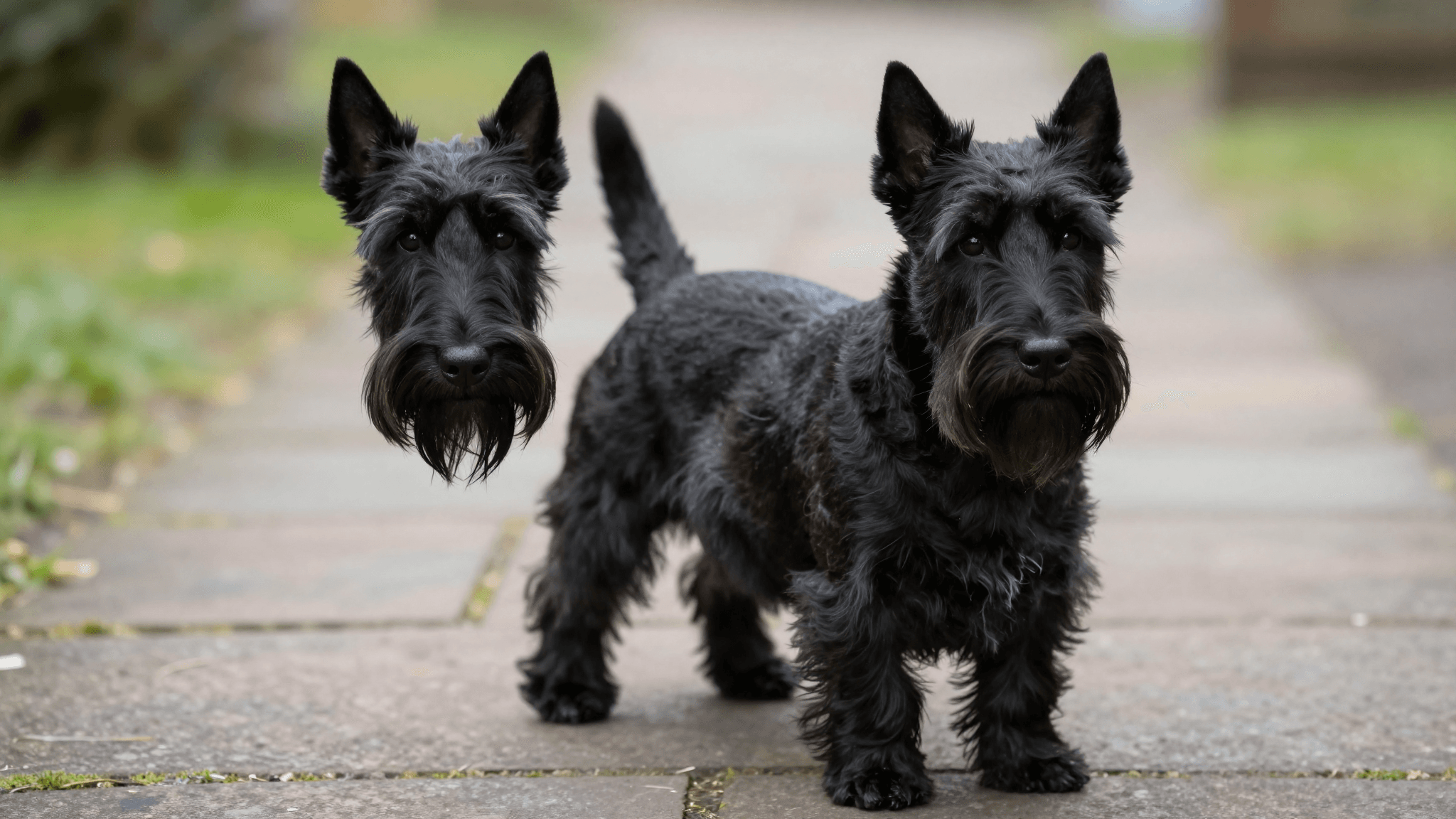

The Scottish Terrier — affectionately known as the "Scottie" — is a small, sturdy Scottish hunting terrier with one of the most recognizable silhouettes in the dog world: short legs, a long body, a distinctive bearded face, and perky ears that read like a profile sketch. Adults stand about 10 inches tall and weigh 18 to 22 pounds. The breed earned its old-world nickname, the "Diehard," for a famously tenacious, independent temperament. Scotties are dignified rather than goofy, deeply loyal to their families, and have lived in the White House three times — most famously alongside Franklin D. Roosevelt's beloved Fala. They are members of the AKC Terrier Group and one of the most enduring small breeds in American family life.
Scottish Terrier at a Glance
The fast facts most prospective owners ask about first:
- Other names: Scottie, Aberdeen Terrier, Diehard
- Group: AKC Terrier Group (recognized 1885)
- Weight: 18–22 pounds (males slightly heavier than females)
- Height: About 10 inches at the shoulder
- Lifespan: 12 years on average (range 11–13)
- Coat: Wiry double coat — harsh weather-resistant outer, soft dense undercoat
- Color: Most often black; also wheaten, brindle, and various brindle-and-black combinations
- Shedding: Low to moderate when properly groomed
- Energy level: Moderate — daily walks, not a high-endurance jogging partner
- Good with kids: Better with older children who respect a dog's space
- Good with other pets: Can be aloof or pushy with other dogs; high prey drive toward small animals
- Apartment-friendly: Yes — compact size and moderate exercise needs fit small spaces well
- Trainability: Intelligent but independent; responds best to short, food-motivated sessions
Appearance
The Scottie's silhouette is so distinctive it became the dog token on the Monopoly board. Almost everything about the breed's look is purpose-built for the job it was originally bred to do — going underground after badgers, foxes, and rats in the rocky terrain of the Scottish Highlands.
Body: Compact, stocky, and surprisingly heavy for its size. Scotties have a long, level back; short, muscular legs; and a deep chest. The breed standard calls for a dog that looks "powerful in a small package" — and that's exactly the impression a well-built Scottie gives.
Head and face: The bearded muzzle, bushy eyebrows, and dignified expression are unmistakable. Eyes are almond-shaped and dark; ears are small, pointed, and carried erect. The head is long in proportion to the body, which contributes to the breed's serious, almost solemn look.
Tail: Carried upright like a small flag — short, thick at the base, and tapering to a point. It's a feature show-line judges look for and a useful identifier from across a park.
Coat: Hard, wiry outer coat over a softer undercoat. Properly maintained, the coat repels water and dirt and lays flat against the body. Show-line Scotties are hand-stripped to keep the coat's harsh texture; many pet owners opt for clipping, which is faster but softens the coat over time.
Color: Black is the color most people picture, but the breed standard also includes wheaten (a pale cream or fawn) and brindle (any color streaked with black). Some brindle Scotties appear almost solid black at a glance and only show their pattern in strong light.
History
The Scottish Terrier traces back to the rocky farmlands of the Scottish Highlands, where small, low-slung terriers were bred for centuries to "go to ground" — chasing badgers, foxes, and rats through dens and burrows. Several Scottish breeds share this heritage, including the Cairn Terrier, the Skye Terrier, the Dandie Dinmont, and the West Highland White Terrier. The modern Scottish Terrier emerged as a distinct type in the 19th century when British breeders began standardizing what had been a loose family of similar working dogs.
The breed was recognized by the American Kennel Club in 1885, making it one of the AKC's original terrier breeds. By the early 20th century, the Scottie had crossed from working dog into pop-culture icon. In 1942, Parker Brothers added a Scottie token to the Monopoly board — likely a nod to President Franklin D. Roosevelt's famous Scottie, Fala — and in subsequent Hasbro polls it has consistently been voted the most popular Monopoly piece in the world.
Scotties have a unique place in American political history. They are the only breed to have lived in the White House three times — with Franklin D. Roosevelt (Fala), Dwight D. Eisenhower (Skunky and Telek), and George W. Bush (Barney and Miss Beazley). Fala remains the only presidential pet ever memorialized in statue form; he's depicted at FDR's feet at the Franklin Delano Roosevelt Memorial in Washington, D.C.
Temperament & Personality
If you have to describe a Scottie in one word, "dignified" is the one most owners reach for. These are not bouncy, goofy dogs — they're serious-minded little terriers with strong opinions and a clear sense of self. The breed earned the nickname "Diehard" honestly: bred to face down a cornered badger underground, the Scottie's default setting is brave, stubborn, and unwilling to back down.
With family: Devoted, but on their own terms. A typical Scottie chooses one or two family members as their inner circle and follows them quietly from room to room. They're often described as "velcro on a slow setting" — they want to be near you, but they don't usually demand to be in your lap.
With strangers: Reserved, sometimes aloof. Scotties are not the dog that runs up to greet every visitor. Early, frequent socialization helps — without it, they can drift toward suspicious or barky in adulthood.
With children: Better suited to families with older kids who understand how to give a dog space. Scotties are sturdy enough not to be fragile, but they don't tolerate ear-pulling, hugging around the neck, or being grabbed while they're eating or sleeping. They will warn first — a growl, a still posture — and a child who reads dogs well can live happily with one.
With other pets: Variable. Many Scotties tolerate or even enjoy a second dog they grew up with, but same-sex aggression is common, especially between two Scotties of the same sex. The breed's prey drive is real — small animals like hamsters, rabbits, and outdoor squirrels will register as game. Cats often coexist if introduced young.
Watchdog ability: Excellent. Scotties are alert, observant, and quick to bark at anything unusual — the doorbell, a delivery driver, a leaf moving across the yard. Training to manage barking should start in puppyhood; once a Scottie decides barking is their job, retraining is uphill work.
Health
Scotties are generally hardy, but the breed has several health quirks that prospective owners should understand before committing. Reputable breeders screen for the most serious of these and can show health-test results on both parents.
- Bladder cancer (transitional cell carcinoma, TCC): This is the single most-discussed Scottie health risk. Scottish Terriers are roughly 18–20 times more likely to develop urinary bladder cancer than the general dog population, according to research funded by the AKC Canine Health Foundation. Early signs — straining to urinate, blood in urine, frequent accidents — can mimic a UTI, so any change in urinary habits in a Scottie deserves a vet visit promptly. Some Scottie-savvy vets recommend periodic urinalysis screening starting around age 6.
- Scottie cramp: A breed-characteristic, mostly benign neurological condition that causes brief muscle spasms or stiff, hopping movements during excitement or hard exercise. It looks alarming the first time but is painless, and most Scotties live full lives with it. Episodes typically resolve within minutes of rest.
- Von Willebrand's disease (vWD): An inherited bleeding disorder that prevents blood from clotting normally. Affected dogs may bruise easily or bleed excessively from minor injuries or surgery. DNA tests exist; ask any breeder for results.
- Craniomandibular osteopathy (CMO): An abnormal bone growth on the jaw that appears in puppies between roughly 4 and 8 months. Affected pups develop a hard, painful swelling along the lower jaw and may resist eating. Most cases resolve on their own by 12–15 months, but the condition is one reason vets advise against over-exercising Scottie puppies.
- Patellar luxation: Kneecap displacement, common in small breeds. Mild cases can be managed without surgery; severe cases require correction.
- Allergies: Skin and food allergies are relatively common. Watch for excessive paw chewing, recurring ear infections, or rashes on the belly.
Average lifespan is around 12 years, with many well-cared-for Scotties reaching 13 or 14. Routine bladder screening, dental care, and weight management make a substantial difference at the upper end of that range.
Exercise Needs
Scotties are moderately active dogs — more energy than a Pekingese, far less than a Jack Russell. A daily routine of two 20-minute walks plus some indoor play is enough for most adults. They are surprisingly happy to nap in a sunny spot between outings.
They tend to be walkers more than fetchers. Many Scotties will retrieve a ball a few times, then look at you as if to say "I've made my point" and wander off. Scent games, food puzzles, barn-hunt classes, and short tracking exercises tap into the breed's working instincts and tire them out more than mindless ball-throwing.
Puppies: Avoid forced or repetitive exercise (long runs, stair-climbing, jumping from furniture) until growth plates close. This is doubly important for Scotties because the breed's high CMO risk means jaw and skull bones are particularly sensitive to overuse stress in the first year.
Hot weather: The dense double coat is built for cool, damp Highland weather, not summer pavement. Scotties overheat quickly; walk early or late in summer, and never leave one in a parked car.
Training
The Scottie is intelligent — sometimes inconveniently so. They're entirely capable of learning sit, down, stay, recall, and tricks. They simply don't see the point of doing them on demand, every time, just because you asked. This is the terrier mind at work, and it's one of the breed's defining traits.
What works:
- Short, food-motivated sessions. Five-minute reps two or three times a day beat one long session every time. Most Scotties are highly food-driven, and treats are far more effective than verbal praise.
- Make it interesting. Vary your cues, locations, and rewards. A bored Scottie will check out and refuse to engage.
- Skip harsh corrections. Yelling, leash-popping, and physical punishment shut Scotties down fast — they're a sensitive breed under all that swagger. Force-based methods damage the relationship without improving behavior.
- Early socialization is mandatory. Take your puppy everywhere — sidewalks, friends' houses, vet's office for friendly visits, busy parks — between 8 and 16 weeks. An undersocialized Scottie can grow into a fearful, snappy adult.
- Manage barking from day one. Teach a "quiet" or "enough" cue before barking becomes a habit. Reward calm; never reinforce frantic barking with attention.
Recall (coming when called) is the hardest cue for most Scotties. The breed was bred to chase prey into burrows, and a Scottie in pursuit of a squirrel will not stop on a "come" cue no matter how well-trained. Keep them on leash or in a securely fenced yard, full stop.
Grooming
The wiry double coat is what makes the Scottie look like a Scottie — and keeping it that way takes more work than the breed's compact size suggests.
Brushing: Two or three times per week with a slicker brush and a metal comb. Pay particular attention to the beard, eyebrows, and the long furnishings on the legs and belly, which tangle easily. A neglected beard becomes a damp, smelly mess of dropped food and water.
Hand-stripping vs. clipping: Show-line Scotties are hand-stripped, a process in which dead outer-coat hairs are pulled out by hand or with a stripping knife. This preserves the harsh texture and rich color of the coat. Most pet Scotties are clipped instead, which is much faster but softens the coat and often dulls the color over time. Both are valid; the choice usually comes down to whether you have a Scottie-experienced groomer in your area and how much you care about the traditional look.
Professional grooming: Plan on every 6 to 8 weeks, whether you choose stripping or clipping. Expect to pay $70–$120 per visit depending on your region.
Daily beard care: Wipe the beard after meals and water bowls. Many Scottie owners switch to wider, shallower water bowls so the beard doesn't sit in water — this single change reduces beard staining and odor dramatically.
Nails, ears, teeth: Trim nails every 3–4 weeks; check ears weekly for redness or odor; brush teeth at least 2–3 times per week. Small breeds are prone to dental disease, and a clean mouth genuinely adds years to a Scottie's life.
Nutrition
Feed a high-quality, small-breed adult formula. Most Scotties do well on roughly 3/4 to 1.5 cups of dry food per day, split into two meals. Exact amounts depend on age, activity level, and whether the dog is being shown or bred.
Watch the waistline. Scotties love food and are skilled freeloaders. The breed's compact frame and short legs mean even a pound or two of extra weight puts real strain on joints and the back. You should be able to feel ribs easily under a thin layer of fat and see a clear waist from above.
Bladder health diets: Because of the breed's elevated bladder cancer risk, some vets recommend feeding diets that promote frequent urination (and thus less time for irritants to sit against the bladder wall). Practical translation: make sure fresh water is always available, walk your Scottie often enough for several daily urinations, and ask your vet whether vegetable-rich diets are appropriate — a small 2005 Purdue study suggested that regular consumption of green leafy and yellow-orange vegetables was associated with lower TCC risk in Scotties.
Is the Scottish Terrier Right for You?
The Scottie is a wonderful dog for the right home and a frustrating one for the wrong home. Here's the honest pros and cons list.
Pros:
- Iconic, instantly recognizable appearance
- Compact size suits apartments and small homes
- Low-to-moderate shedding when properly groomed
- Deeply loyal — a one- or two-person dog in the best sense
- Excellent watchdog; will tell you about every visitor and squirrel
- Generally hardy and long-lived for a purebred
Cons:
- Independent to the point of stubborn; not a dog for owners who want instant obedience
- Vocal — barking management is a daily task
- High prey drive; not safe off-leash in unfenced areas
- Significant grooming commitment ($800–$1,500+ per year in professional care)
- Elevated bladder cancer risk; veterinary costs can spike in senior years
- Reserved with strangers; not the breed for owners who want a social butterfly
A Scottie fits beautifully into a household where someone is home most days, where exercise is reliable but moderate, and where the owner appreciates a dog with strong opinions and independent grace. If you'd rather have a goofy retriever who lives to please, this is not your breed.
Finding a Scottish Terrier
Three main paths exist.
1. Reputable breeders. The Scottish Terrier Club of America (STCA) maintains a breeder referral directory of members who have signed the club's code of ethics. A good breeder will:
- Provide health-test results on both parents (bladder cancer history in the line, vWD DNA test, patellar evaluations)
- Welcome you to meet the mother and see where puppies are raised
- Ask you as many questions as you ask them
- Take the puppy back at any point in its life if you can't keep it
Expect to pay $1,500–$3,500 for a well-bred Scottie puppy in the U.S., with show-quality pups at the upper end. Wait lists of 6–12 months are normal with the best breeders.
2. Breed-specific rescue. The STCA-affiliated rescue network (Scottie Rescue) places adult Scotties whose owners can no longer keep them — typically through no fault of the dog. Adult dogs often come with known temperaments, established house manners, and lower price tags ($200–$500). For owners who don't need the puppy stage, this is often the better path.
3. General shelters and mixed-breed rescues. Purebred Scotties land in city shelters occasionally; mixes are more common. Petfinder and Adopt-a-Pet listings turn up Scottie crosses with Westies, Yorkies, Miniature Schnauzers, and Cairn Terriers. If you don't need a pedigree, mixes often inherit the best of both breeds.
Avoid: Pet stores, online "puppy mills," and breeders who won't show you the parents or the whelping area. The Scottie's breed-specific health risks make breeder vetting more important here than for many breeds.
Cost of Ownership
A realistic budget for a Scottie:
Initial costs (Year 1):
- Puppy from a reputable breeder: $1,500–$3,500
- Crate, bed, leash, collar, bowls, initial toys: $200–$400
- First-year vet care (vaccines, spay/neuter, microchip): $400–$800
- Puppy training class: $150–$300
- Initial grooming setup or first professional grooms: $200–$400
Year 1 total: roughly $2,500–$5,500, depending on puppy price and region.
Annual recurring costs (Years 2+):
- High-quality food: $400–$700
- Professional grooming every 6–8 weeks: $600–$1,000
- Routine vet care (annual exam, vaccines, parasite prevention): $400–$700
- Pet insurance (recommended given bladder cancer risk): $400–$700
- Toys, treats, replacement gear: $150–$300
Annual total: roughly $2,000–$3,400, before any emergency or chronic-illness care.
Senior-stage costs (age 8+) often climb due to dental cleanings, arthritis management, and — given breed-specific risk — bladder cancer screening or treatment. Pet insurance taken out early (before any pre-existing conditions are recorded) is one of the best financial decisions Scottie owners make.
Scottish Terrier FAQ
Are Scottish Terriers hypoallergenic?
No dog is truly hypoallergenic, but Scotties are widely considered a lower-allergen breed thanks to their wiry coat and modest shedding. Properly groomed Scotties shed far less than most double-coated breeds. People with mild allergies often tolerate them well; people with severe allergies should spend extended time around an adult Scottie before committing.
Do Scottish Terriers bark a lot?
Yes. Scotties are alert watchdogs with strong opinions, and they will bark at the doorbell, delivery drivers, squirrels, other dogs passing the window, and most things they consider worth announcing. Early training to manage barking and reward calm behavior makes a real difference, but expect a vocal dog by nature.
Are Scotties good with kids?
Scotties do best with older children (roughly age 8+) who understand how to give a dog space and read warning signals. Younger toddlers who hug, grab, or pull on a Scottie's beard can trigger growling or snapping, since the breed has a strong sense of personal space. They are not a casual "great family dog for any age" pick.
Scottie vs Westie — what's the difference?
The Scottish Terrier and West Highland White Terrier share Scottish Highland roots and a similar working background, but they're distinct breeds. Scotties are typically black, slightly larger (18–22 lb), more dignified and reserved, with a longer, more solemn face. Westies are white, slightly smaller (15–20 lb), and noticeably more playful and outgoing. Both bark, both have a strong prey drive, and both need professional grooming — but the Westie is the more extroverted dog of the two.
How long do Scottish Terriers live?
The average Scottie lifespan is about 12 years, with a typical range of 11–13. Well-cared-for Scotties with good genetics, weight management, dental care, and prompt veterinary attention sometimes reach 14. Bladder cancer is the most common life-shortening illness in the breed.
Why are Scottish Terriers at higher risk of bladder cancer?
Scotties are estimated to be roughly 18 to 20 times more likely to develop transitional cell carcinoma (TCC) of the bladder than the average dog. The exact cause is not fully understood, but a combination of genetic predisposition and environmental factors (including exposure to certain lawn chemicals) is implicated. Discuss screening urinalysis with your vet starting around age 6, and report any change in urination habits promptly.
Can Scottish Terriers live in apartments?
Yes — Scotties are one of the better terriers for apartment life. They are compact, only need moderate daily walking, and are content to nap between outings. The main caveat is barking; thin walls and a vocal Scottie can wear on neighbors, so early bark management training matters more in an apartment than a single-family home.
Are Scottish Terriers easy to train?
Scotties are intelligent but independent — the classic terrier mind. They learn quickly, then evaluate whether they feel like cooperating. Short, food-motivated sessions and patient, positive methods work well; harsh corrections backfire. Recall is the hardest cue and the reason most experienced Scottie owners keep the dog leashed or fenced at all times.
How often do Scotties need grooming?
Plan on at-home brushing 2–3 times per week and professional grooming (clipping or hand-stripping) every 6 to 8 weeks. Daily beard wiping after meals and water keeps the face clean and odor-free. Skipping grooming leads to mats, skin issues, and a soft, color-faded coat over time.
What other breeds are similar to the Scottie?
Other Scottish Highland terriers — the Cairn Terrier, West Highland White Terrier, Skye Terrier, and Dandie Dinmont Terrier — share the Scottie's working heritage and compact build. The Miniature Schnauzer is unrelated but has a similar bearded face and wiry coat. For small, wiry terriers with less intense temperament, look at the Yorkshire Terrier or the Shorkie (a Yorkie–Shih Tzu mix) — both are smaller and more lap-oriented.
The Bottom Line
The Scottish Terrier is one of the most distinctive small breeds in the world — instantly recognizable, deeply tied to American political and pop-culture history, and built around a temperament that's equal parts dignified and stubborn. For the right owner — someone who wants a loyal, independent dog with strong opinions, and who can commit to consistent grooming and bark management — a Scottie is a remarkable companion who will reward that investment for 12+ years. For an owner looking for a playful, eager-to-please family dog, the breed's "diehard" character is more friction than charm.
If you're sure, start with the Scottish Terrier Club of America for breeder referrals or rescue contacts. If you're still deciding, spend a few hours with an adult Scottie before you commit — the breed's personality reveals itself most honestly outside the puppy stage.