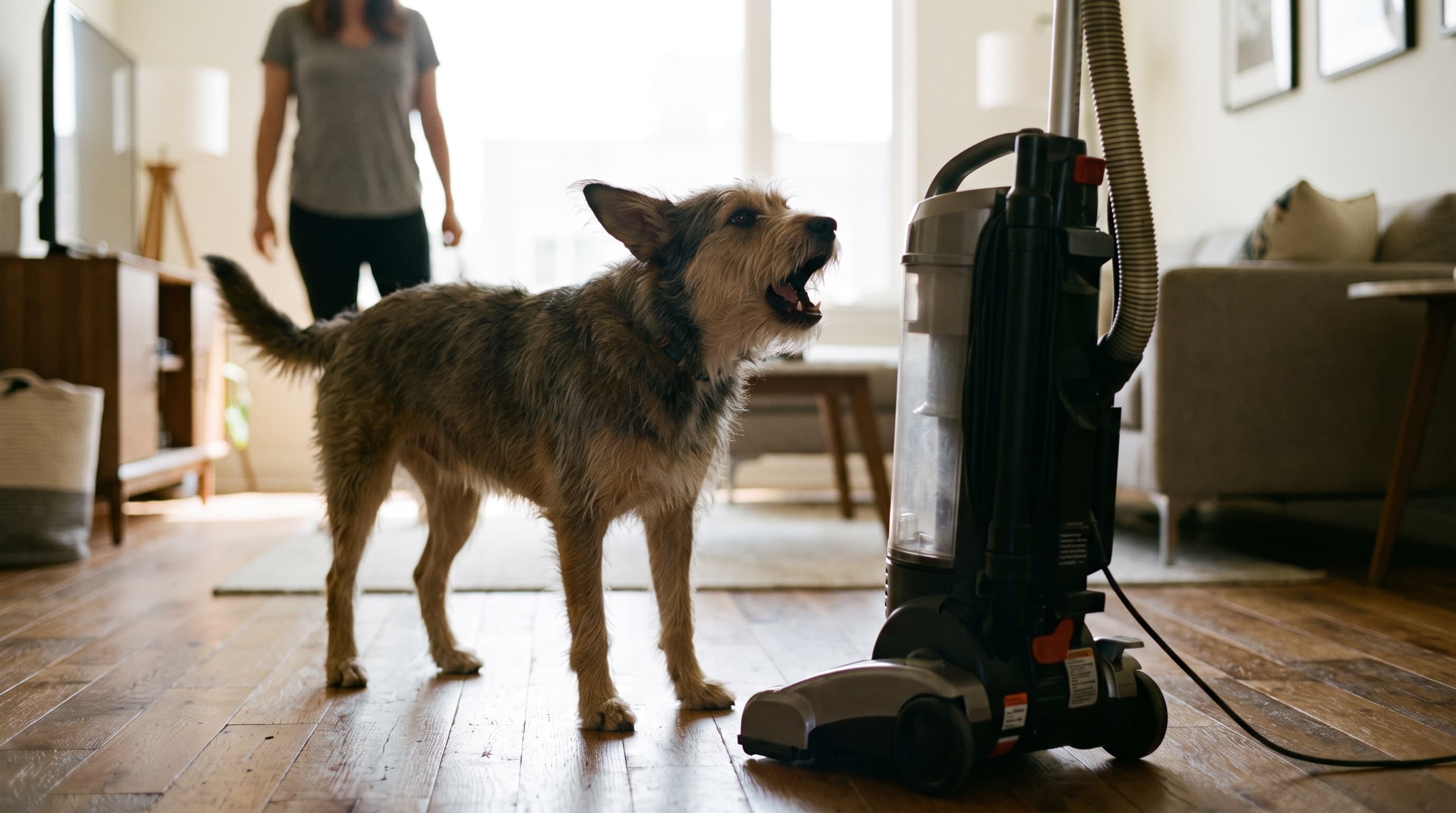

Turn on the vacuum in a lot of American living rooms right now and two things happen at once: the dog loses its mind, and someone reaches for their phone. A goofy little piece of dog-owner theater is having a big moment on TikTok again this week — instead of shushing the barking dog, owners march up to the vacuum, give it a smack, and scold it. "Eh eh! You be nice to my dog. He did nothing wrong!" one owner tells the machine in a clip that circulated on August 28. His dog, Bowie, stops barking almost instantly, sits, and watches quietly.
It is genuinely funny. It also looks like it works. And that combination is exactly why trainers want dog owners to slow down before they adopt it as a fix. Here's what's actually happening when you yell at your vacuum — and what behaviorists say to do instead.
How the "yell at the vacuum" trend took off
The bit isn't new — it just keeps coming back. The version that launched it went massively viral in 2024, when Cody Weishaar filmed himself "disciplining" the vacuum on behalf of his two dogs, Bear and Ellie. That video racked up 13.5 million views, and the premise was pure comedy. "They don't like the vacuum, so we decided to try and discipline it to see if that would help," Weishaar told Newsweek. "I think it worked for Bear, but it definitely didn't work for Ellie."
That split result — one dog calms, one dog keeps barking — is the whole story in miniature, and it's why the trend resurfaces every few months with a new cast of dogs. The comments do half the work. "Guess I have to start lecturing my washing machine now too," one viewer wrote. Owners tag each other, promise to try it on the robot vacuum, and the loop starts again. By late August 2026, "yell at the vacuum for dog" and "dog barking at vacuum trend" were spinning up fresh TikTok discovery pages, with Bowie's clip as the current poster child.
The appeal is obvious. Barking at the vacuum is one of the most universal dog complaints there is, right up there with the separation anxiety and reactivity issues owners wrestle with daily. A fix that's free, instant, and hilarious is going to spread. The question is whether it's actually a fix at all.
Why your dog barks at the vacuum in the first place
To judge the trick, it helps to understand what the vacuum means to your dog. It is not being dramatic. According to a vet-reviewed breakdown from Dr. Paola Cuevas, MVZ, most vacuum barking comes down to a handful of overlapping drivers: outright fear of a loud, unpredictable object; a lack of early desensitization, so an adult dog meets the machine and reads it as a predator; herding instinct in breeds like Border Collies and Australian Shepherds that can't stand a big thing moving erratically across "their" floor; and plain prey drive, since the vacuum's lurching advances and retreats look a lot like something alive.
Layer on the sensory reality. Dogs hear at far lower intensities and higher frequencies than we do, so a noise that's merely annoying to you can be genuinely overwhelming to them — and they feel the vibration through the floor on top of it. From your dog's point of view, a growling monster with no fixed schedule invades the house, roars, and chases furniture. Barking is the alarm. It's fear management, not defiance.
That framing matters, because it changes what "success" should even mean. A dog that goes silent isn't necessarily a dog that feels safe.
Does scolding the vacuum actually work?
Sometimes the barking stops. That part is real, and it's why the videos are so satisfying. But behaviorists say a quiet dog and a calm dog are not the same thing — and the mechanism behind the "win" is not the heartwarming one the caption implies.
Caroline Spencer, a certified dog behaviorist quoted by Newsweek, was blunt about it: "This is not an empathic way of helping a dog." Her bigger concern is what the dog absorbs from the performance. "A dog seeing or experiencing a person's anger will only make them fear the human more," she said. Your dog doesn't parse the joke. It sees you get loud and aggressive near an object it's already frightened of. If the barking stops, that can be a startled, shut-down quiet — the dog reading your worked-up energy and going still — not a dog that has decided the vacuum is fine.
There's a second trap the experts flag. Dr. Cuevas's review notes that "laughing and smiling at your dog's behavior only encourages them" — the exact reaction most owners have while filming. A dog that gets a big animated response when the vacuum comes out may simply learn that the vacuum reliably summons an entertaining show from its favorite person. In other words, the trend can accidentally reward the very barking it's trying to stop.
What behaviorists say to do instead
The good news: there's a boring, well-tested method that actually resolves vacuum fear instead of papering over it. It's the same two-part approach trainers reach for with thunderstorms, fireworks, and doorbells — desensitization and counterconditioning.
The American Kennel Club lays out a simple progression. First, "introduce the vacuum in a controlled environment at a very low volume or a great distance from your dog" — far enough away, or quiet enough, that your dog notices it but doesn't panic. Trainers call this staying "below threshold." Then, "pair the sound of the vacuum with the highest food reward. Do this several times until your dog's reaction changes from unsure and concerned to happy or excited." Only after you get that cheerful, tail-loose response do you "gradually increase the volume of the vacuum in small increments, and repeat."
If your dog tips over into worry at any point, the AKC's guidance is to dial the intensity back down — move farther away, stop the vacuum's movement, muffle it, or turn it off — and return to the level where your dog was comfortable. You're not powering through the fear; you're rewriting the association one small, successful rep at a time until the vacuum predicts chicken instead of chaos.
A weekend starter plan
- Day 1–2: Leave the vacuum out, unplugged, in the middle of the room. Toss treats near it and around it so your dog chooses to investigate on its own terms.
- Day 3–4: With the vacuum still off, have a helper hold your dog across the room while you touch and push it a few inches. Reward calm watching.
- Day 5–7: Run the vacuum for two or three seconds in a far room, then feed a jackpot of treats the moment it switches off. Shorten the distance and lengthen the time only as your dog stays loose and interested.
Consistency beats intensity. Five relaxed minutes a day will move a fearful dog further than one dramatic confrontation ever will.
When to bring in a pro
Done carelessly, exposure work can make things worse — the AKC warns that "most owners are not taking the time to properly teach their pup about a novel stimulus," so fear becomes the default. If your dog's vacuum reaction is severe — panicked flight, snapping, trembling, or refusing to eat even prized treats — that's a sign to loop in your veterinarian or a qualified positive-reinforcement trainer or behaviorist rather than troubleshooting alone. Intense, generalized noise phobia sometimes travels with other anxiety issues that deserve a real plan, not a viral hack.
So go ahead and enjoy the vacuum videos — they're delightful, and Bowie is a very good boy. Just don't mistake a startled hush for a solved problem. Your dog isn't asking you to fight the vacuum. It's asking you to make the scary thing predictable, and that's a job for treats, patience, and a few quiet reps — not a shouting match with an appliance.
For more myth-busting takes on the training trends blowing up your feed — and calm, vet-informed advice you can actually use — keep it locked to Sidewalk Dog.