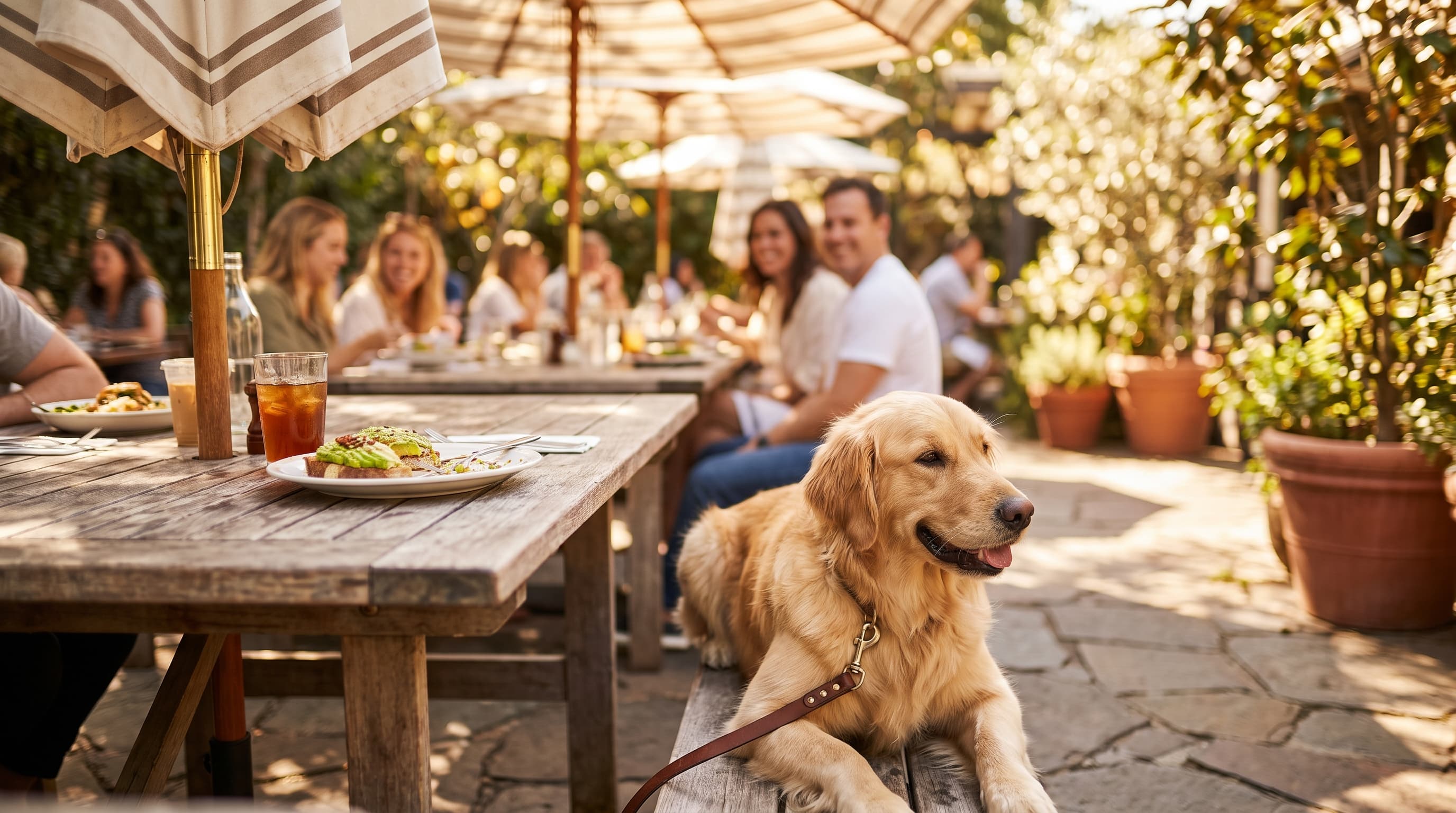

It's the question that surfaces on every warm-weather walk past a bustling restaurant patio: Can I actually bring my dog to that table? This summer, the answer is "yes" in more places than ever — but only if you know the rules. In Salt Lake County alone, health officials have already approved 49 restaurants to legally welcome dogs on their patios for the 2026 season, and the appetite for dining out with a pup is only growing.
According to Lightspeed Commerce's 2026 State of Hospitality report, 45% of restaurant-goers now support letting people bring their dogs to eat — with nearly two-thirds of Gen Z on board, compared with about a third of Baby Boomers. Dogs, in other words, are becoming regulars. Here's how to make sure your four-legged sous-chef is a welcome guest and not a health-code headache.
The short answer: it depends on your state — and the restaurant
There is no single national law that lets dogs eat out with you. Instead, the U.S. runs on a patchwork of state statutes and local health-department rules, and nearly all of them share one crucial feature: they are opt-in. A law permitting dogs on patios doesn't force any restaurant to allow them; it simply gives owners the option to say yes, usually after applying for a variance and passing an inspection.
That means two restaurants on the same block can have opposite policies, and both are following the law. It also means the burden is on you to confirm a spot is genuinely dog-friendly before you show up leash in hand. When in doubt, call ahead — or check a curated local guide like our roundups of dog-friendly restaurants in Chicago and San Diego.
A real-time snapshot: Salt Lake County's 2026 list
Salt Lake County offers a useful window into how these programs actually work. The county's Board of Health first amended its food-sanitation rules to allow dogs on patios back in 2012. That first year, just a dozen restaurants signed up. By the end of 2025, the roster had grown to 65 locations — and the health department has already cleared 49 establishments for the 2026 patio season, with more expected to be added as summer rolls on.
To earn a spot on that list, a restaurant has to do real work: submit a special-processes safety plan, pay an application fee, and pass an on-site inspection of the patio. It's not a rubber stamp — and that's exactly why a county-approved patio is a safer bet than a place that simply hasn't gotten around to posting a "no dogs" sign.
What the rules actually require
The specifics vary by jurisdiction, but the framework is remarkably consistent from Utah to Colorado to New York. Here's what you'll typically find on the books.
What the restaurant must do
- A separate outdoor entrance. Dogs have to be able to enter and exit the patio without walking through the indoor dining room, and self-closing doors usually have to separate the two areas. Colorado's law, Senate Bill 20-078, spells this out plainly: the establishment must have "a separate entrance to the area through which pet dogs may enter and exit without passing through" the restaurant.
- No food prep on the patio. The dog-friendly area can't double as a food-preparation zone.
- Signage. Restaurants generally must post notice that dogs may be present, so other diners aren't caught off guard.
- Extra cleaning. In Salt Lake County, patios must be cleaned with animal-friendly chemicals at the start of each shift or every six hours, and any accident has to be sanitized within five minutes.
- Hands off. Staff typically aren't allowed to touch the dogs, and dogs can't come into contact with dishes or utensils.
What you and your dog must do
- Stay leashed. Nearly every jurisdiction requires dogs to remain leashed (or confined to a carrier) the entire time. In New York State, the health department requires dogs to be leashed whenever they're on the patio floor.
- Bring ID. New York goes a step further, requiring a municipal license tag on the collar. Salt Lake County requires a current license and rabies tags. Keep them on.
- Keep paws off the furniture. Dogs on chairs, benches, or tabletops are a near-universal no. Water is fine — but usually only in a disposable container you bring or the restaurant provides.
- No sharing your plate. Feeding your dog human food at the table is generally prohibited, and it's a fast way to lose the privilege for everyone.
- Own your dog's behavior. Colorado's statute makes it explicit that the owner bears full responsibility for the pet's conduct. A patio pass is a two-way deal.
The state-by-state patchwork
Because there's no federal standard, the details shift as you cross state lines. Colorado's 2020 law is a widely copied model: it lets restaurants opt in statewide but preserves the right of local governments to ban patio dogs entirely within their borders. New York permits dogs on patios but not indoors — unless the animal is a service dog protected under the Americans with Disabilities Act, which is an entirely separate legal category. Utah, meanwhile, delegates the whole program to county health departments, which is why Salt Lake County can publish its own approved list each season.
One important clarification runs through all of these rules: they generally apply to pet dogs only. Service animals covered by the ADA are protected regardless of any patio policy and can accompany their handlers indoors. Emotional-support animals, on the other hand, don't carry the same legal access rights and fall under the same "pet" rules as everyone else's dog.
How to be the dog owner every patio wants back
Rules are the floor, not the finish line. The difference between a restaurant that quietly stops welcoming dogs and one that leans into it often comes down to how well-behaved the four-legged regulars are. A few field-tested habits go a long way:
- Time it right. Skip the Saturday dinner rush for your dog's patio debut. A quieter weekday afternoon means fewer triggers and more patience from the staff.
- Practice a solid "place" and "settle." A dog that can lie calmly under the table for an hour is the gold standard. If yours isn't there yet, do a few low-stakes practice runs at a quiet dog-friendly patio before committing to a full meal.
- Pack the essentials. A collapsible water bowl, a favorite chew to keep them occupied, waste bags, and a mat that signals "this is your spot" can transform the experience.
- Choose a corner. Ask for a table at the edge of the patio, away from the server traffic lane. Fewer legs and food trays passing by means a calmer dog.
- Read the room — and your dog. If your pup is panting hard, lunging, or barking, it's not their day. Leaving early and trying again later is a win, not a failure.
Before you go: a quick checklist
Trending toward a patio meal this weekend? Run through this first:
- Confirm the restaurant is actually dog-approved — call, check their site, or use a trusted local guide.
- Make sure your dog's license and rabies tags are current and on the collar.
- Bring a leash (no retractables on a crowded patio), a water bowl, waste bags, and a chew.
- Feed your dog beforehand so they're not begging, and give them a good walk to burn off energy.
- Know your exit plan in case it's too hot, too crowded, or just too much.
With record summer heat in the forecast, remember that the pavement leading to that patio can burn paws even when the shade feels pleasant — the seven-second hand test on the sidewalk applies here too.
Dining out with your dog is one of summer's simplest joys, and it's more accessible in 2026 than it's ever been. Do it right, and you're not just enjoying a meal — you're keeping those patio gates open for the next dog and owner behind you. For more on where to eat, stay, and roam with your pup this season, explore the rest of Sidewalk Dog — we sniff out the good spots so you don't have to.