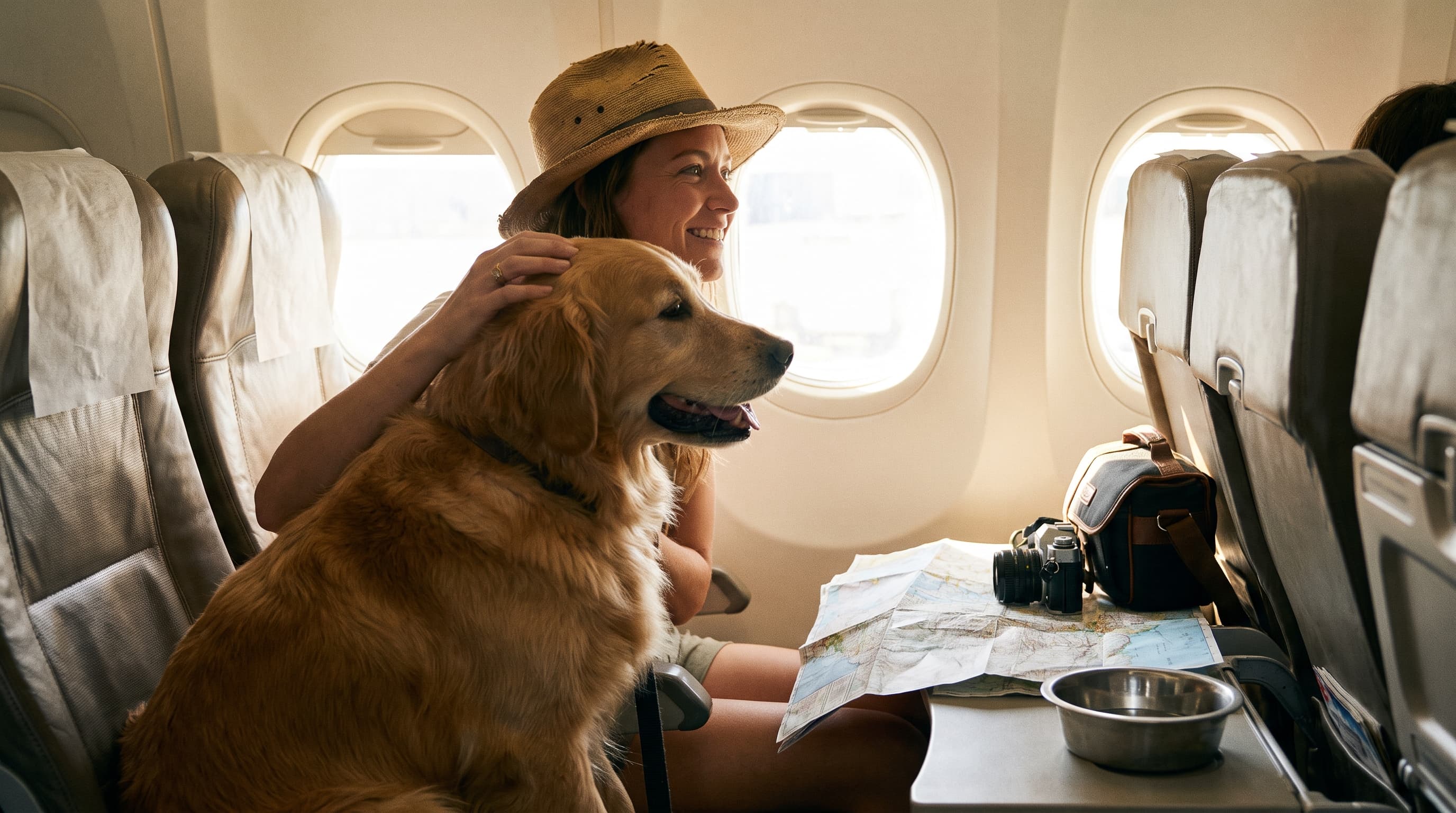

If you own a Lab, a Golden, or any dog that tips the scale past 20 pounds, you already know the drill at the airport: your best friend rides in the cargo hold, in a crate, out of sight for the entire flight. Meanwhile, this summer, a 66-pound retriever in Italy can trot down the jet bridge, settle into a reserved row, and fly beside its owner the whole way. That gap is not your imagination — and it just got a lot wider.
ITA Airways, Italy's flag carrier, has officially launched its "Large Pet Friendly" service for the summer 2026 season, and it is reframing a question American dog owners have been asking for years: if a big dog can safely fly in the cabin in Rome, why not in Raleigh?
What Italy actually changed
After winning approval from ENAC, Italy's civil aviation authority, ITA Airways now allows dogs weighing up to 30 kilograms — roughly 66 pounds — to travel in the passenger cabin on scheduled domestic flights within Italy. For context, that is more than three times the weight most U.S. airlines allow in the cabin today.
The policy didn't appear overnight. It followed a proof-of-concept flight in September 2025 between Milan Linate and Rome Fiumicino that carried two larger dogs — a mixed-breed named Honey and a Labrador named Moka — to demonstrate that transporting bigger animals outside the hold was operationally realistic. Italy's deputy premier, Matteo Salvini, was on board for the demonstration, a signal of how much political momentum the change carried.
ITA frames the shift in unmistakably emotional terms. "This decision stems from listening to our passengers and the understanding that pets are part of the family," said CEO Joerg Eberhart in the carrier's announcement. "We want every journey to begin and end together, without separation."
The fine print matters
Before you book a one-way to Milan, know the limits. The 30-kilogram allowance applies almost exclusively to ITA's domestic Italian routes; on most international flights, the old cabin limit of roughly 12 kilograms still applies. Space is tight, too — each flight can accommodate only about six large animals, seated in designated rows or in a purchased seat. It's a meaningful crack in the door, not a wide-open gate. But it's the most significant move any major European carrier has made toward treating big dogs as passengers rather than cargo.
Why U.S. big-dog owners are stuck
Here's the frustrating part for Americans: it isn't a weight rule keeping your 60-pound dog out of the cabin. It's a carrier rule.
On the major U.S. airlines, an in-cabin pet has to fit inside a soft carrier that slides fully under the seat in front of you — generally no bigger than about 19 by 13 by 9 inches, with the dog and carrier together weighing under roughly 20 pounds. A dog that can't turn around comfortably in that footprint simply doesn't qualify, no matter how calm or well-trained it is. That's why a mellow 50-pound Lab is barred from the cabin while a wiry 18-pound terrier is welcome.
Everything above that threshold gets funneled into cargo, and the requirements there are strict for good reason. Carriers won't fly animals when ground temperatures fall below 45°F or climb above 85°F, the combined dog-and-kennel weight generally can't exceed 100 pounds, and the kennel has to meet airline-grade standards. Cargo also isn't cheap: domestic fees commonly run a couple hundred dollars or more each way, and that's before the stress of watching your dog disappear onto a conveyor belt.
Even the in-cabin option for small dogs adds up. One-way pet fees currently sit around $125 on American and United and about $95 on Delta and Southwest — per direction, on top of your own ticket.
Breed bans stack on top
Weight isn't the only wall. Many carriers restrict or outright refuse brachycephalic (short-nosed) breeds like Bulldogs and Pugs in cargo because of well-documented breathing risks at altitude, and some extend restrictions to breeds labeled "aggressive," a category that has swept in German Shepherds, Rottweilers, and Pit Bull–type dogs. For millions of owners, the practical answer to "can my dog fly with me?" is simply no.
The U.S. workaround is quietly growing
The good news: a small but expanding class of pet-first carriers is treating Italy's headline as a business plan.
The buzziest is RetrievAir, a startup built expressly for people who refuse to put their dogs in cargo. Dogs ride in the cabin tethered to the seat frame by a harness — no hold involved — and, per the airline, dogs under about 75 pounds don't even need a bought seat, while heavier dogs get their own window seat while you take the aisle. After a first year connecting cities like Los Angeles, New York, Chicago, Dallas–Fort Worth, and Denver, RetrievAir is adding Atlanta, San Francisco, Scottsdale, Seattle, Tampa Bay, and Washington D.C. in 2026 — with its inaugural Scottsdale flight already sold out. The catch is price: these fares run well above a standard coach ticket, closer to a premium experience than a budget booking.
Semi-private options exist too. JSX lets dogs up to 65 pounds ride in the main cabin on select routes, typically in the $400–$800 range — closer to a normal fare than a charter, and far cheaper than the private-jet services that start in the thousands.
None of these fully replaces a $200 Southwest ticket. But collectively they're proof that the "big dogs can't fly in the cabin" rule is a business choice, not a law of physics.
What to do this summer if you have a big dog
With roughly 71 million U.S. households owning a dog and pet travel booming, a lot of families are wrestling with this exact question during peak vacation season. A few practical moves:
- Price the pet-first carriers honestly. If RetrievAir or JSX serves both your cities, compare the true cost of a cabin seat against cargo fees plus the peace of mind of keeping your dog beside you.
- Rethink whether you need to fly at all. For big dogs, driving is often the lower-stress, lower-risk choice — and it opens up dog-friendly stops along the way. If your trip is a road trip, our guide to dog-friendly restaurant patios this summer is a good place to start planning meals.
- If you must use cargo, avoid the heat window. Book early-morning or late-evening flights, choose nonstops, and confirm the carrier's temperature embargo before you pay.
- Get your dog carrier-comfortable early. Weeks of positive crate work makes any travel day — cabin, cargo, or car — dramatically easier on your dog.
Will U.S. airlines follow?
Italy's move puts real pressure on the industry. Once one flag carrier proves that a 66-pound dog can fly in the cabin safely and profitably, "it can't be done" stops being a credible answer. Whether U.S. carriers respond will likely come down to demand — and demand is exactly what millions of American big-dog owners have been voting with, one frustrating booking at a time.
For now, the dream of walking your Golden onto a Boeing and buckling in together is a reality in Rome and a startup in the States. But the gap that felt permanent a year ago is starting to look temporary.
At Sidewalk Dog, we track the news, rules, and routes that actually affect life with your dog — so you can spend less time reading fine print and more time on the sidewalk together. Explore more travel and lifestyle guides at sidewalkdog.com.