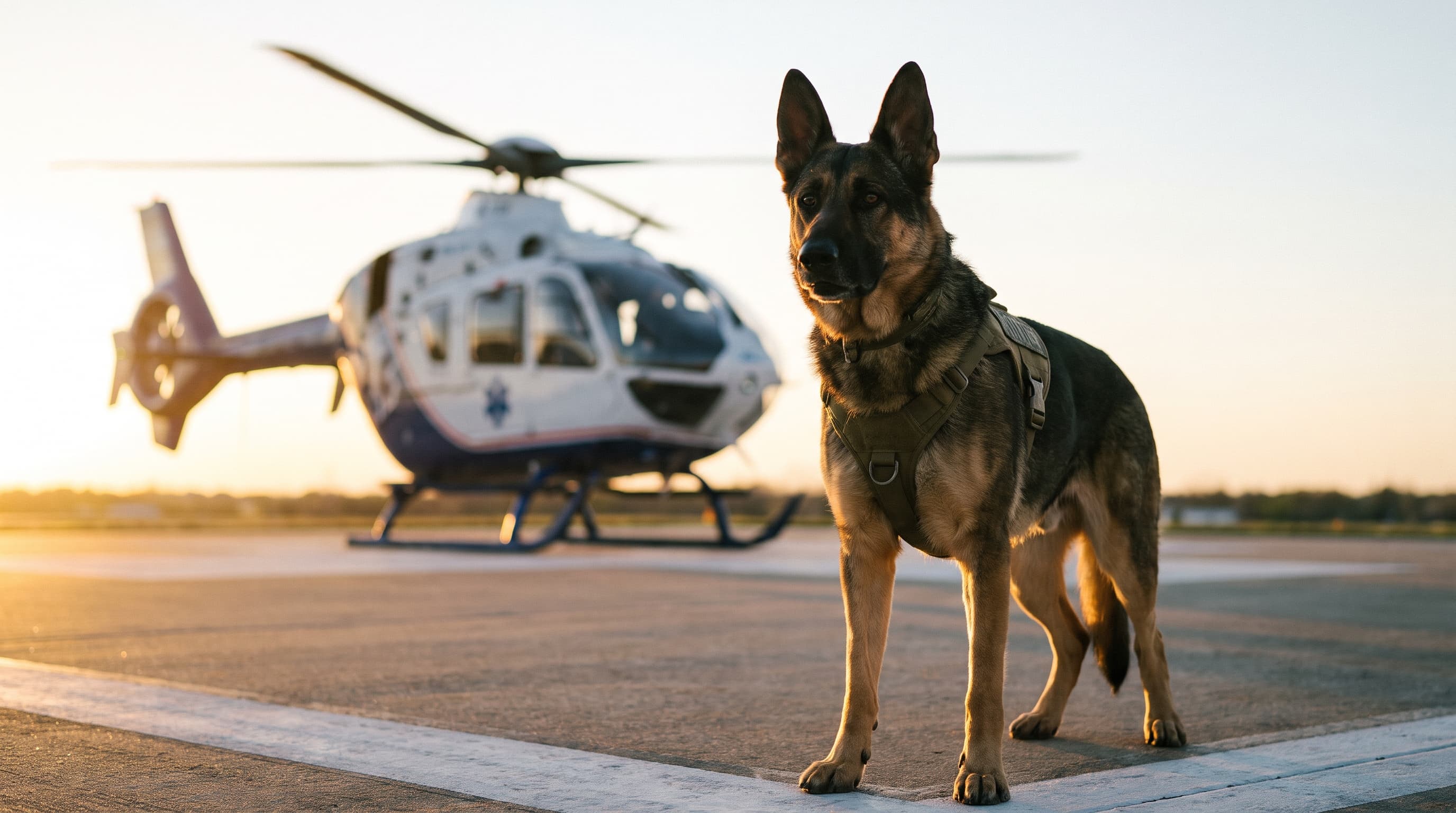

When a police dog is shot, burned, or overcome by heat in a remote corner of northern Michigan, the nearest clinic often can't do much more than stabilize and hope. As of this month, those dogs have a faster way out. A Traverse City flight program has begun flying injured and critically ill police K-9s to advanced veterinary care around the clock — the first service of its kind in the state, with two flight nurse paramedics on board who can treat the dog in the air.
It's a small program with an outsized message: the animals we ask to run toward danger are finally getting an emergency system built around them. Here's what's actually happening, why air transport matters so much for a working dog, and what it quietly says about the gap between how we treat police dogs and how the law has long defined them.
What North Flight Aero Med is actually doing
The program runs through North Flight Aero Med, the Traverse City–based air medical service, and was developed alongside Munson Healthcare, Corewell Health, and Michigan State University. It is now flying injured police dogs 24 hours a day, with Michigan State University's veterinary hospital as the primary destination for the most serious cases.
That destination matters. “Clinics cannot provide some of the critical care that needs to be done when these officers are injured,” Leslie Schutte, the program's clinical flight operations manager, told reporters, adding that MSU “is really the go-to location for those officers.” In other words, the problem was never a lack of expertise in the state — it was distance. A dog hurt two or three hours from a specialty hospital doesn't have two or three hours.
The flight crews are equipped to handle the injuries a K-9 is most likely to suffer on the job: trauma, burns, poisonings, and heat-related emergencies. Because two flight nurse paramedics ride along, care starts the moment the dog is loaded rather than when it lands.
How a handler calls for it
The activation chain is deliberately simple, because in a crisis simple is what works. A K-9 handler contacts dispatch in their region, dispatch reaches the flight communications team, and that team activates the emergency response — the same backbone that already moves critically injured people across northern Michigan, now opened up to the dogs who serve alongside officers.
Why air transport is a bigger deal than it sounds
If you've never thought about how an injured police dog gets to a vet, you're not alone — and that's the point. For most of American history, there was no plan at all. A wounded K-9 was loaded into the back of a patrol car and driven, often by a handler in shock, to whatever clinic happened to be open.
For a working dog, the clock is brutal. The single most common way police dogs die on the job isn't gunfire — it's heat. A study cataloging 96 K-9 line-of-duty deaths between 2011 and 2015 found heat exhaustion was the leading cause, ahead of gunfire and automobiles, with roughly 29% of deaths tied to overheating. Many of those dogs died after being left in hot patrol cars. Heatstroke and severe trauma share a cruel feature: survival is measured in minutes, and the right equipment in the first hour changes everything.
That's the quiet logic behind a helicopter. It isn't about spectacle. It's about collapsing a 150-mile drive into a short flight while a trained medic manages the dog's airway, cools its body, or controls bleeding en route. For a species that can slide from “distressed” to “critical” faster than a person, that compression of time is the whole ballgame.
The law is finally catching up to the dog
Here's the part that surprises most owners: for decades, it was often illegal for an ambulance crew to touch an injured police dog. Emergency medical systems were built for humans, and the statutes that govern them frequently left no room for a four-legged patient, no matter how dire.
Michigan began closing that gap in 2018. Under Public Act 600, which took effect in March 2019, ambulances in the state may transport an injured police dog to a veterinary clinic — but only when the dog needs emergency treatment and no person requires that ambulance at the same time. People come first, always; the law simply stopped forcing crews to leave a bleeding dog behind when no one else needed the ride.
Michigan wasn't alone. Massachusetts passed one of the most widely cited versions, “Nero's Law,” in 2022, letting EMS crews provide first aid and transport to injured K-9s. It's named for Nero, the dog partner of Yarmouth Sergeant Sean Gannon, who was killed in the line of duty in 2018; Nero was shot too, and under the rules at the time, EMTs weren't permitted to treat or move him. A growing number of states have since adopted similar “pre-veterinary care” measures.
Michigan's new air program is the next rung on that ladder. The 2018 law said an ambulance could carry a hurt police dog; the flight service answers the harder question of what happens when the dog is too far from the care it needs to survive the drive.
Why this is more than a feel-good story
There's an uncomfortable backdrop here. In much of the country, police dogs are still legally classified as equipment rather than officers, and many retire with no pension and no guaranteed help with veterinary bills. Programs like North Flight Aero Med push against that framing in the most concrete way possible — by treating a K-9 in crisis like a patient worth flying.
What this means for your dog, even if it never wears a badge
Most of us will never dispatch a helicopter for our dogs. But the thinking behind this program is exactly the thinking that saves ordinary pets, and it's worth borrowing.
Know your emergency plan before you need it. The K-9 system works because the route to advanced care is mapped out in advance. Do the same at home: find your nearest 24-hour emergency and specialty veterinary hospital today, save the address and phone number in your phone, and know roughly how long the drive takes. In a real emergency, you will not want to be searching.
Respect heat the way the professionals do. If overheating is the top killer of athletic, superbly conditioned police dogs, your pet is not somehow immune. Never leave a dog in a parked car, watch for heavy panting, bright-red gums, wobbliness, or collapse, and treat those signs as the emergencies they are.
Learn the basics. The flight medics buy time with airway management and cooling; you can buy time too. A short pet first-aid course and a stocked kit — plus knowing how to recognize bloat, heatstroke, and shock — turn a panicked owner into a useful one.
The real headline isn't the helicopter. It's the shift in how we value the dogs in our lives — from property we transport when it's convenient to patients we fight to save. A northern Michigan flight crew just made that shift literal. The rest of us can make it at home, one emergency plan at a time.
At Sidewalk Dog, we cover the people, policies, and research shaping life with dogs — and the everyday moves that keep yours safe. Browse our latest stories and keep your pup's emergency plan one step ahead.