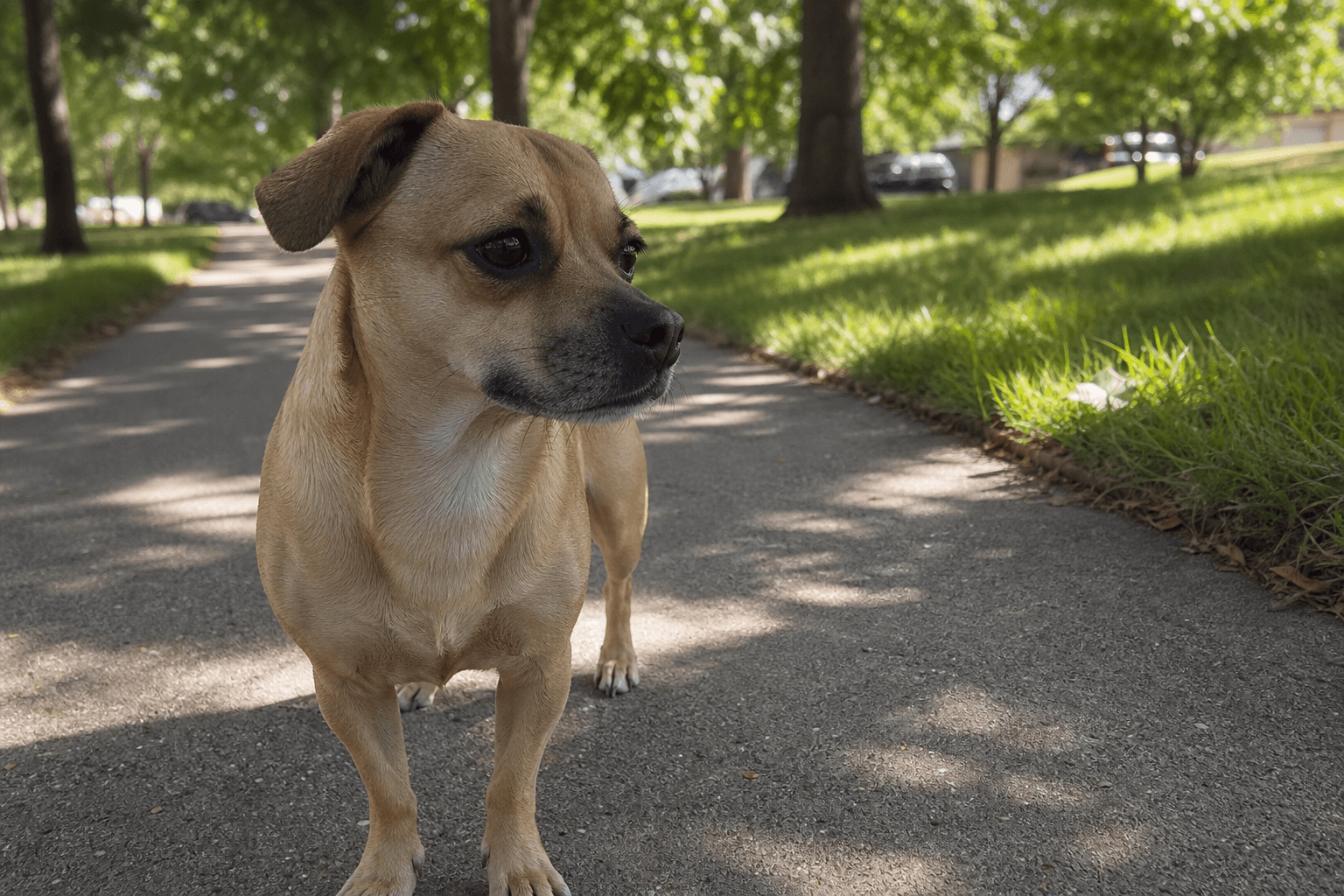

If you own a Pug, a French Bulldog, a Boston Terrier or any other short-muzzled dog, you have probably had the conversation. Someone hears your dog snore from across the room and asks, half-joking, whether that's normal. And you have probably wondered yourself.
A study published in early August 2026 in the journal Animal Welfare gives that question an unusually clear answer — and it is not a comfortable one for flat-faced breeds. Researchers at the Royal Veterinary College (RVC), working with Paragon Veterinary Referrals, EviVet Evidence-Based Veterinary Consultancy and Blue Cross, examined 150 pet dogs in the UK and compared purebred Pugs against two popular "designer" Pug crosses: the Jug (Pug x Jack Russell Terrier) and the Puggle (Pug x Beagle).
The gap was enormous. Nearly half of the purebred Pugs — 47.1% — were diagnosed with severe airway disease. Every single purebred Pug was graded as having some degree of affected breathing. Among the crosses, all of the Jugs and all but one of the Puggles were graded as unaffected.
That single generation of outcrossing did something no amount of owner effort can do: it gave the dogs a longer nose.
What the study actually measured
This was not an owner-opinion survey. Between November 2023 and September 2024, researchers recruited 51 purebred Pugs, 51 Jugs and 48 Puggles from the UK pet-owning population. Every dog got a hands-on veterinary assessment covering respiratory, eye, dental, skin and neurological problems, plus a formal Respiratory Function Grading Scheme (RFGS) assessment — the standardized exercise-based test used to grade brachycephalic obstructive airway syndrome, or BOAS. Owners separately completed validated questionnaires on health history, veterinary spending, quality of life, behavior and their relationship with the dog. Researchers also measured body shape: skull proportions, relative muzzle length, nostril openness and skin folds.
The findings, in the researchers' own summary, showed "major improvements" in the crosses:
- Breathing: 47.1% of purebred Pugs had severe airway disease; 100% were graded as affected. Nearly every Jug and Puggle was graded unaffected.
- Nostrils: severe nostril narrowing (stenotic nares) appeared only in purebred Pugs, affecting more than one in five (21.6%) of them.
- Skin: every purebred Pug had nasal skin folds, versus 15.7% of Jugs and 27.1% of Puggles. Nasal fold dermatitis affected 38.3% of Pugs, 2% of Jugs and none of the Puggles.
- Everyday function: 51% of Pug owners reported breathing, heat-regulation or exercise problems — compared with 2% of Jug owners and 4.2% of Puggle owners.
- Eyes and orthopedics: Pugs showed significantly more eyelid abnormalities (entropion and ectropion) and more orthopedic and neurological abnormalities on exam.
- Cost: purebred Pugs accrued substantially higher veterinary costs — a reported average of about £45 per month, versus roughly £10 for the crosses.
- Quality of life: 58.8% of Pug owners rated their dog's quality of life as "excellent," versus 92.2% of Jug owners and 81.2% of Puggle owners.
Statistically, the strongest single thread running through the data was muzzle length. Longer relative muzzle length was strongly associated with lower odds of respiratory disease. The crosses did not get healthier because they were crossbred as such — they got healthier because they got more nose.
The part that surprised people: personality didn't change
The common worry about outcrossing a companion breed is that you lose what people love about it. The study found the opposite of a loss: behavior profiles and dog-owner relationship quality were similar between the purebred Pugs and the crosses. The affectionate, people-oriented, velcro-dog temperament that draws people to flat-faced breeds in the first place survived the cross intact.
Lead author Dr. Rowena Packer framed the welfare stakes plainly: improving the wellbeing of dogs with extreme conformations is one of the biggest challenges in the dog world, and the data suggest that moving away from breed purity can be a fast route to intrinsically healthier dogs.
It is worth saying clearly what this study is and is not. It is a single, relatively small sample of UK pet dogs, focused on one brachycephalic breed and two specific crosses. It does not tell you that every "designer" mix is healthy, and it does not settle the broader ethical debate about how dogs should be bred — a debate where reasonable people, including breeders, rescuers and veterinarians, land in very different places. An earlier RVC survey published in PLOS One in January 2026 found the UK public genuinely split on whether crossbreeding flat-faced dogs helps or hurts.
Why this matters a lot in the U.S. right now
The French Bulldog was named America's most popular breed for the fourth straight year by the American Kennel Club in March 2026. Flat-faced dogs are not a niche; they are the mainstream. And even AKC leadership has been notably direct about it — AKC President and CEO Gina DiNardo said the French Bulldog "is not a 'one size fits all' breed," adding that "popularity does not mean it's right for everyone."
The health record backs up the caution. A separate RVC VetCompass study comparing 2,781 French Bulldogs with 21,850 other dogs in UK primary care found Frenchies at increased risk for 20 of 43 common disorders tracked — roughly 46% of them — including BOAS, skin fold dermatitis, ear infections, conjunctivitis, corneal ulceration and patellar luxation. Research in Acta Veterinaria Scandinavica found a 52.7% recurrence rate after a first surgically treated intervertebral disc disease episode in French Bulldogs, with a median age at first diagnosis around four years.
Translated into a household budget: insurance analyses put French Bulldog premiums at or above the breed average precisely because the risk profile is so well documented, and BOAS corrective surgery commonly runs in the low thousands of dollars. Some insurers write brachycephalic airway conditions out of coverage entirely, or classify them as pre-existing if signs appeared before the policy started.
If you already own a flat-faced dog: a five-minute home check
Nothing in this research is a reason to feel bad about the dog asleep next to you. It is a reason to stop treating noisy breathing as a personality quirk. Veterinary specialists at the University of Cambridge's BOAS research group list the signs owners should learn to recognize — and "he's always snored" is on the list, not off it.
Watch and listen for:
- Respiratory noise — snoring, snorting or stertor, especially if it happens at rest and not just during excitement
- Visibly narrowed nostrils that pinch closed on inhale
- Gagging, retching or regurgitation, particularly around meals
- Refusing or slowing down on walks your dog used to handle
- Overheating fast in mild weather
- Restless, position-shifting or apnea-like sleep — sleeping propped up or with a toy under the chin is a red flag, not a cute habit
- Blue or gray-tinged gums or tongue, or collapse, during exertion. This is an emergency.
Do: keep your dog lean — weight is the single biggest modifiable factor in airway signs; walk in the cool hours; use a harness rather than a neck collar; ask your vet for a functional RFGS-style breathing assessment rather than a glance in the exam room; and get an airway evaluation before any elective anesthesia, since brachycephalic dogs carry higher anesthetic and aspiration-pneumonia risk.
Don't: assume surgery is either unnecessary or a magic fix. Reviews in Today's Veterinary Practice report that most dogs improve meaningfully after soft palate and nostril surgery, with complications in up to a quarter of cases and best outcomes when it is done young — often around one to two years old, before secondary changes like laryngeal collapse set in. And don't muscle through a hot day because your dog "seems fine." Heat-related illness in brachycephalic dogs has been documented at more than four times the odds of other dogs.
If you're choosing a dog: questions that actually predict health
The muzzle-length finding hands prospective owners something genuinely useful — a visible, checkable proxy instead of a marketing claim.
- Look at the nose, not the label. "Designer cross" on a listing guarantees nothing. Some crosses inherit the flat face anyway. Ask to see the puppy's parents and look at relative muzzle length and open nostrils on both.
- Ask for the parents' breathing grades. Responsible breeders of brachycephalic breeds can produce RFGS or equivalent functional airway assessments for the sire and dam. "They breathe fine" is not a grade.
- Ask about eyes, skin folds and spines, not just hips. Entropion, fold dermatitis and IVDD are where the money and the suffering actually go.
- Meet the temperament you want in an adult. Since the study found behavior held steady across purebreds and crosses, you do not have to trade personality for a working airway.
- Look at shelters and breed rescue. Pug and Frenchie mixes turn up regularly, already grown, with a known breathing history you can watch in real time.
The bottom line
This study does not tell anyone which dog to love. It tells us something more specific and more useful: in flat-faced dogs, a longer nose is not a cosmetic detail, it is a health outcome — and it can change in a single generation without changing the dog's heart. If you own one of these dogs, the takeaway is not guilt. It is a vet visit where breathing gets measured instead of mentioned.
At Sidewalk Dog we spend a lot of time helping owners get their dogs out into the world — patios, trails, festivals, road trips. For a flat-faced dog, knowing exactly how much air your dog can move is what makes all of that safe instead of risky. Check our city guides for shaded, low-key dog-friendly spots near you, and save the long midday adventures for the dogs built for them.