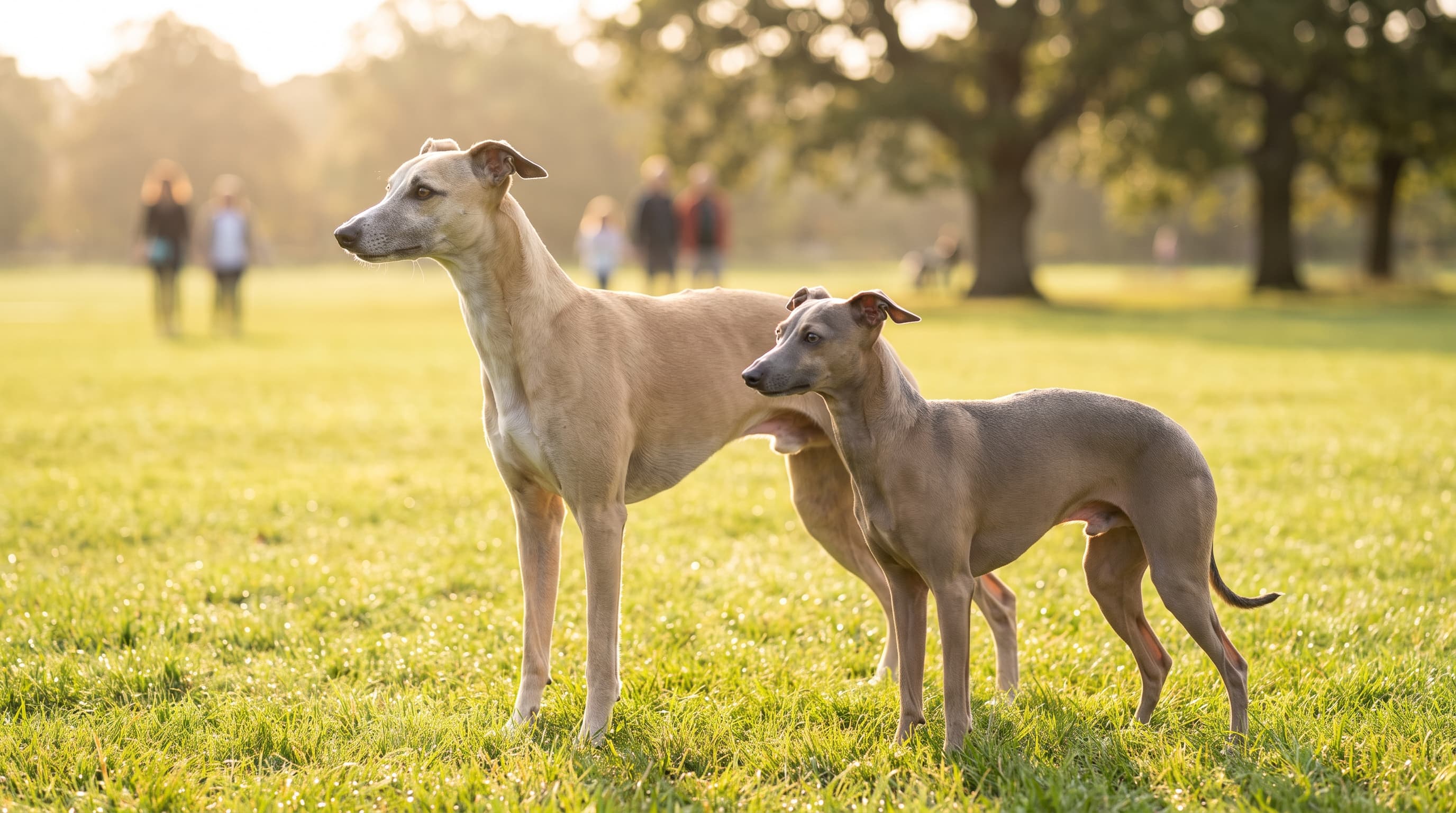

The whippet vs italian greyhound question comes down to size, energy, and lifestyle. Whippets stand 18-22 inches and weigh 25-40 lb, needing daily off-leash sprints and structured exercise. Italian Greyhounds stand 13-15 inches and weigh 7-14 lb, thriving as apartment lap-warmers with shorter zoomies. Both are gentle, quiet sighthounds — the winner depends on your space, activity level, and how much dog you actually want.
Side-by-Side Snapshot
- Whippet: 18-22 in tall, 25-40 lb, 12-15 yr lifespan, medium-energy, 45-60 min daily exercise, AKC Hound Group.
- Italian Greyhound: 13-15 in tall, 7-14 lb, 14-15 yr lifespan, moderate energy, 20-40 min daily exercise, AKC Toy Group.
Both share the classic sighthound silhouette — deep chest, tucked belly, arched back, whip-thin tail — because they descend from the same ancient coursing family. The American Kennel Club places them in different Groups for a reason: the whippet was bred to work (rabbit coursing, rat catching, then racing), while the Italian Greyhound was bred to charm royalty from a velvet cushion.
History: Working Sprinter vs. Renaissance Companion
The Italian Greyhound is the older of the two. Small greyhound-type dogs appear in Mediterranean art going back more than 2,000 years — miniaturized sighthounds were prized companions in ancient Egypt, Greece, and later throughout Italian and European courts. By the Renaissance the breed was a fixture in noble portraits, including Frederick the Great and Queen Victoria's household.
The whippet is a comparatively modern breed, developed in 19th-century northern England when working-class miners crossed small greyhounds with terriers and later Italian Greyhounds. The result was a fast, affordable, easy-to-feed dog that could win rabbit-coursing bets on a Sunday afternoon. Dogster's breed history calls the whippet the "poor man's racehorse" for exactly this reason.
Size and Build: Almost Triple the Dog
Size is the loudest difference. A large whippet can outweigh an Italian Greyhound by 25-30 lb — nearly triple the mass. That changes almost every practical thing about ownership: crate size, car harness class, food bill, jacket sizing, and how much couch real estate they claim.
Bone structure also differs. Italian Greyhounds have famously thin legs, which look elegant but do fracture more easily than a whippet's. Vets frequently see IG leg fractures from falls off couches or awkward jumps out of car doors, especially in dogs under 10 months. Canine Journal's IG safety notes flag jump-related fractures as the single biggest health concern for the breed.
Temperament: Both Gentle, Slightly Different Flavors
These two breeds are among the calmest indoor dogs you can own. Both love a warm blanket, both have short bursts of zoomies, and both are famously quiet — barking is minimal in both breeds compared to terriers or herding dogs.
Whippet personality
Whippets are easygoing, athletic, and affectionate without being clingy. They handle routine solo time better than IGs, especially if they've had a run first. Around strangers they're polite but reserved — not friendly-golden-retriever, more well-mannered-librarian. Around other dogs, they're generally social but should not be trusted with small pets outdoors because their prey drive is real.
Italian Greyhound personality
IGs are more sensitive and more "velcro." They bond intensely to one or two people, mirror household moods, and struggle more with change. Separation anxiety is a well-known breed quirk — a full workday alone without prep is often too long. On the flip side, that sensitivity is exactly what makes them extraordinary companions for people who work from home or want a dog that's always within arm's reach.
Exercise Needs: 60 Minutes vs. 30 Minutes (Ish)
A common myth: because sighthounds sleep 18 hours a day, they need no exercise. Not true — both breeds need to run, they just don't need long marathon walks.
- Whippet daily minimum: a 20-30 min walk, plus 15-20 min of true sprinting in a fenced area or on a long line. Weekly sport (lure coursing, FastCAT, agility) is a bonus that keeps them mentally sharp.
- Italian Greyhound daily minimum: a 15-20 min walk plus a few short indoor or fenced-yard sprints. Weather matters — IGs shiver in anything under 50°F and often refuse rainy walks.
Both breeds should stay leashed or fenced. A whippet in prey drive can hit 35 mph in a few strides; an IG in prey drive is smaller but no easier to catch. Neither breed has reliable off-leash recall in the presence of a squirrel.
Grooming and Living Care
Grooming is almost identical: single, short, close coat; a weekly rubdown with a rubber mitt handles shedding. Both breeds shed lightly year-round, without the seasonal blowouts you get from double-coated dogs. Neither is hypoallergenic in the technical sense, but many mild-allergy owners tolerate them well.
Cold sensitivity is where they diverge. A whippet handles typical fall weather in a fleece; an IG often needs an insulated coat and paw balm below 45°F. Both benefit from a bed with sides or a cave-style cushion — sighthounds love to burrow.
Health: Long-Lived Sighthounds, Different Risk Lists
Both breeds are relatively healthy, with lifespans that beat most similar-sized dogs. Common issues:
- Whippets: Deafness (less than 1% but breed-linked), mitral valve disease in seniors, exercise-induced injuries, occasional bloat.
- Italian Greyhounds: Leg fractures (juveniles especially), dental disease (crowded small mouths need brushing 4-5x weekly), luxating patellas, hypothyroidism, epilepsy in some lines.
Both breeds are exceptionally sensitive to anesthesia — their low body fat clears drugs differently. Always confirm your vet has sighthound-specific anesthesia protocols before any procedure.
Health information here is general education, not a substitute for veterinary advice. Talk to your vet about screening tests and preventive care for your specific dog.
Cost, Availability, and Finding One
Whippet puppies from health-tested breeders typically run $1,500-$3,000. Italian Greyhound puppies run $1,500-$3,500, sometimes higher for show lines. Adoption is realistic for both — sighthound-specific rescues place adults and seniors regularly, often for $300-$500 including vet work.
Availability leans slightly whippet — there are more of them in the U.S. and rescues turn over faster. If you're new to sighthounds, an adult rescue is one of the easiest ways to learn breed traits without the fragile-puppy learning curve.
Which One Is Right for You?
Pick the whippet if you:
- Have a fenced yard or reliable off-leash space
- Want a medium-size dog that's an athletic partner
- Work outside the home some days and need a dog that handles it
- Live in a house with kids over 6 who can respect a resting dog
Pick the Italian Greyhound if you:
- Live in an apartment or small home (see our best dogs for apartments guide)
- Work from home or have a dog-friendly workplace
- Want a genuine lap dog that folds into your life
- Are okay with cold-weather gear and jump-proofing your furniture
Comparison to Their Bigger Cousin
If you're also weighing the standard Greyhound, our whippet vs greyhound guide covers that head-to-head. In short: Greyhounds are calmer, longer, and heavier than whippets and generally do better in slower households. For a deeper look at each breed individually, see our full whippet breed profile and Italian Greyhound breed profile.
Frequently Asked Questions
Are whippets and Italian Greyhounds the same breed?
No. They share ancestry and body type but are distinct AKC-recognized breeds with different sizes, temperaments, and histories. The whippet is in the Hound Group; the Italian Greyhound is in the Toy Group.
Which is better for apartment living?
Italian Greyhounds edge out whippets for apartments because of size, quieter energy, and shorter walk requirements. Whippets can live in apartments successfully if the owner commits to daily sprints and mental enrichment.
Are Italian Greyhounds just mini whippets?
They look similar but weren't developed from whippets — the direction was the reverse. Italian Greyhounds are one of the ancestors of modern whippets, along with terrier crosses. Calling an IG a "mini whippet" is a common mistake, though a fair visual shortcut.
Do whippets or Italian Greyhounds shed more?
About the same — both shed lightly year-round without seasonal blowouts. Weekly grooming keeps loose hair off the furniture in either case.
Which breed lives longer?
Italian Greyhounds average 14-15 years; whippets average 12-15 years. Both are among the longest-lived breeds in their size class, and well-cared-for individuals often push past those numbers.
Are they good with kids?
Both can be great with respectful older kids. Whippets are physically more durable and handle rough-and-tumble better; Italian Greyhounds are fragile and better matched to calm households or families with kids old enough to be gentle with tiny dogs.
Can either breed be trusted off-leash?
Neither, in an unfenced environment with wildlife or open space nearby. Both have strong sight-driven prey drive that can override even excellent training in a fraction of a second.
Final Take
Whippet vs Italian Greyhound isn't a better-or-worse question — it's a which-life-do-you-live question. Whippets are couch potatoes with an athlete's body; IGs are athletes in a lap-dog package. Match the breed to your daily rhythm, your temperature preferences, and how much fragile-dog handling you're up for, and either one will repay you with a decade-plus of quiet, devoted company.
Love thoughtful breed guides like this? Explore our full whippet and Italian Greyhound profiles, and subscribe to the Daily Wag newsletter for a weekly dose of breed deep-dives and dog-nerd reading.