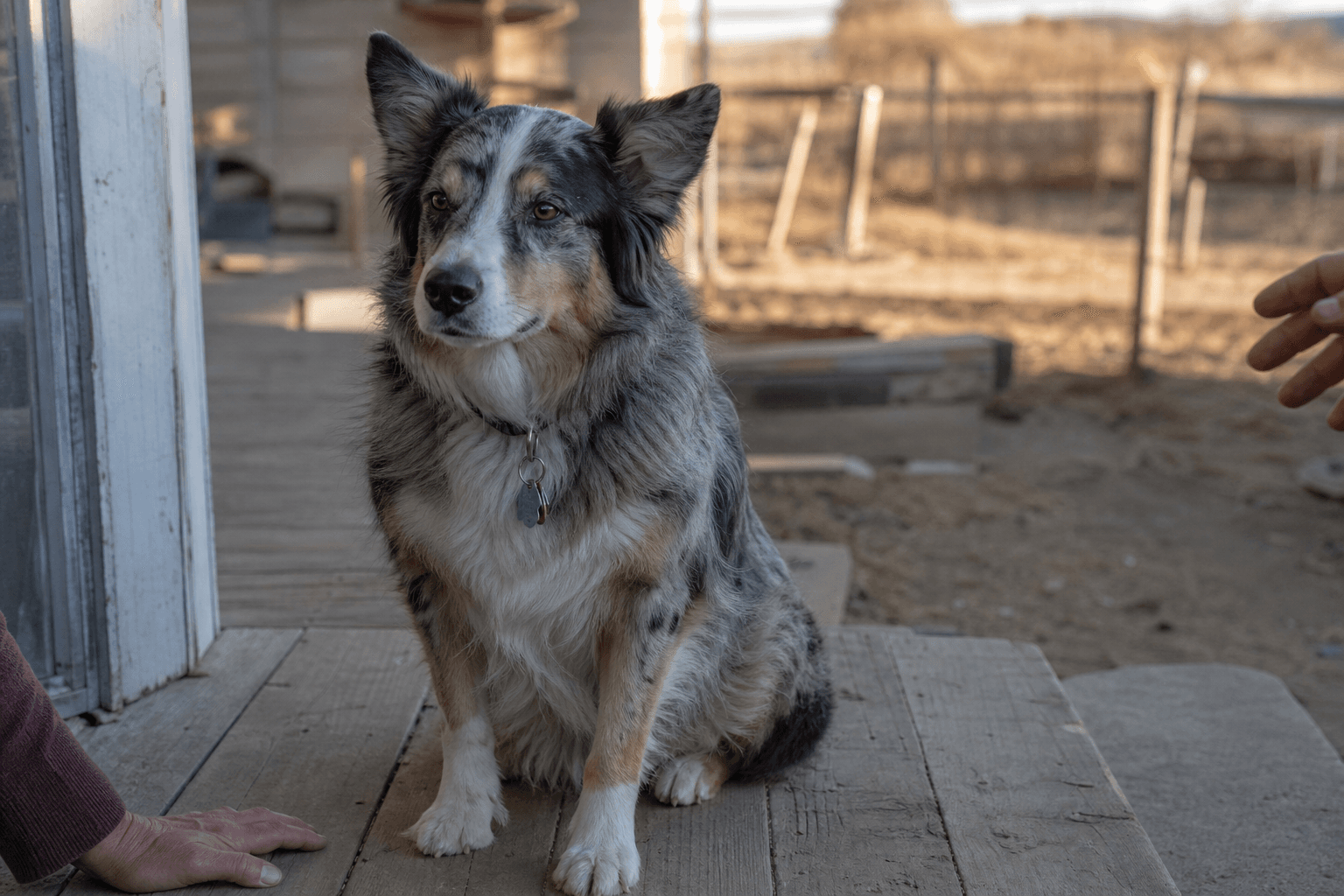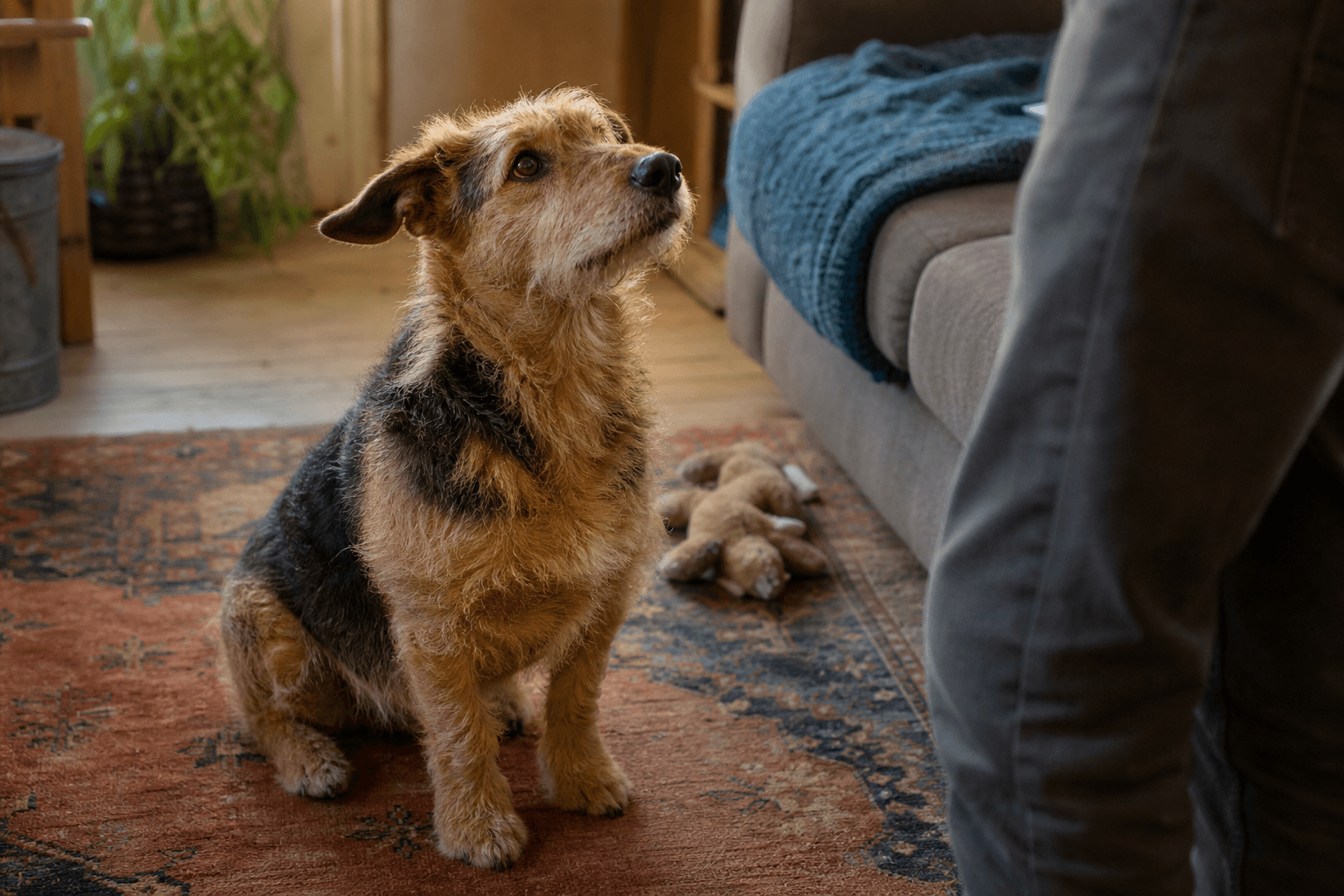

If you have ever suspected your dog knows the difference between the day you are frightened and the day you are just sad, there is now brain-scan evidence on your side.
In a study published August 7, 2026 in the Cell Press journal iScience, researchers slid awake, unrestrained pet dogs into an MRI scanner and showed them photographs of human faces — happy, neutral, angry, fearful, sad — while recording what lit up inside. The headline finding: dogs' brains do not simply sort us into "good human" and "bad human." For the first time, scans showed distinct neural patterns separating human fear from sadness and from anger.
"Humans are really good at picking up small details on the face, and so are dogs," said first author Raúl Hernández-Pérez, a neuroscientist at the University of Vienna, in a statement released with the study. "This makes dogs very interesting. By studying their brains, we can understand what adaptations have developed to support their remarkable social and emotional understanding of humans."
It is a genuinely charming result. It is also smaller and more specific than the "your dog reads your mind" headlines suggest — and the practical takeaway for owners is less about what your dog can perceive and more about what you are broadcasting all day without noticing.
What the study actually did
The work came in two parts, both using awake canine fMRI — pet dogs trained to lie still in a scanner without sedation, which is its own small miracle of positive-reinforcement training.
In the first experiment, eight dogs viewed photos of strangers wearing either happy or neutral expressions. Happy faces activated two regions: the temporal cortex, involved in higher-order sensory and cognitive processing, and the caudate nucleus, a core part of the reward system.
"The activity in the caudate nucleus is particularly interesting," said co-author Laura Cuaya of the University of Vienna, who began the research at the National Autonomous University of Mexico and expanded it through a collaboration at Eötvös Loránd University in Hungary. "It suggests that happy human faces may have emotional significance for dogs." In plain terms: a smiling human face appears to register in a dog's brain somewhere near the same neighborhood as good things happening.
In the second experiment, 12 dogs saw faces expressing happiness, anger, fear and sadness, and the team used machine-learning classifiers to test whether brain activity could be told apart emotion by emotion. That temporal-cortex-and-caudate network responded uniquely to happiness — smiles were easy to separate from all three negative expressions.
Then came the new part. A whole-brain analysis found separate regions carrying the distinction between negative emotions: activity in the right rostral suprasylvian gyrus distinguished fear from sadness, and the right mid ectosylvian gyrus plus the left splenial gyrus distinguished fear from anger.
The honest caveats
Three limits matter, and any article that skips them is selling you something:
- The samples were tiny. Eight dogs, then 12. This is proof-of-concept neuroscience, not a population estimate.
- Anger and sadness were not distinguishable. The analysis found no brain region reliably separating those two. Fear was the emotion that stood out — possibly because fear and threat cues are simply more attention-grabbing, as University of Melbourne canine science researcher Mia Cobb noted in an analysis for The Conversation.
- Distinguishing is not understanding. A different brain pattern for fearful faces does not prove your dog knows you are afraid, or why, or what to do about it. It proves the information is not being thrown away.
The bigger picture: your dog is reading you constantly
The iScience result lands on top of a decade of converging evidence that dogs are unusually tuned to human emotional signals.
A 2015 Current Biology study from Ludwig Huber's group in Vienna showed dogs could learn to discriminate happy from angry human faces — and generalize it to faces and face-halves they had never seen. A 2020 Scientific Reports study combining fMRI, eye-tracking and preference tests found that seeing their own caregiver's face activated emotion- and attachment-related brain regions in dogs, while a stranger's face mostly triggered visual and motor processing. And a study of 91 dogs found they could pick up emotional information from an interaction between two strangers and then change their own decision-making about approaching food based on it.
The most useful study for daily life, though, may be the oldest of the bunch. In 2019, zoologist Lina Roth and colleagues at Sweden's Linköping University measured hair cortisol — a record of stress over months, not minutes — in 58 dog-owner pairs of border collies and Shetland sheepdogs. Owner cortisol and dog cortisol correlated strongly in both summer and winter samples. Dogs' activity levels and training volume did not explain it. Owner personality traits did.
Critically, the effect ran one way. "Dogs are quite good at understanding humans," Roth told National Geographic. "They're definitely better at understanding us than we are at understanding them." Anxious owners had chronically stressed dogs; anxious dogs did not produce chronically stressed owners. Two breeds, one country, 58 pairs — again, not the final word. But combined with the new brain data, the picture is consistent: emotional information flows downhill from us to them.
What to actually do with this
You cannot stop having feelings, and you should not try. What you can do is manage the moments where your emotional state gets loaded onto your dog with consequences.
1. Audit your three highest-leakage moments
For most owners, the same handful of situations account for nearly all emotional spillover:
- Departures. Guilty, drawn-out goodbyes give a worried dog a long, escalating cue that something bad is coming. Keep leaving boring and brief.
- Vet visits. Your tight leash and held breath in the waiting room are data to your dog. Notably, a 2020 JAVMA study found dogs showed fewer fear behaviors during routine exams when their owner stayed in the room — presence helps, tension does not.
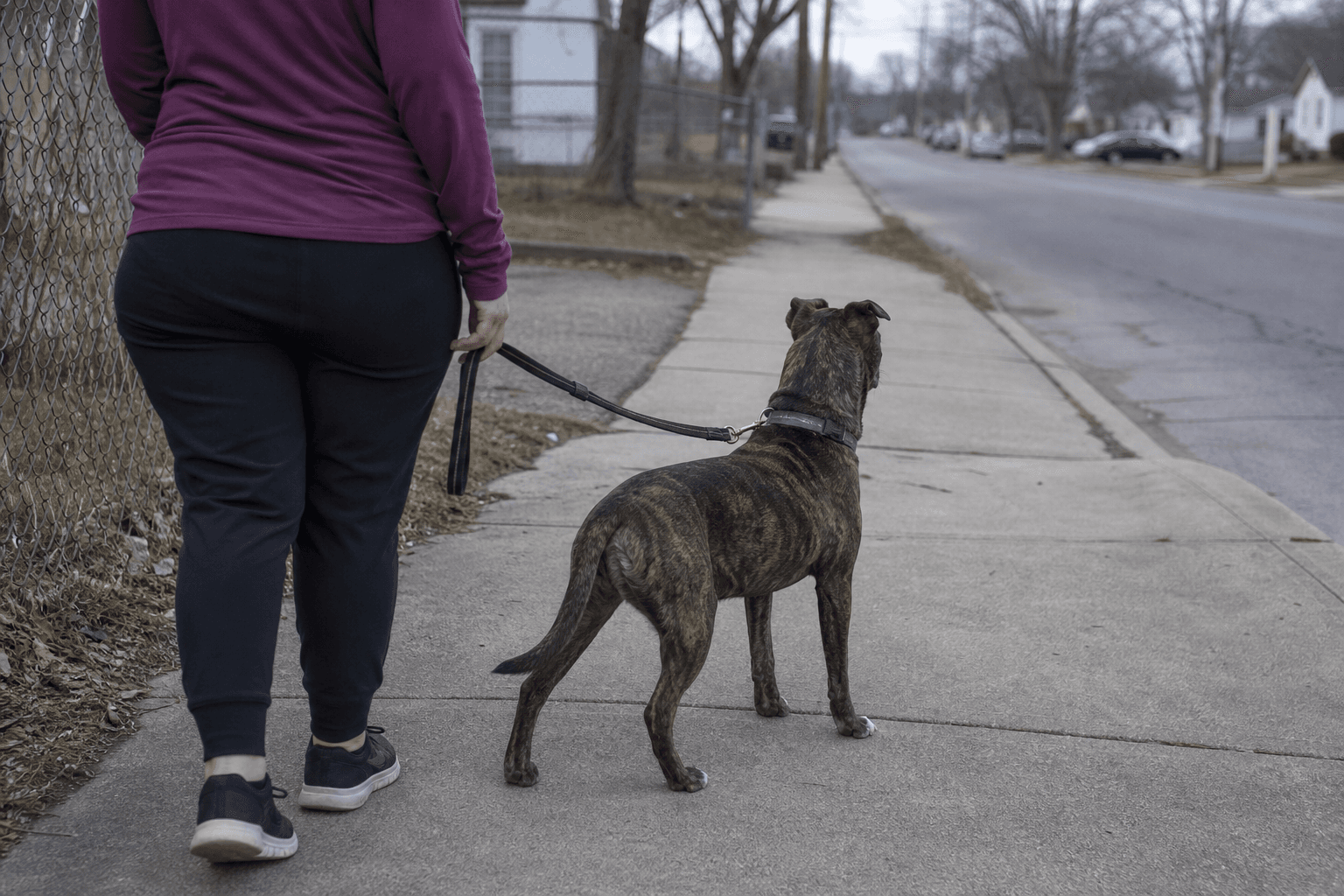
- Reactive encounters on walks. Spotting the neighborhood trigger dog and stiffening up teaches your dog that other dogs make you change. Practice a mechanical routine instead: see dog, turn, feed, keep moving.
2. Separate your bad day from your dog's training session
If you are frustrated, angry, or fried, do not run a training session — especially not one on something your dog finds hard. Do something with a near-guaranteed outcome instead: a sniff-heavy walk, a scatter-feed in the grass, a food puzzle. Enrichment does not require you to be at your best; teaching does.
3. Watch for the quiet stress signals
Dogs rarely announce stress. They leak it. Learn this list and scan for it when your own mood is off: lip licking with no food present, yawning when not tired, turning the head away, a lowered body or tucked tail, panting in a cool room, whale eye (whites showing), shaking off as if wet when dry, refusing treats they normally love. Two or more, stacking, is your cue to change the situation — not to reassure and press on.
4. Build in a stress circuit-breaker
You do not need to buy anything, but if you want tiers:
- Free: A 20-minute decompression walk on a long line where your dog sets the pace and sniffs. Ten minutes of scatter-feeding in the yard. A predictable daily rhythm — dogs handle a stressed household far better when meals, walks and bedtime stay fixed.
- Under $40: A snuffle mat or a couple of food-dispensing puzzles, a 15- to 30-foot long line, and a lick mat for the vet-visit car ride.
- $100+: A few sessions with a certified trainer (look for CPDT-KA, KPA-CTP, or a Fear Free certified professional) to build a departure or reactivity protocol. If you suspect real separation anxiety or generalized fear, ask your vet for a referral to a veterinary behaviorist (DACVB) — that is a medical problem, not an obedience one.
Do and don't
- Do keep your face and voice neutral-to-cheerful during scary handling, nail trims, and vet exams.
- Do comfort a frightened dog. You cannot reinforce an emotion; the old "don't coddle a scared dog" advice does not hold up.
- Don't use anger as a training tool. Beyond the ethics, you are training your dog to read your face for threat instead of for information.
- Don't assume a behavior change is defiance. New sudden anxiety, clinginess, or house-soiling warrants a vet exam before a training plan — pain and illness look a lot like "attitude."
The takeaway
The most striking thing in the iScience paper is not really the fear-versus-sadness distinction. It is where the distinctions were found: scattered across a network of regions rather than concentrated in one tidy "emotion center." Reading emotion in another creature, in dogs as in us, appears to be a whole-brain social project — which is a fitting description of what a dog does with an average Tuesday in your house.
Your dog has been running that project on you for years. The evidence keeps pointing the same direction: they are paying closer attention than we give them credit for, and the calm you manufacture for their benefit is not wasted effort.
Want more of this — dog science translated into things you can actually do, plus the best dog-friendly patios, parks and trails near you? Explore Sidewalk Dog and our city guides, and join thousands of owners getting our newsletter.