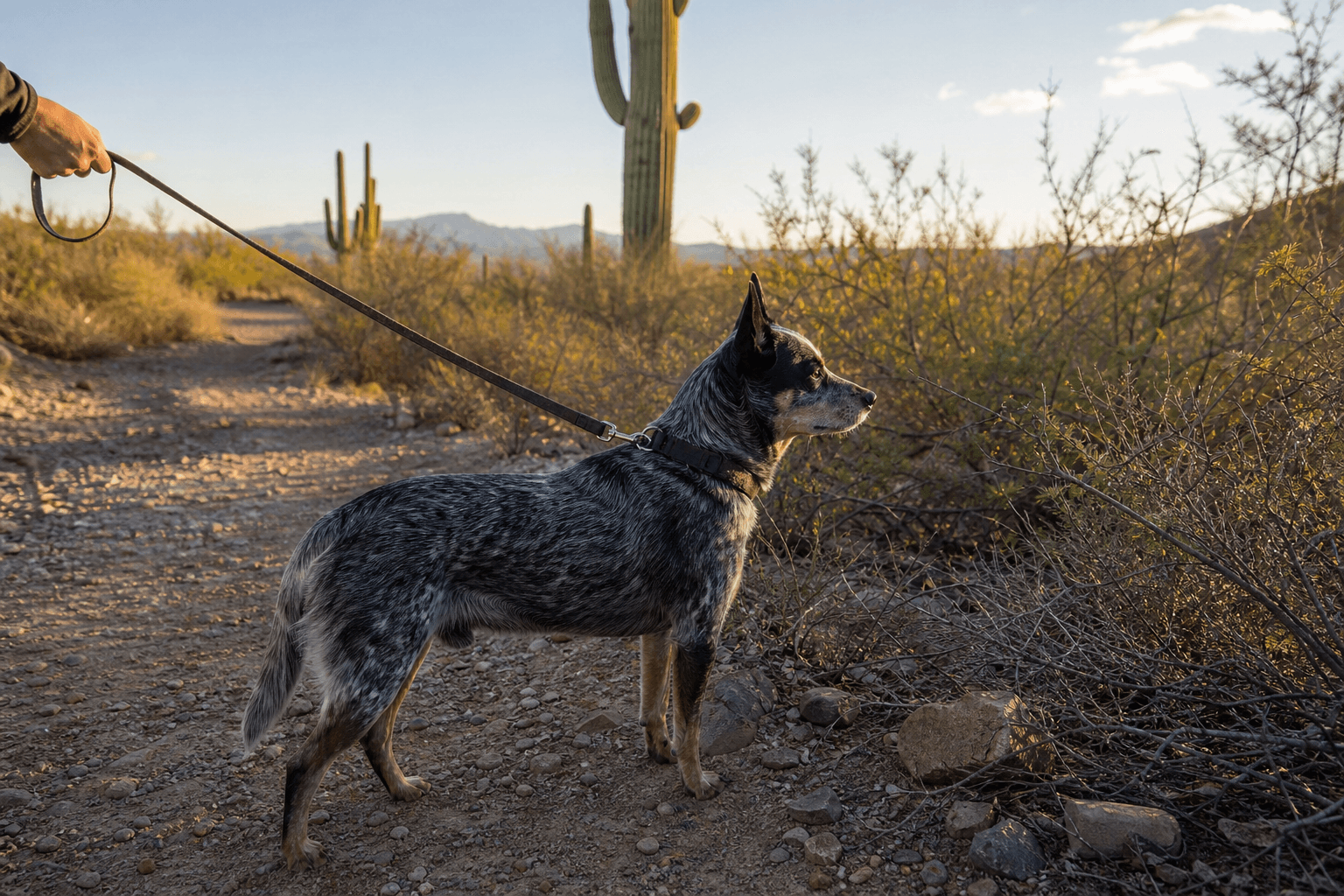

Ripley, a 2-year-old blue heeler mix with a big prey drive, trotted up to Brian — a large western diamondback rattlesnake — the way most dogs do: nose first, no hesitation. Then came a quick zap on the neck from an electronic collar, meant to stand in for a viper's bite. Suddenly Ripley wanted nothing to do with Brian's rattling tail or textured brown skin.
She was never actually in danger. Brian's venom glands were removed years ago, and he now works as a training prop in Tucson, Arizona. But the scene, described in an Associated Press story published August 1, has put a decades-old corner of the dog world back in the spotlight — right as August arrives, the month when rattlesnake encounters peak across much of the country.
If you hike, camp, or just live where snakes do, here's what the story actually means for your dog.
Why This Is Suddenly Everywhere
Snake avoidance training isn't new. Trainer J.J. Belcher of Sublime Canine has spent more than two decades traveling the Western U.S. teaching it to thousands of pet and working dogs, including search-and-rescue animals and the occasional police K-9. What's new is the scrutiny — and the timing.
2026 has been an unusually heavy snakebite year. A warm winter followed by an early Western heat wave pushed snakes into activity sooner than normal. In California, state poison control authorities logged 77 venomous snakebites in humans in just the first three months of the year, against an annual average of roughly 200 to 300, plus multiple fatalities in a state that typically sees zero or one.
For dogs, the numbers are sobering in a different way. The ASPCA estimates as many as 150,000 dogs are bitten by venomous snakes each year in the United States. The Merck Veterinary Manual puts total pit viper bites across all animals at 150,000 to 300,000 annually, and notes that fatal snakebites are more common in dogs than in any other domestic animal — largely because a small dog can absorb a full dose of venom relative to its body size.
In hot spots, it's a daily occurrence. Dr. Sarah Carotenuto, an emergency and critical care veterinarian who teaches at the University of Arizona's College of Veterinary Medicine, told the AP that the Veterinary Specialty Center of Tucson treats four to six dogs a day for rattlesnake bites during season.
How Avoidance Training Actually Works
The standard protocol is short and blunt. A dog is leashed and fitted with an electronic collar, then walked past a live snake — often defanged or devenomized, sometimes caged, occasionally a scent-and-sound-rigged stand-in. When the dog shows interest, the trainer delivers a correction, escalating only as needed until the dog reliably moves away from the sight, sound, and smell of a snake.
Belcher charges $125 for a single session and offers a free refresher a year later to confirm the lesson stuck. "It's a very fast and effective form of training," he told the AP. Most trainers in this niche insist the electronic collar is what makes the association strong enough to hold in a real encounter, when a dog is off-leash and excited.
Notably, Belcher says he developed a positive-reinforcement alternative for clients uncomfortable with e-collars — but it requires multiple sessions, so he'd have to charge about $2,500. Nobody has taken him up on it.
What the ASPCA Says
The ASPCA's position is neither an endorsement nor a condemnation, and it's worth reading carefully. Pamela Reid, vice president of the organization's behavioral sciences team, told the AP that this type of training "can be highly effective" — but only with a trainer genuinely knowledgeable in the method.
"It is imperative to weigh the dog's risk of a snakebite against the potential fallout from using an electronic collar," Reid said. She added that teaching a dog to come reliably when called, and to "leave it" when fixated on something dangerous, "can go a long way toward keeping a dog safe."
That's the honest summary of the current evidence: aversion training is widely used, widely believed to work, and not yet rigorously proven. Carotenuto says she's now taking part in a University of Arizona research study examining whether rattlesnake-aversion training works at all — and which method works best. Until that lands, owners are making a judgment call.
How to Decide If Your Dog Needs It
A few honest questions to work through, ideally with your own veterinarian and a qualified trainer:
- How real is the exposure? Off-leash hiking in Arizona, Texas, California, Colorado, or the Southwest desert is a very different risk profile than leashed sidewalk walks in Minneapolis.
- How is your dog wired? The dogs that benefit most are the ones with tunnel-vision prey drive who blow through a recall cue. A soft, handler-focused, easily spooked dog may be a poor candidate — trainers and vets alike warn that fear fallout and misplaced associations are real risks.
- How solid is your recall right now? A bombproof "leave it" and an instant recall are useful in a thousand situations, not just snake encounters. That's the foundation regardless of what you decide about a collar.
- Who is holding the remote? Ask how many dogs the trainer has worked with, whether snakes are handled humanely, how they assess a dog's temperament first, and what they do if a dog shuts down. Vague answers are your answer.
What About the Rattlesnake Vaccine?
Many owners in snake country ask about the canine rattlesnake vaccine, a western diamondback toxoid. It's important to understand what it does and doesn't do. Per Washington State University's Veterinary Teaching Hospital, the vaccine aims to reduce the severity of symptoms — not prevent envenomation — and studies show mixed results. One multicenter study of 82 dogs with moderate to severe bites found no statistically significant difference in morbidity or mortality between vaccinated and unvaccinated dogs.
The critical takeaway: a vaccinated dog that's bitten still needs emergency veterinary care immediately. The vaccine is not a substitute for a hospital visit, and neither is avoidance training.
If Your Dog Is Bitten: Do This, Not That
Rattlesnakes account for roughly 99% of venomous bites in pets, according to WSU. Signs usually appear within about 30 minutes and include swelling and bruising at the bite site, pain, drooling, and weakness; severe cases can bring difficulty breathing, abnormal heart rate, or collapse. Colorado State University's veterinary team notes that small snakes may not leave visible puncture marks at all — so unexplained swelling and severe pain after a walk in brush deserves the same urgency.
Do:
- Move your dog away from the snake and keep them as calm and still as possible — carry them if you can.
- Drive to the nearest emergency veterinary hospital immediately. Time is the variable you control.
- Photograph the snake only if you can do so safely; it helps guide treatment.
- Call ahead so the hospital can prepare antivenom.
Don't:
- Apply ice, a tourniquet, or a compression wrap.
- Cut the wound or try to suck out venom.
- Give tranquilizers, corticosteroids, or any human medication.
- Wait to "see if it gets worse."
The good news is that outcomes are generally strong with fast treatment. In a study of 282 dogs treated for pit viper envenomation at a high-volume Arizona emergency facility, 96.1% survived to discharge. Lower survival was associated with older age, smaller body weight, and bites to the chest rather than the head or limbs.
Be ready for the cost, too. Antivenom commonly runs several hundred to about $1,000 per vial, and severe cases can require many vials; total emergency bills frequently land in the low thousands and can climb much higher. It's one of the strongest arguments for pet insurance if you live in snake country.
The Cheapest Protection Is Still Free
Whatever you decide about collars and vaccines, the least controversial layer of protection costs nothing: keep your dog leashed on trails, stay on wide paths and out of dense brush and rocky crevices, avoid tall grass at dawn and dusk when snakes are most active in late summer, and clear woodpiles, rodent attractants, and hiding spots from your yard. A snake-proofed backyard and a reliable recall prevent more bites than any single training session.
Rattlesnakes almost always warn before they strike. Dogs just aren't built to take the hint — which is exactly why the decision falls to us.
Looking for more ways to keep your pup safe and busy this summer? Sidewalk Dog covers dog-friendly trails, patios, and adventures in cities across the country — plus the news dog owners actually need. Come sniff around.