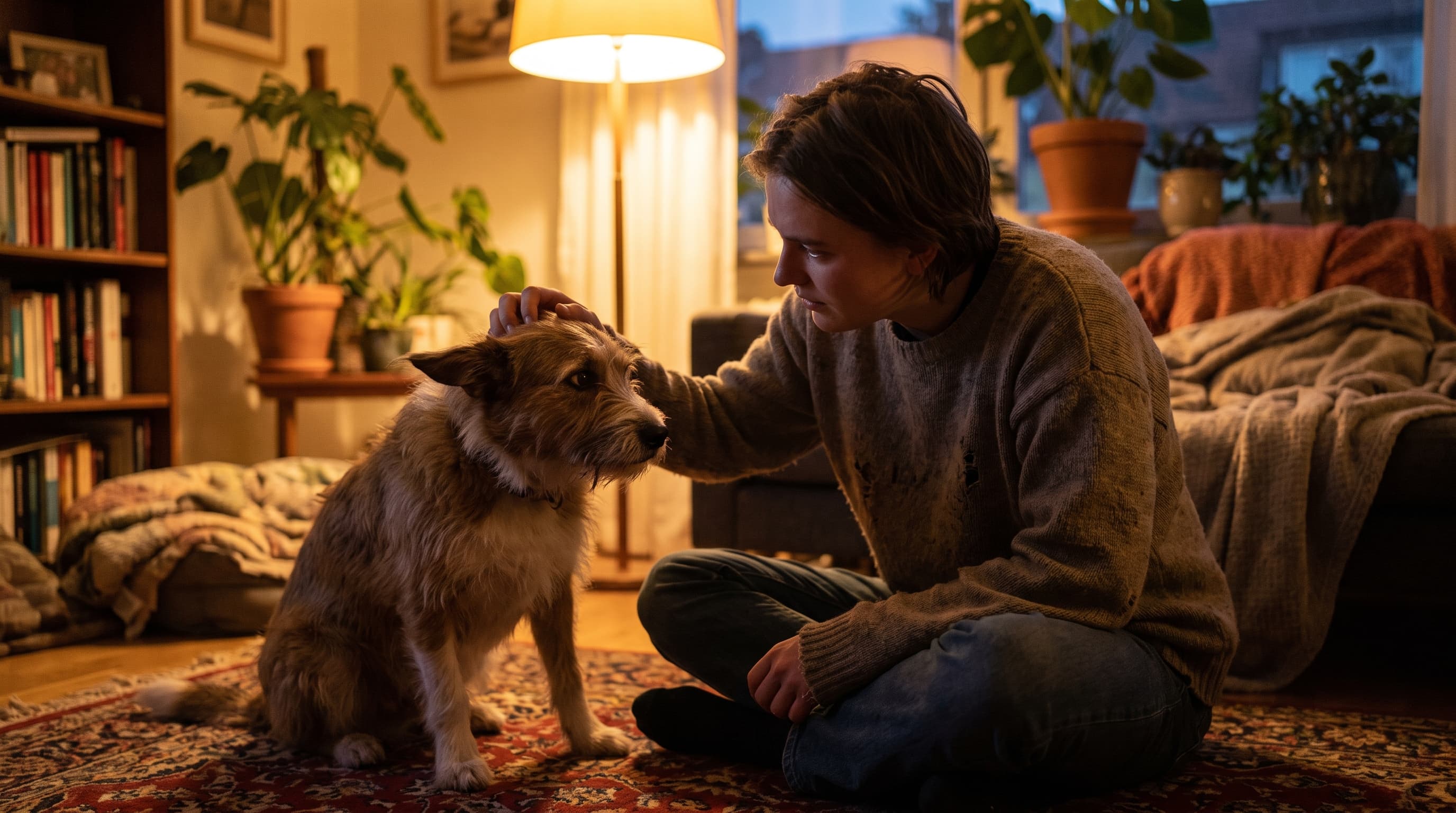

You've almost certainly scrolled past one: the lights are low, a dog is happily eating dinner, and suddenly a masked "intruder" bursts in and drags the owner out of frame. The camera stays locked on the dog. Does the pup leap to the rescue — or keep crunching kibble like nothing happened? The "fake intruder" dog loyalty test has become one of the most-shared dog challenges on TikTok this fall, spawning millions of views and a wave of copycat clips under hashtags like #loyaltytest and #dogintrudertest.
It looks harmless. It is not. Trainers and veterinary behaviorists who study how dogs actually process fear say this particular trend sits in a different, riskier category than the goofy pet videos we usually love — and the fallout can follow you long after the video stops trending. Here's what's really happening inside your dog's head when you stage a kidnapping, and why the pros are asking owners to put the phone down.
What the "loyalty test" trend actually asks your dog to do
The setup is almost always the same. An owner sits with their dog, often while the dog is eating or resting, then a second person — usually masked or hooded — storms in and pretends to grab, attack, or "kidnap" the owner. The whole point is the dog's reaction: viewers are invited to judge whether the dog is "loyal" enough to intervene.
The trouble, according to certified professional dog trainer Sassafras Patterdale (CPDT-KA), is that the whole premise is built on deceiving an animal that trusts you. "This mean-spirited trend is all about trying to lie to dogs," Patterdale writes, warning that dogs don't understand they're being pranked. They experience a genuine threat to the person they rely on most — with no way to know it's fake, and no off-switch when the camera stops rolling.
Dogs read context, body language, and tone far better than they read intentions. As the American Kennel Club notes in its guide to canine body language, dogs are exquisitely tuned to sudden movement, raised voices, and the emotional state of their humans. Stage enough panic and your dog will believe it — because from the inside, there is no difference between a real emergency and a convincing one.
The stress signals owners miss on camera
Before a dog ever reacts dramatically, it almost always tries to say "I'm uncomfortable" in quieter ways. The AKC lists the classic stress signals owners should watch for: "whale eye" (when a dog shows the whites of its eyes), tucked ears or tail, lip-licking, yawning, panting, and pointedly looking away. These are calming signals — a dog's attempt to defuse a situation it finds threatening.
The cruel irony of the loyalty-test videos is that many of them capture exactly these signals — the freeze, the whale eye, the frantic lip-lick — and viewers read them as "the dog is thinking about what to do." In reality, that's a stressed animal broadcasting distress. When those early signals get ignored (or, worse, rewarded with a treat and a laugh), a dog learns that its warnings don't work. Over time, that's how you end up with a dog that skips the whispers and jumps straight to a growl, a snap, or a bite.
Why "he'd never bite" is exactly the wrong assumption
Here's the scenario the trend is practically engineered to produce: your dog does decide to defend you, and it bites the "intruder" — who is often a friend, a partner, or a family member. Behaviorally, that's a completely reasonable response to a perceived attack. Legally and financially, it can be a catastrophe.
A single bite can get a dog labeled a "dangerous dog," triggering law enforcement involvement, mandatory muzzling, loss of homeowner's insurance, or even eviction — and dogs with a documented bite history can, in the worst cases, be euthanized. That's a devastating price for a few seconds of content.
The money side is sobering on its own. U.S. insurers paid out a record $1.57 billion in dog-related injury claims in 2024, according to the Insurance Information Institute (Triple-I) and State Farm — with the average claim climbing to $69,272 and the number of claims jumping nearly 19% in a single year. Dog bites are also a serious public-health issue: the CDC reports that more than four million Americans are bitten by animals each year, and children are among the most frequent and most severely injured victims. Deliberately provoking a defensive reaction, then posting it, is exactly the kind of preventable incident these numbers are made of.
The trust you can't get back
Even if your dog never bites and never gets in trouble, there's a quieter cost. Behavior experts warn that staging a threat from — or against — the person a dog trusts most can erode that bond in ways that don't heal on their own. A dog that learns "sometimes my safe person creates terrifying situations for no reason" may become warier of strangers at the door, more reactive to sudden movement, or more anxious when left alone.
"We want our dogs to see us as safe people," Patterdale writes — and that safety is the foundation everything else is built on. It's the same reason behaviorists pushed back on the "yell at the vacuum" trend earlier this year: any challenge that trades your dog's sense of security for a punchline is borrowing against a bank account you can't easily refill.
What to do instead — the content that actually strengthens the bond
The good news is that the internet's genuine appetite for dog videos doesn't require scaring anyone. If you want share-worthy footage that also makes your dog happier, trainers point to enrichment, not ambush.
- Film a "find it" game. Scatter treats or hide a favorite toy and let your dog use their nose. Scent work is one of the most reliably calming activities you can offer — we broke down the science in our guide to nose work for dogs.
- Capture real teamwork. Teach a new trick, a tidy recall, or a "go to your mat" cue and film the wins. That footage shows your dog choosing to engage with you — the opposite of a loyalty test.
- Document the sniffari. A slow, dog-led walk where your pup gets to sniff everything is deeply enriching and quietly photogenic.
- Reward the calm. Some of the most charming dog content online is just a dog being relaxed and safe. That's the vibe you're actually trying to build.
If you've already tried it
Don't spiral — dogs are resilient, especially when the pattern doesn't repeat. Stop the prank immediately and don't do it again. Rebuild predictability with normal routines: consistent meals, calm greetings, and plenty of low-pressure wins. Watch for lingering signs of stress in the days afterward — new wariness at the door, clinginess, resource guarding, or reactivity to strangers — and if any of that shows up, loop in a certified trainer or a veterinary behaviorist sooner rather than later. Early help is far easier than untangling a fear that's had months to set in.
The bottom line
The "fake intruder" loyalty test is a perfect storm: it looks funny, it's easy to film, and it's built on a misunderstanding of what dogs can and can't process. But your dog can't tell that the danger is staged, can't consent to the experiment, and can't undo a bite once it happens. A few seconds of engagement isn't worth your dog's trust — or a six-figure insurance claim.
At Sidewalk Dog, we're all for dogs going viral — just for the right reasons. Skip the fake kidnapping, grab a handful of treats, and film the good stuff instead. For more vet-informed takes on the trends filling your feed, keep up with Sidewalk Dog — your dog will thank you for it.