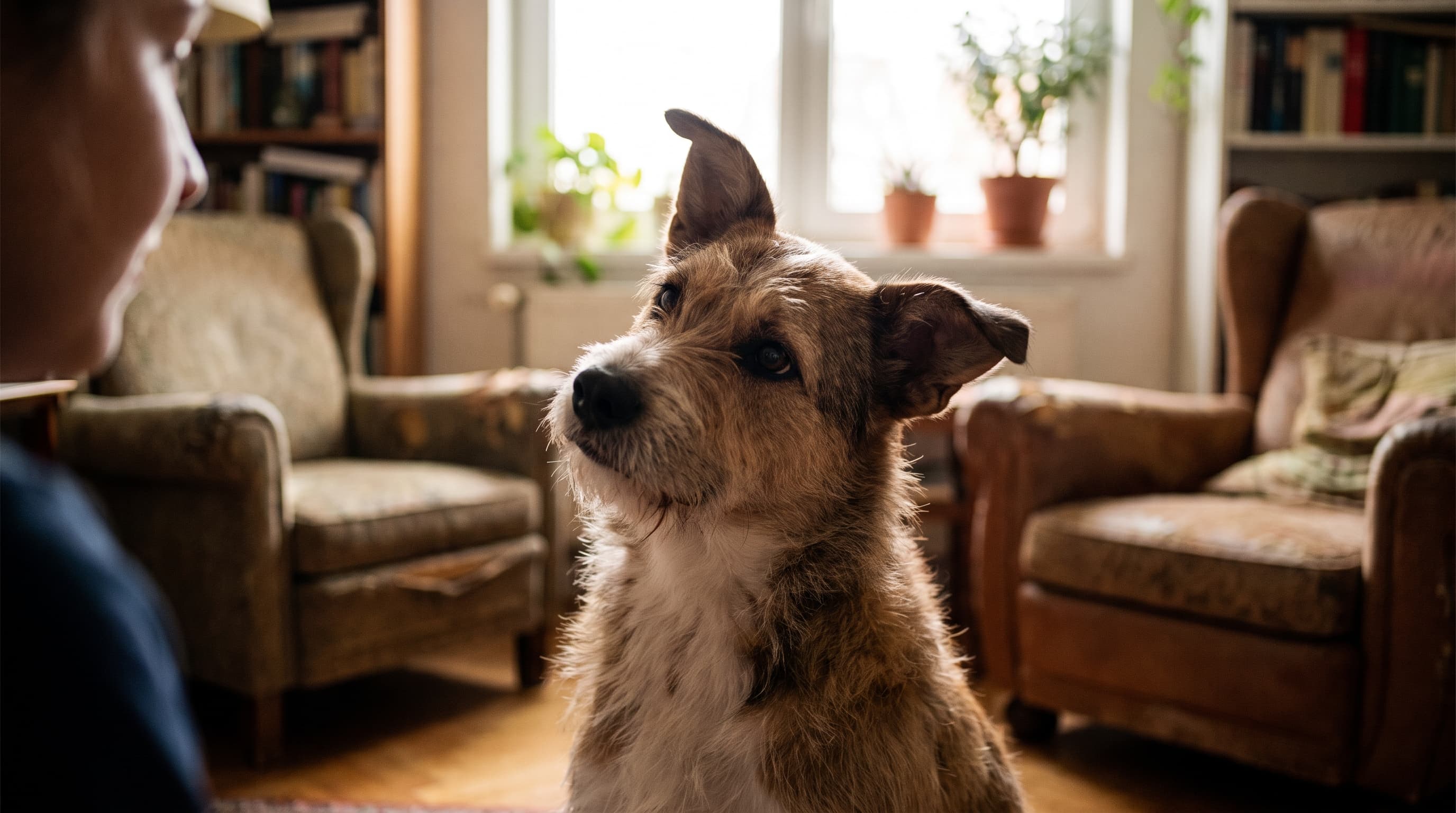

Say the word "walk" in a normal voice and watch what happens. Ears swivel, head tilts, a tail starts to thump. Most dog owners assume their dog simply memorized the sound. But a new study published in Science on September 24 suggests something far more sophisticated is going on inside your dog's head: dogs pull individual words out of the blur of human conversation using the very same trick that human babies rely on. They listen for the consonants.
It is the first time this ability, long thought to be a hallmark of how humans acquire language, has been documented in another species. And it reshapes how we should think about the running commentary we all deliver to our dogs every day.
The problem every listener has to solve
Human speech does not come with spaces. When we talk, sounds run together in a continuous stream, yet somehow a listener has to figure out where one word stops and the next begins. Babies crack this puzzle in their first year, and one of their earliest tools is a "consonant bias" — a tendency to treat consonants, rather than vowels, as the reliable signposts that mark word boundaries.
Researchers at the Neuroethology of Communication Lab at Eötvös Loránd University in Budapest wanted to know whether dogs, who share our homes and hear our speech constantly, do the same thing. So they built an experiment around the family dog's brain.
What the study actually did
The team compared 20 companion dogs and 20 adult humans using non-invasive EEG — sensors resting gently on the scalp that record electrical activity while the subject simply listens. Both groups heard streams of three-syllable nonsense "words" arranged three ways: some where the word boundaries were marked by consonant patterns, some marked by vowel patterns, and a random-syllable stream as a control.
The clever part is that the vowels in the recordings were actually louder than the consonants. If dogs were just following the most acoustically obvious sound, they should have latched onto the vowels. They did the opposite.
About 400 milliseconds after each word began, a distinct change appeared in the brain's electrical activity — but only for the consonant-structured words, and it showed up in both dogs and humans. Their brains were quietly tracking the consonants to decide where words started and stopped, even though the vowels were shouting louder.
"This is what we call the consonant bias," lead researcher Attila Andics, the cognitive neuroscientist who directs the Budapest lab, told reporters. "Basically, what we show now here is evidence that unlike other mammals, dogs do the same."
It doesn't matter how your dog grew up
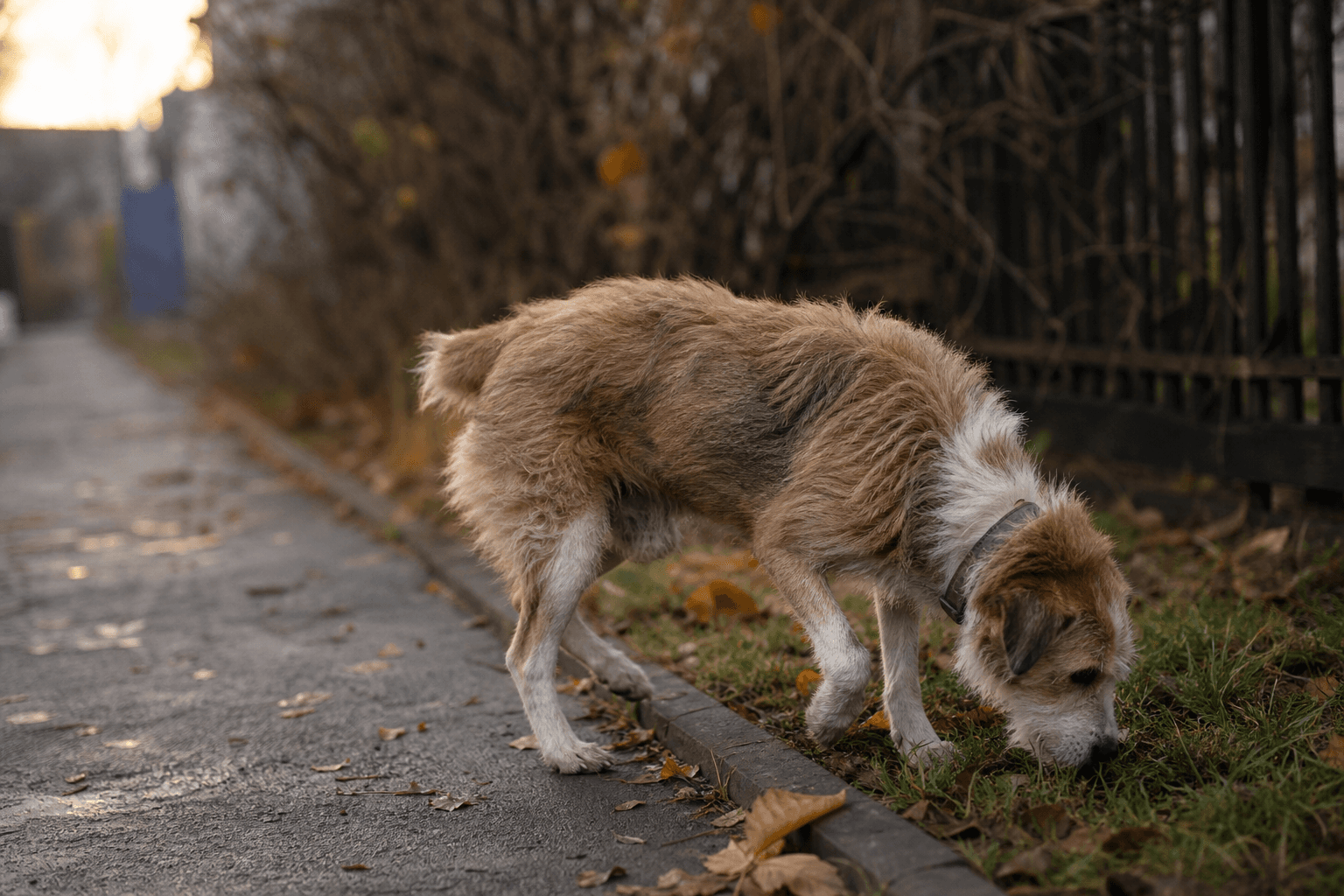
Here is the finding that surprised the researchers most. You might expect that a dog raised from puppyhood in a chatty household would develop this skill, while a dog who spent early life on the street or in a shelter would not. That is not what the data showed.
Dogs displayed the same consonant bias regardless of whether they had rich early exposure to human speech. That points to a general "statistical learning" mechanism — the brain quietly tallying patterns in whatever speech it hears — rather than a skill that has to be trained in during a narrow window of puppyhood.
For anyone who has adopted an adult rescue dog and wondered whether they "missed the window" to bond and communicate, that is genuinely reassuring news. Your dog's brain appears to keep doing this math no matter when they arrived in your life.
Dogs and babies, side by side
The parallels to human infants drew notice from cognition researchers who were not involved in the work. "They're listening, they're paying attention," said Francys Subiaul, a cognitive scientist at George Washington University, in comments on the study. "And those experiences are shaping their brains in ways that are quite similar to how those experiences shape the brains of our babies."
Amritha Mallikarjun, a postdoctoral researcher at Harvard who studies canine perception, framed it as a two-way street: "Our experiences as dogs have been domesticated have both shaped their brains and our brains."
Where dogs and people part ways
The study is careful not to oversell it. Dogs are not secretly fluent. There were clear limits. While humans could also use vowel patterns to find word boundaries when consonants were absent, dogs could not track vowel-defined words effectively. And human brains parsed speech all the way down to individual sounds, while dogs treated the whole syllable as their smallest unit.
In other words, your dog is doing a real and impressive version of what a baby does, but a coarser one. The authors also note they cannot yet say whether this consonant bias is something special that emerged over tens of thousands of years of domestication, or an older auditory ability shared more widely across mammals that simply had not been tested before.
What this means for how you talk to your dog
This is a brain study, not a training manual, so treat the practical notes as informed extensions rather than proven prescriptions. Still, a few sensible takeaways fall out of it.
Lean on consonant-rich cue words
If your dog is quietly using consonants as anchors, then cue words with crisp, distinct consonants are easier to pick out of a sentence than mushy, vowel-heavy ones. "Sit," "down," "crate," and "drop" give the brain sharp edges to grab. Two cues that sound alike may be harder to tell apart than we assume, so choose commands that are consonant-distinct from one another.
Keep talking — it's not wasted
The narration you deliver while you cook, drive, or fold laundry is not background noise to your dog. Their brain is running statistics on it. That does not mean they understand your monologue, but the ambient stream of your voice is genuine input, and this study suggests it is being processed more actively than we gave dogs credit for.
Say the word before you show the leash
Because dogs are pulling words out of continuous speech, saying a cue clearly on its own — a beat before the visual that usually accompanies it — gives that word a cleaner shot at landing. Pair it consistently with the same action, and you are feeding the pattern-matching machinery the study describes.
The bigger picture
This work joins a fast-growing body of research showing that dogs process human language in ways that echo young children, from learning object names by overhearing them to reading our emotional cues. None of it means your dog is decoding grammar. But it does mean the animal at your feet is a more attentive, more capable listener than the old "they just respond to tone" story allowed.
So the next time your dog snaps to attention at "walk" while ignoring an entire sentence around it, know that something remarkable is happening. Somewhere around 400 milliseconds in, a brain not so different from a toddler's just found the word.
For more research-backed looks at how dogs think, learn, and communicate, keep it locked to Sidewalk Dog — where we translate the science into the everyday stuff of living with a good dog.