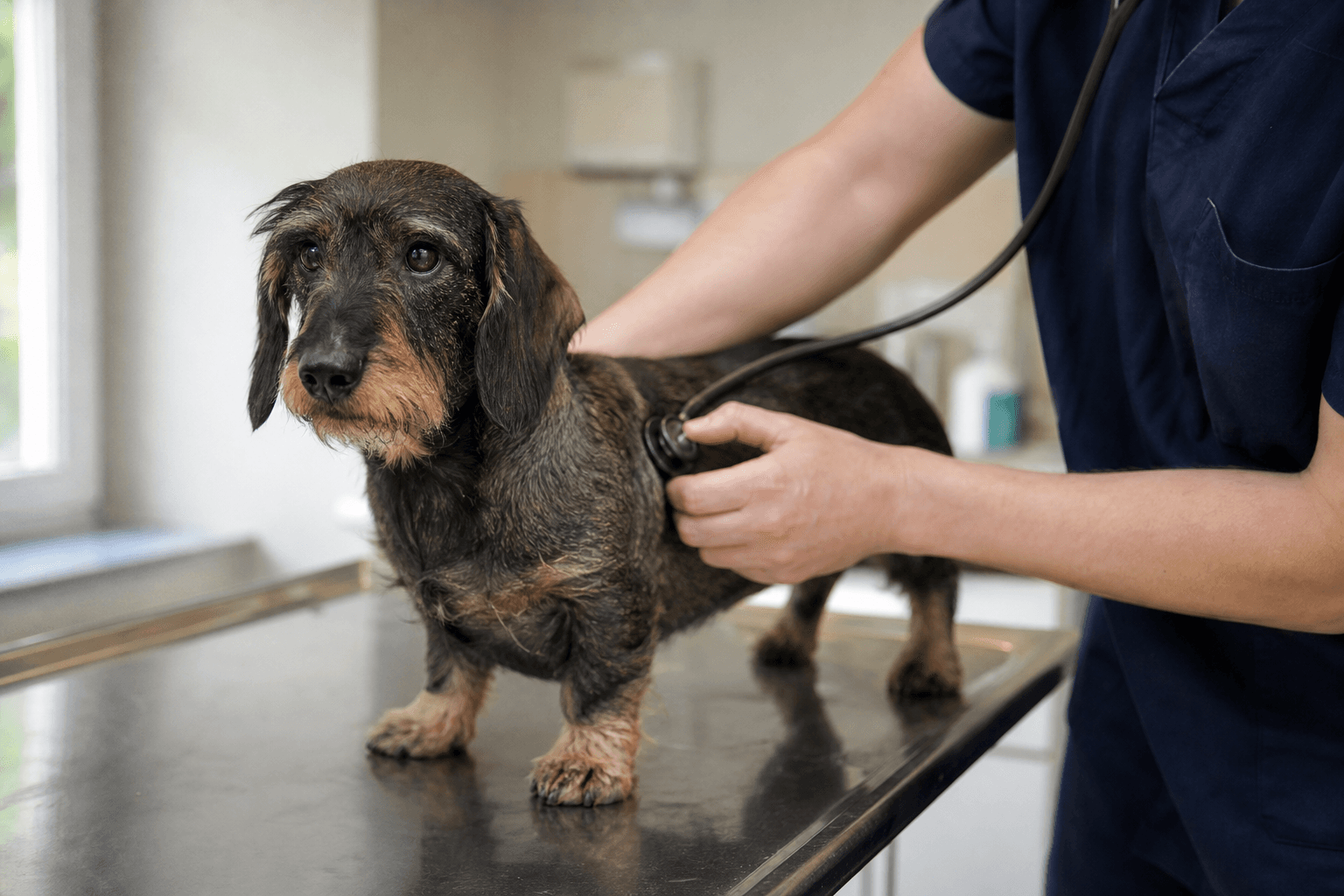

If your dog has had a checkup in the last year, there is a good chance artificial intelligence was in the room with you — even if nobody said so out loud. It may have been listening to your dog's heart through a digital stethoscope, measuring the heart on an X-ray, or quietly writing the visit notes while your vet talked to you.
Two new pieces of research published this month put hard numbers on how well that technology actually works in dogs. One is reassuring. The other is a warning. Together, they give dog owners something genuinely useful: a way to tell the difference between AI that makes your vet sharper and AI that could send you home with the wrong answer.
The warning: an AI stethoscope that missed murmurs and over-called arrhythmias
On August 5, researchers at North Carolina State University published a study in the Journal of the American Veterinary Medical Association testing an AI-enabled digital stethoscope on 105 companion animals — 54 dogs and 51 cats. Every animal was examined by a board-certified veterinary cardiologist, a cardiology resident, and a fourth-year veterinary student, and the humans' findings were compared with the device's.
The results in dogs were mixed at best. Of the 38 dogs the doctors identified as having a heart murmur, the AI correctly caught 33 — about 87%. That means roughly one murmur in eight went unflagged. Fourth-year veterinary students matched the device exactly; experienced clinicians beat it.
The rhythm findings were worse. The AI never once called a dog's heart rhythm normal. It correctly flagged all six true cases of atrial fibrillation — but also labeled 22 additional dogs as having atrial fibrillation when they did not. As study author Dr. Jake Johnson put it, "the stethoscope never once called a dog's rhythm normal, and its atrial fibrillation calls were wrong three out of four times."
The reason is not mysterious. The device tested (a Core 500 from Eko Health) is built for people, and its algorithm was trained on human hearts. Dogs have faster, more variable heart rates and a normal respiratory sinus arrhythmia that would look alarming in a human chest. "We were hearing from veterinarians who were second-guessing themselves based upon the stethoscope's findings," Johnson said — which is exactly the failure mode owners should care about.
The researchers' conclusion was not "don't use it." It was that the ECG tracing the device captures is good quality, and the tool works best as an adjunct — a quick trace, or a flag worth a second look — not a stand-alone diagnosis.
The good news: AI that measures instead of guessing
Contrast that with a validation study published in PLOS ONE by a Texas A&M College of Veterinary Medicine team, which Texas A&M and science outlets highlighted again this month. The tool, RadAnalyzer, measures two standard numbers from a chest X-ray: vertebral heart size (VHS) and vertebral left atrial size (VLAS). Vets use those to judge whether a dog's heart is enlarging — the key question in mitral valve disease, the most common heart problem in small-breed dogs.
Across high-quality radiographs from 1,058 client-owned dogs spanning 80 breeds, the app's measurements correlated closely with a trained human observer (r = 0.917 for VHS, 0.873 for VLAS), with mean biases near zero. In plain English: on a good right-lateral X-ray, the software measured the heart about as consistently as an experienced specialist.
Why the different outcome? RadAnalyzer does one narrow, measurable job on dog data, and it was validated on dogs before being marketed as a dog tool. The stethoscope algorithm was asked to make a species-jumping diagnostic judgment it was never trained for. That distinction — measurement versus diagnosis, validated on dogs versus borrowed from humans — is the single most useful filter an owner can carry into an exam room.
The AI you'll notice most: the one taking notes
The fastest-moving veterinary AI isn't diagnostic at all. It's the ambient "scribe" that listens to the appointment and drafts the medical record. A 2026 North American survey of 1,273 validated practices found 46.6% of clinical staff personally use an AI scribe at least some of the time, and 50% of practices have at least one scribe user. An earlier AAHA/Digitail survey of 3,968 veterinary professionals found 39.2% already using AI tools of some kind, with accuracy and data privacy cited as the top concerns.
For owners, scribes are mostly a win: a vet who isn't typing is a vet who is looking at your dog. But two things are worth knowing. First, the note is a draft — vets are expected to review and correct it before it becomes the permanent record. Second, your appointment audio is being processed by a third-party vendor, and you are entitled to ask what happens to it.
Nobody is checking these tools before they reach your dog
Here is the part that surprises most owners. In human medicine, AI-enabled diagnostic devices are regulated by the FDA as medical devices. In veterinary medicine, there is no equivalent premarket screening. As the AVMA has reported, companies building diagnostic software for animals are not required to demonstrate accuracy before selling it.
The American College of Veterinary Radiology and the European College of Veterinary Diagnostic Imaging said so bluntly in a 2025 joint position statement: no commercially available AI product for veterinary diagnostic imaging currently meets the standards they would want for transparency, validation, or safety. They called for a veterinarian — preferably a board-certified specialist — to stay in the loop on every AI output, and encouraged vets to disclose AI use to clients and offer alternatives. A 2026 audit in Frontiers in Veterinary Science of commercial veterinary AI products found much the same: public documentation of how these tools were trained and validated is thin.
None of this means your vet is doing something shady. It means the burden of asking falls partly on you.
What to ask at your dog's next appointment
You don't need to be technical. Four questions cover it:
- "Was any part of that reading done by software?" Perfectly normal question, and a good vet will answer it plainly.
- "Was the tool validated on dogs, or adapted from human medicine?" This is the NC State lesson in one sentence.
- "Does this change what we do next, or do we confirm it first?" An AI flag should trigger a confirming test — not a diagnosis.
- "If a scribe is recording, where does that audio go?" Reasonable, and you can decline.
When a screening result should be confirmed
- A murmur flagged by a device → confirm by auscultation from the veterinarian, then chest radiographs and, if indicated, an echocardiogram. An echo read by a cardiologist remains the reference standard.
- An "irregular rhythm" or atrial fibrillation alert → confirm with a full ECG. Given the over-calling seen in the NC State data, do not start cardiac medication on a stethoscope alert alone.
- An AI heart-size measurement → useful for tracking change over time, but the number depends on X-ray quality and positioning. A single VHS reading is a data point, not a verdict.
- A normal AI result in a dog with symptoms → trust the symptoms. Coughing, exercise intolerance, fast resting breathing, or fainting deserve a workup regardless of what the software said.
The one number worth tracking yourself
No app beats a resting respiratory rate you count at home. With your dog fully asleep, count chest rises for 30 seconds and double it. Most healthy dogs sit under 30 breaths per minute at rest. A sustained climb above that in a dog with known heart disease is one of the earliest reliable signs of fluid backing up into the lungs — and it is the kind of trend your vet genuinely wants a text about.
The honest bottom line
AI is not coming to your vet's office; it arrived, and mostly through the side door. Used as a measuring tape, a second set of eyes, or a note-taker, it makes good veterinary care more consistent. Used as an oracle, it produces confident answers about your dog that nobody validated on a dog.
Your job isn't to referee the technology. It's to make sure a licensed human being is still the one making the call about your dog's heart — and to ask, out loud, when you're not sure. If you would like more plain-English breakdowns of the research that actually affects your dog, that's what we do every week at Sidewalk Dog — along with the best dog-friendly places to go once the checkup is behind you, in your city.