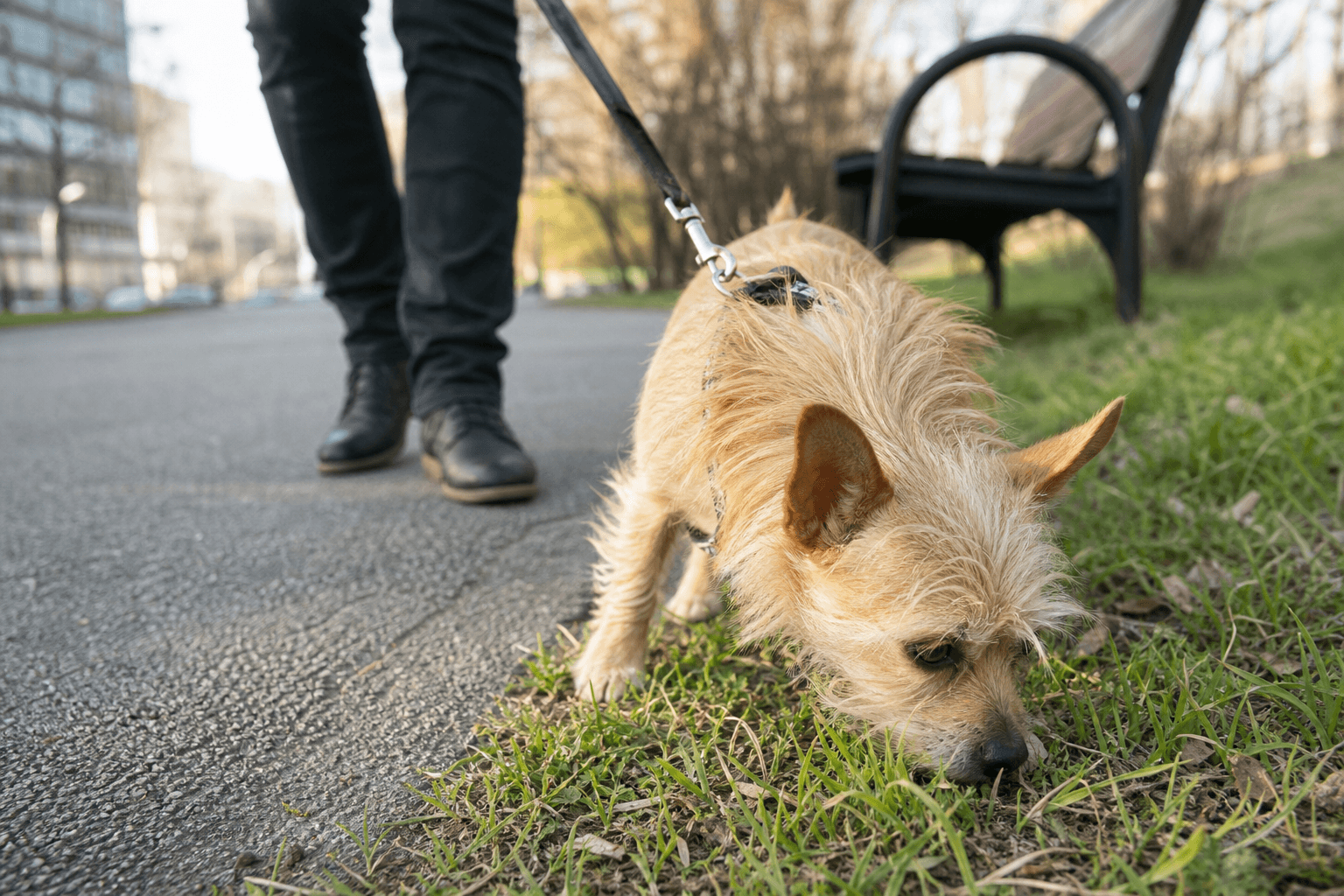

A downtown dog walk turned into an emergency room run for Valeria Vecchio and her dog Clifford last week in Edmonton. Partway through their usual loop through a park, Clifford went lethargic. His gums and tongue turned pale. He started vomiting. By the time Vecchio had him in a car headed for the animal hospital, he was barely breathing and his heart rate had dropped.
The vet's suspicion: opioid toxicity, most likely from something Clifford picked up off the ground.
It is the kind of story that reads like a freak accident, and it isn't. Emergency veterinarians in cities across North America say they are seeing more dogs poisoned by drugs picked up on sidewalks, in parks and along trails — and the peak is right now, in late summer, when dogs and people are outside the most.
What vets are actually seeing
Dr. Jami Frederick, president of the Alberta Veterinary Medical Association and an emergency veterinarian, told CBC News that her team sees opioid toxicity in pets once or twice a month, and that cases climb in summer "when people are out walking their pets in public areas more often." Marijuana ingestion is still far more common, she said — but opioid cases are no longer rare.
The pattern shows up elsewhere too. On Vancouver Island, a 14-year-old chocolate Labrador named Quigley died in April after a short walk through a downtown park; a urine test came back positive for opioids. The treating veterinarian, Dr. Corinne Chapman, said she now sees roughly two drug-exposure cases a week — most involving cannabis — after two decades of practice in Calgary where she could count such cases "on one hand."
The best national data comes from a 2025 case series in the Journal of Addiction Medicine, which reviewed ASPCA Animal Poison Control calls from 2019 to 2023. Researchers led by Orrin D. Ware of the University of North Carolina at Chapel Hill narrowed more than 600 initial reports down to 117 animals with a confirmed or suspected illicit-fentanyl exposure — 113 dogs and 4 cats. A few details are worth sitting with:
- The dogs skewed young and small: average age 1.9 years, average weight about 10.5 kg (23 lbs).
- Chihuahuas (21 cases) and American Pit Bull Terriers (14) were the most frequently identified breeds.
- The most common form was powder or crystals (30% of dog exposures) — not pills.
- Most cases came from the United States, concentrated in California, Washington, Arizona and Florida.
Small dogs are overrepresented for two obvious reasons: they scavenge close to the ground, and it takes far less drug to affect a 15-pound body than a 70-pound one.
The signs don't look like "poisoning"
Most owners are watching for the dramatic version — seizures, foaming, collapse. Opioid toxicity usually announces itself much more quietly, which is exactly why it gets missed on a walk.
In the ASPCA case series, the top reported signs in dogs were lethargy (34.5%), vocalization (32.7%) and ataxia — wobbly, drunk-looking movement (23.9%). Vets also watch for:
- Slow, shallow or irregular breathing
- Pinpoint pupils
- Very slow heart rate
- Pale or grey gums
- Extreme sedation, or unresponsiveness to their name
- Vomiting
The awkward part: a wobbly, sleepy, whining dog also describes heat exhaustion, a cannabis edible, a tick-borne illness, or a dog who simply overdid it at the park. You are not expected to make the diagnosis. You are expected to move fast.
The first 10 minutes: what to actually do
Do this:
- Get your dog away from the spot and check their mouth for powder, foil, a pill or residue. Use a glove, a poop bag over your hand, or a stick — do not run your bare fingers through unknown powder.
- Call ahead and drive. Head for the nearest emergency veterinary hospital and phone en route so they can have naloxone and oxygen drawn up before you arrive.
- Call a poison line while someone else drives — ASPCA Animal Poison Control (888-426-4435) or Pet Poison Helpline (855-764-7661). Both charge a consultation fee; both will call the hospital directly with a case number.
- Tell them exactly where you were and what you saw on the ground. "Downtown park, powder near a bench" changes the working diagnosis instantly.
- Photograph the location if you can do it safely, and report it to your city's 311 or parks line. Cleanup crews respond to specific reports far more than general ones.
Don't do this:
- Don't induce vomiting on your own. A sedated dog with a depressed gag reflex can aspirate — and hydrogen peroxide given to a semi-conscious dog is its own emergency.
- Don't wait to "see if he sleeps it off." Respiratory depression is what kills in opioid toxicity, and it deepens over time.
- Don't give human medications from your cabinet, ever.
- Don't skip the hospital because your dog perked back up. This is the single most important thing on this list — see below.
About naloxone — the honest version
Naloxone (the generic behind Narcan) reverses opioid effects in dogs as well as people, and it's the first-line treatment vets reach for. Published veterinary emergency protocols describe intravenous or intramuscular dosing at roughly 0.01–0.04 mg/kg, and a pharmacokinetic study in healthy dogs found the standard 4 mg intranasal atomizer reaches useful blood levels within a few minutes.
Some emergency vets, including Dr. Frederick, now suggest that owners who regularly walk in high-risk areas carry a naloxone kit — free at many pharmacies and public health offices. That is a reasonable, low-cost precaution. But it comes with a caveat that matters more than the kit itself:
"Often the naloxone does not work for as long as the opioid works," Frederick said. "So they may have to have repeat doses, and the safest place to have them monitored and redosed would be at a veterinary hospital."
Vets call this re-narcotization: naloxone's half-life is short — around 40 minutes in dogs — while fentanyl and its analogues can outlast it. A dog can wake up, wag, look fine, and slide back into respiratory depression in the car. Field naloxone is a bridge to the hospital, never a substitute for it. Talk to your own veterinarian before you carry one, so you know the dose for your dog's size and how to give it.
Lowering the odds on every walk
You can't sanitize a city, but you can change the math. Three tiers, from free to not:
- Free: Teach a rock-solid "leave it" and "drop it," and practice them on real walks, not just in the kitchen. Walk on a shorter lead through downtown corridors and let the long line come out at the field. Learn your dog's normal gum color now, while they're healthy — it's your best at-a-glance vitals check. Save your nearest 24-hour emergency vet in your phone today.
- Under $30: A basket muzzle, conditioned properly over a couple of weeks, is the single most effective tool for a committed scavenger — and it does not stop panting or drinking. Pair it with a front-clip harness for control.
- Bigger investment: A few sessions with a certified trainer (look for CPDT-KA credentials) on impulse control and muzzle conditioning, and a pet insurance policy that covers emergency toxicity care — an overnight stay with naloxone, fluids and monitoring routinely runs $1,000 to $3,000.
And an easy behavioral swap: let your dog do their serious sniffing in grass, fields and trails rather than along building edges, benches and alley mouths, where discarded material collects. A good sniffing walk is one of the best things you can give a dog — it just doesn't have to happen on the block with the most foot traffic.
The bigger picture, without the panic
Perspective matters here. Illicit fentanyl still doesn't crack Pet Poison Helpline's Top 10 dog poisons — that list is led by chocolate, grapes and raisins, rodenticides, xylitol and onions, with marijuana at #8. Your dog is far likelier to be poisoned by something in your own kitchen than by something on the sidewalk.
What's changed is that a category that used to be a working-K9 problem is now, in some neighborhoods, an ordinary-pet problem. The response isn't to stop walking your dog. It's to know the signs, know where the closest emergency hospital is, and treat "he's suddenly very sleepy and wobbly" as an emergency rather than a curiosity.
Sidewalk Dog is built on the belief that the best days are the ones you spend outside with your dog. Check our city guides for dog-friendly parks, patios and trails near you — and if this piece prompted you to save your emergency vet's number, that's ten seconds well spent.