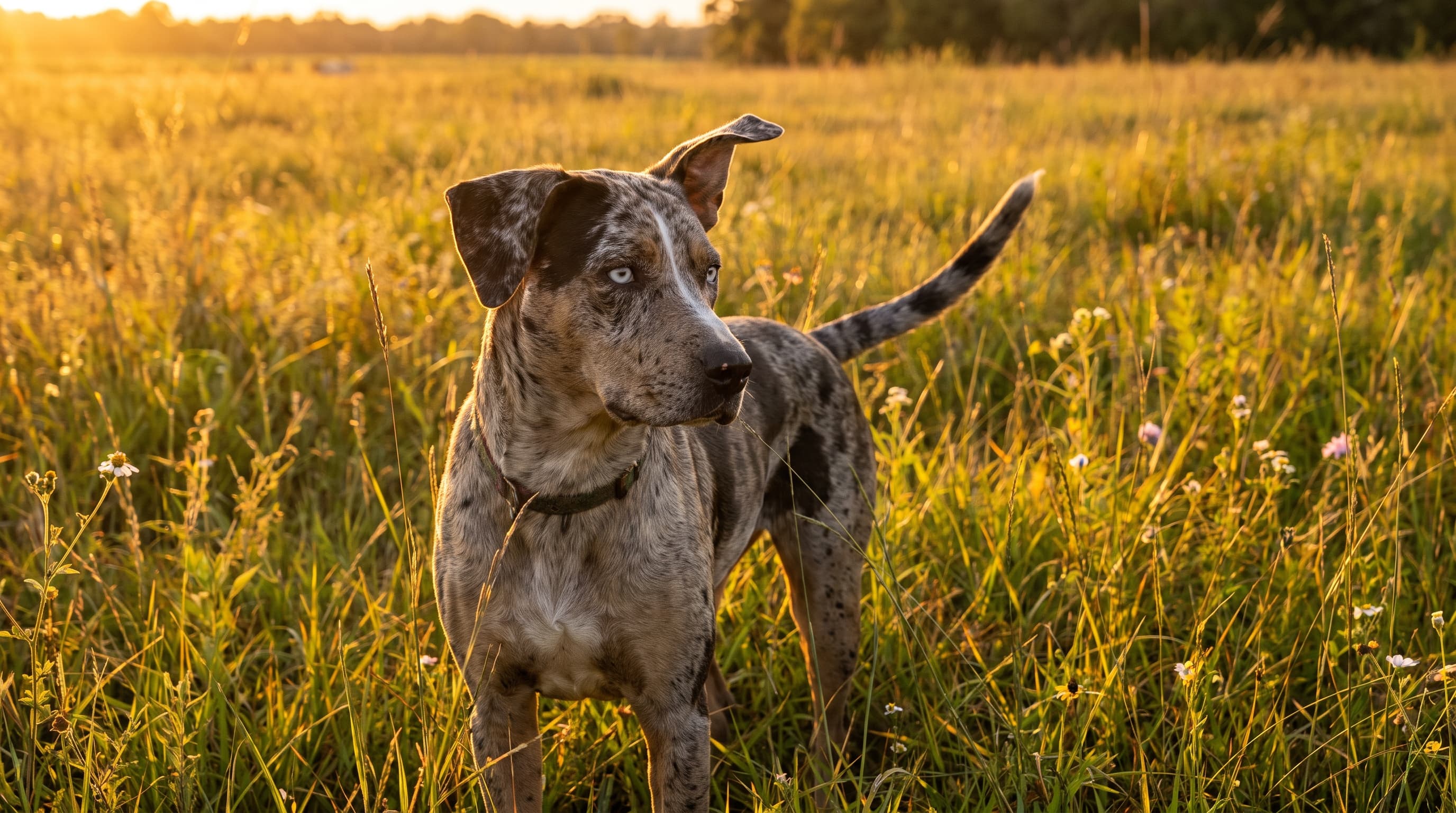

The Catahoula Leopard Dog is a medium-to-large American working breed developed in the swamps of central Louisiana from Native American, Spanish, and French dog lineages. Named the official state dog of Louisiana in 1979, the Catahoula stands 22–24 inches tall, weighs 50–95 pounds, and is best known for its distinctive merle "leopard" coat, often-blue "glass" eyes, and webbed feet. Bred for tracking and baying wild boar, this is a hard-driving working dog — not a beginner-friendly pet.
Catahoula Leopard Dog at a Glance
Before going deeper, here are the essentials prospective owners ask about most:
- Other names: Louisiana Catahoula Leopard Dog, Catahoula Cur, Catahoula Hog Dog, Leopard Catahoula
- Breed group: Working/Herding (UKC Herding Group; AKC Foundation Stock Service since 1996)
- Height: 22–24 inches at the shoulder
- Weight: 50–95 pounds (males larger than females)
- Lifespan: 10–14 years
- Coat: Short to medium, single coat — smooth or slightly coarse
- Coat patterns: Merle ("leopard"), brindle, solid, or patched in many color combinations
- Shedding: Low to moderate, year-round
- Energy level: Very high — true working-breed stamina
- Good with kids: Yes with their own family; supervise around small children due to size and prey drive
- Good with other dogs: Often challenging, especially same-sex; early socialization required
- Apartment-friendly: No — needs a securely fenced yard and a job
- Recognition: UKC (full, 1995), AKC FSS (1996), National Association of Louisiana Catahoulas (NALC)
- State dog status: Official state dog of Louisiana since 1979
Appearance
The Catahoula is one of the most visually distinctive working dogs in North America. No two look exactly alike, but the silhouette is consistent: a powerful, athletic, well-muscled dog built for stamina, swimming, and dense undergrowth.
Body: Catahoulas are slightly longer than they are tall, with deep chests, strong shoulders, and tight, well-knit feet. The frame is purpose-built for endurance over speed — they can trail a hog through a swamp for hours.
Coat patterns — the famous "leopard" look: The merle gene is what gives Catahoulas their signature mottled, patchwork appearance. Common patterns include:
- Blue leopard: Gray base with darker black or blue patches
- Red leopard: Cream or buff base with red or liver patches
- Black leopard: Black base with gray or white mottling
- Brindle: Striped tiger-like pattern
- Solid: Single color with optional white trim on chest, legs, or face
- Patched: Large blocks of color on a white base
Eyes — "glass" and "cracked": Catahoulas are famous for their eyes. They may be brown, amber, green, blue, or any combination, and many display heterochromia (two different-colored eyes) or "cracked" eyes (a single eye with two distinct colors). Pale-blue or ice-blue eyes are called "glass eyes," and they're considered a hallmark of the breed.
Webbed feet: One of the Catahoula's most functional traits — true webbing between the toes lets them swim strongly and move through marsh, mud, and soft ground that would bog down most breeds. This is original-equipment Louisiana swamp adaptation.
Head and expression: The head is broad and powerful with a moderate stop, a strong muzzle, and drop ears that hang close to the cheeks. Expression is alert, intense, and watchful — never sleepy.
History
The Catahoula is one of the oldest American dog breeds, with roots reaching back to before European contact. Its story is essentially the story of Louisiana itself: three cultures, three dog lineages, and one of the harshest hunting environments in North America.
Native American roots: Long before Europeans arrived, the Choctaw and other Indigenous peoples of the lower Mississippi Valley kept domesticated wolf-like dogs for hunting and camp life. These dogs were the foundation stock.
Spanish influence (1500s): When Spanish explorers — including Hernando de Soto's expedition — moved through the region in the 16th century, their mastiffs, greyhounds, and war dogs interbred with the native dogs. This added size, scenting ability, and the merle coat gene that would become the breed's signature.
French influence (1700s): French settlers arriving in the 17th and 18th centuries are widely credited with introducing the Beauceron, a French herding dog, into the mix. This is where the modern Catahoula's herding-style gather-and-bay working method comes from.
The name: "Catahoula" likely derives from the Choctaw language. One common theory combines okhata (lake) and hullo (beloved); another traces it to Couthaougoula, the name of a Choctaw nation in the region. The breed is named after Catahoula Parish in north-central Louisiana.
Hog hunting heritage: Louisiana settlers used Catahoulas to control populations of feral pigs — descendants of escaped Spanish swine — that ravaged crops and forests. The Catahoula's working method is unique: a "catch and bay" style where dogs work in groups, with some circling and barking to hold the boar in place while others rush in. Strong, brave, and tough enough to face a 200-pound wild hog without being killed, the Catahoula became indispensable to Louisiana ranchers and hunters.
State dog status: In 1979, Louisiana Governor Edwin Edwards signed legislation naming the Catahoula Leopard Dog the official state dog of Louisiana, recognizing its central role in the state's agricultural and cultural history.
Modern recognition: The United Kennel Club granted full recognition in 1995, placing the breed in the Herding Group. The American Kennel Club accepted the breed into its Foundation Stock Service in 1996, where it remains today. The NALC, founded in 1977, is the breed's oldest and most active dedicated registry.
Temperament & Personality
The Catahoula's personality is rooted in its working history. This is a serious, intelligent, independent dog bred to think and act on its own at the end of a long day in a swamp. That same independence is what makes them difficult pets in the wrong home.
With family: Catahoulas bond intensely with their people and are deeply loyal. They're affectionate and even goofy with those they trust, but the affection is measured — this is not a Labrador. Expect a velcro dog who follows you room to room and a watchful protector who knows where every family member is at all times.
With strangers: Reserved-to-aloof, never indiscriminately friendly. A well-socialized Catahoula will tolerate visitors politely once their owner welcomes them; a poorly socialized one can become territorial or fearful. This is a natural watchdog — they'll alert-bark at strangers and intruders, and they take that job seriously.
With children: Generally good with kids in their own family, especially when raised together. Their size, speed, and intensity make them better suited to households with older children (8+) than with toddlers. Supervise interactions with visiting kids, who don't know the dog.
With other dogs: This is one of the breed's known challenges. Catahoulas can be dog-aggressive, particularly with same-sex dogs of similar size. Early, ongoing socialization is mandatory, and many owners find their adult Catahoula does best as the only dog, or paired only with an opposite-sex partner.
With other pets: Prey drive is intense. Catahoulas bred for boar hunting see small running animals as prey. Cats, rabbits, chickens, and small dogs may not be safe without extensive socialization from puppyhood, and even then, individual dogs vary.
Independence and stubbornness: Catahoulas were bred to make decisions without a handler nearby. They're not biddable in the way a Border Collie or Golden Retriever is. They will assess, decide, and act — which is brilliant in the woods and frustrating in obedience class.
Health
Most Catahoulas are tough, hardy dogs with few breed-specific health issues — but a handful of conditions, particularly those tied to the merle coat gene, are critical for prospective owners to understand.
Deafness and double-merle breeding — the critical warning: This is the single most important health issue in the breed, and it's entirely avoidable through responsible breeding. The merle gene that produces the famous leopard coat is a dominant mutation that also affects pigment in the inner ear. When two merle-patterned dogs are bred together, roughly 25% of the resulting puppies will be "double merles" (MM) — predominantly white dogs with serious health consequences:
- Deafness: Approximately 10% of double-merle Catahoulas are deaf in one or both ears, due to the absence of pigment cells in the inner ear (the same cells the body uses for both coat color and hearing).
- Eye abnormalities: Microphthalmia (abnormally small or non-functional eyes), colobomas, cataracts, and partial-to-complete blindness are all significantly elevated in double-merle dogs.
- Other developmental issues: Skeletal, cardiac, and reproductive abnormalities occur at higher rates.
Reputable breeders never breed merle to merle. If a breeder offers a "rare white" Catahoula puppy at a premium price, walk away — that's a double-merle, and the puppy has likely been produced through irresponsible breeding. The NALC and other major registries strongly discourage the practice.
Other conditions to watch for:
- Hip dysplasia: A malformation of the hip joint that can lead to arthritis and lameness. Reputable breeders OFA-test parent dogs.
- Elbow dysplasia: Less common than hip but worth screening.
- Eye conditions in non-double-merle dogs: Progressive retinal atrophy and cataracts can still occur.
- Bloat (gastric dilatation-volvulus): Like many deep-chested breeds, Catahoulas can be at risk. Feed two smaller meals rather than one large one, avoid heavy exercise within an hour of meals, and learn to recognize symptoms (unproductive retching, distended belly, restlessness) as a veterinary emergency.
- Skin issues: Allergies and demodectic mange occur occasionally.
The breed's typical lifespan of 10–14 years assumes good preventive care: annual vet visits, parasite prevention, hip and eye screening from breeding stock, and weight management.
Exercise Needs
Among American working breeds, the Catahoula is one of the most demanding. This is not a once-a-day walk dog. Plan for a minimum of 1.5–2 hours of vigorous activity every day, and ideally a "job" — something that gives the dog a purpose beyond just burning calories.
What a Catahoula needs:
- 60–90 minutes of off-leash running or hiking on a typical day
- Swimming whenever possible — they're built for it and love water
- A securely fenced yard (6 feet minimum) for daily decompression
- Mental work: tracking, scent games, advanced obedience, agility, or barn hunt
- A real job: herding, hog hunting, search and rescue, or competitive dog sports
Catahoulas left under-exercised will not become calm couch dogs — they'll become destructive, vocal, fence-jumping problem dogs. Owners who can hike, run, bike, or work their dog daily will be rewarded with a steady, focused companion. Owners who can't will end up returning the dog to rescue.
Climate and conditions: The short coat handles heat better than a Husky or Malamute but offers little insulation in cold weather; a winter coat or jacket helps below freezing. They can work in heavy cover, mud, and water with no fuss.
Training
Catahoulas are intelligent and capable of learning almost anything, but they are not for first-time owners. The combination of independence, intensity, and stubbornness requires an experienced handler who can lead without coercion.
What works:
- Positive reinforcement with high-value rewards (food, toys, the chance to work)
- Clear, consistent rules from day one — no exceptions
- Short, varied sessions that engage the brain
- Early socialization (8–16 weeks) with people, dogs, sights, sounds, and surfaces
- A confident handler who can stay calm and patient under pressure
What doesn't:
- Harsh corrections, alpha-rolls, or physical punishment — Catahoulas will shut down or escalate
- Inconsistency — they will exploit any gap in the rules
- Skipping socialization "because they'll grow out of it"
- Off-leash freedom without an airtight recall — their prey drive overrides training in a heartbeat
Owners often borrow training principles from other working breeds — see our guides to the Anatolian Shepherd, Australian Shepherd, and Belgian Malinois for parallel approaches. For a deeper dive, check out Anatolian Shepherd.
Early socialization is non-negotiable. Without it, the Catahoula's natural wariness becomes fear or aggression, and the prey drive becomes uncontrollable. A puppy class with a trainer experienced in working breeds is the best money you'll spend on the dog.
Grooming
Grooming is the easiest part of owning a Catahoula. The short, single coat sheds moderately year-round but doesn't blow coat seasonally the way double-coated breeds do.
- Brushing: Once a week with a rubber curry brush, grooming mitt, or short-bristle brush. Pick up loose hair, distribute skin oils, and check for ticks and burrs.
- Bathing: Every 6–12 weeks, or as needed after particularly muddy outings. Over-bathing dries out the coat.
- Nails: Trim every 3–4 weeks. Working dogs may wear nails down naturally on rough terrain, but most pet Catahoulas need help.
- Ears: Check weekly and clean as needed. The drop ears can trap moisture, especially after swimming.
- Teeth: Brush several times a week with dog-safe toothpaste; annual dental cleanings under anesthesia as recommended.
- Eyes: Wipe gently if you see discharge; report any cloudiness or sudden changes to your vet.
Nutrition
Catahoulas are active, athletic dogs with the metabolism of a true working breed. They need a diet that fuels long days of activity without packing on weight during downtime.
What to look for:
- A high-quality commercial food (or a vet-supervised raw or home-cooked diet) with real animal protein as the first ingredient
- Formulated for active large-breed adults, with appropriate calcium-to-phosphorus ratios
- Roughly 25–30% protein and 12–18% fat for active adults
Portion guide: A typical adult Catahoula eats roughly 2.5–4 cups of dry food per day, split into two meals. Working dogs or those running long distances may need more; older or less active dogs need less. Adjust based on body condition: you should be able to feel ribs without pressing hard.
Puppy considerations: Feed a large-breed puppy formula to control growth rate and reduce orthopedic problems. Slower, steadier growth is better for hips and joints than rapid weight gain.
Bloat precautions: Split daily food into two meals rather than one. Avoid vigorous exercise for at least an hour before and after eating. Use a slow-feeder bowl if your dog gulps.
Is the Catahoula Right for You?
This breed isn't for everyone — and that's not a marketing line, it's the truth. Catahoulas are returned to rescue more often than the average breed because owners underestimate the commitment.
The Catahoula is a great fit if you:
- Have prior experience with working or guarding breeds
- Live on rural land, a homestead, or a property with significant fenced acreage
- Can commit 1.5–2 hours of real exercise daily, every day, in any weather
- Want a deeply loyal protector and adventure partner
- Can offer a structured "job" — hunting, herding, dog sports, hiking, or scent work
- Are confident with consistent, fair leadership
The Catahoula is probably not for you if:
- You're a first-time dog owner
- You live in an apartment, condo, or small urban home
- You work long days with the dog left alone
- You have other same-sex dogs, free-roaming small pets, or cats you can't keep separate
- You're hoping for a calm, biddable, off-the-shelf family dog
- You aren't prepared to commit to early, intensive socialization
Finding a Catahoula
Reputable breeders: Start with the National Association of Louisiana Catahoulas breeder directory. Good breeders will:
- Health-test parent dogs for hips, elbows, and eyes (OFA or equivalent)
- Never breed merle to merle
- Raise puppies in the home with early socialization
- Ask you as many questions as you ask them
- Offer a written contract with a take-back clause
- Be transparent about temperament, working ability, and known issues in the line
Red flags — beware double-merle breeding: Walk away from any breeder who advertises "rare white" Catahoulas, charges extra for predominantly white puppies, or can't tell you the merle status of both parents. Walk away from breeders with multiple breeds, who pressure you to "decide today," or who refuse to let you visit. Avoid breeders selling through pet stores or online classified ads.
Rescue: Catahoulas land in shelters more often than their popularity suggests, because so many people get the breed without understanding the commitment. Try Catahoula Rescue Inc., regional cur-breed rescues, and general shelters in the South — Louisiana, Texas, Mississippi, and Alabama all have steady supplies. Petfinder searches for "Catahoula" or "Catahoula mix" surface dozens at any given time.
Cost of Ownership
Initial costs:
- Puppy from a reputable breeder: $600–$1,200
- Rescue adoption: $150–$400
- Initial vet visit, vaccinations, microchip: $250–$500
- Spay/neuter: $250–$600 (more for large males)
- Supplies (heavy-duty crate, harness, leash, bed, bowls, toys): $400–$700
- Secure fencing (if needed): $1,500–$5,000+ depending on yard size
Annual ongoing costs:
- Food: $500–$900
- Routine vet care: $400–$700
- Parasite prevention (heartworm, flea, tick): $200–$400
- Pet insurance: $400–$800
- Training (especially in year one): $300–$1,500
- Toys, gear, miscellaneous: $200–$400
Plan for roughly $2,500–$4,500 in year one (excluding fencing) and $1,800–$3,500 annually thereafter. Emergency vet bills — torn ACL, foreign-body surgery, bloat — can add $3,000–$8,000 in a single incident. Pet insurance pencils out well for active working dogs.
Frequently Asked Questions
Is the Catahoula Leopard Dog a good family dog?
Yes, for the right family. Catahoulas are deeply loyal to their people and generally good with children they're raised with. But they need an active, experienced family with the time to provide 1.5–2 hours of daily exercise, early socialization, and consistent training. They're not a fit for first-time owners or sedentary households.
Are Catahoulas aggressive?
Catahoulas are not human-aggressive by nature, but they are protective and wary of strangers, and they have a strong prey drive. Same-sex dog aggression is a known issue in the breed. With early socialization and consistent training, most Catahoulas are stable, trustworthy companions. Without it, problems are likely.
How rare is the Catahoula Leopard Dog?
Catahoulas are uncommon outside the American South but not truly rare. They remain in the AKC's Foundation Stock Service rather than fully recognized status, so they don't appear in the AKC's annual popularity rankings. NALC and UKC registries track thousands of dogs. You're more likely to see them in Louisiana, Texas, and surrounding states than elsewhere.
Why do Catahoulas have webbed feet?
Catahoulas were developed to work in the swamps, marshes, and bayous of Louisiana, where soft ground and standing water are the norm. Their webbed feet are a functional adaptation that lets them swim strongly and move through mud and marsh that would bog down other dogs. It's true webbing between the toes — visible when you spread the foot — not just loose skin.
What's the difference between a Catahoula and a Catahoula Cur?
They're the same breed. "Catahoula Cur," "Catahoula Hog Dog," "Louisiana Catahoula Leopard Dog," and "Catahoula Leopard Dog" all refer to the same dog. "Cur" historically referred to working dogs of mixed heritage used by farmers and hunters — the term is neutral or affectionate in Southern usage.
Why are double-merle Catahoulas dangerous to breed?
When two merle-patterned dogs are bred together, roughly 25% of puppies inherit two copies of the merle gene. These "double merle" puppies are predominantly white and have significantly elevated rates of deafness (about 10% in Catahoulas), eye abnormalities including microphthalmia and blindness, and sometimes skeletal or cardiac defects. Reputable breeders and the NALC strongly oppose merle-to-merle breeding. If a breeder offers "rare white" puppies at a premium, that's a red flag.
Can Catahoulas live in apartments?
No. Catahoulas need a securely fenced yard, daily access to open space, and a real job to be content. Apartment life almost always produces a destructive, vocal, frustrated dog that ends up in rescue. If you live in an apartment, choose a different breed.
How long do Catahoula Leopard Dogs live?
Most Catahoulas live 10–14 years. Good preventive care — annual vet visits, weight management, hip and eye screening, parasite prevention — can push lifespan toward the upper end of the range.
Is the Catahoula recognized by the AKC?
The Catahoula entered the AKC's Foundation Stock Service in 1996 and remains in FSS status, which allows participation in AKC companion events (rally, obedience, agility) but not in conformation championships. The breed has full recognition with the United Kennel Club (since 1995, Herding Group) and with the National Association of Louisiana Catahoulas.
Are Catahoulas good with other dogs?
It depends. Catahoulas raised with other dogs from puppyhood often do fine, especially with opposite-sex partners. Same-sex aggression is common, particularly between intact adults. Many Catahoulas do best as the only dog. Always introduce slowly, watch for tension, and don't assume that two Catahoulas in the same house will work out.
If the Catahoula isn't quite right for you, consider exploring other working breeds with similar drive but different temperament profiles — the Leonberger (gentler family-focused giant), the Great Pyrenees (livestock guardian), or the Australian Cattle Dog (smaller, also intense). For more on the merle gene shared across breeds, see our guide to the Australian Shepherd.