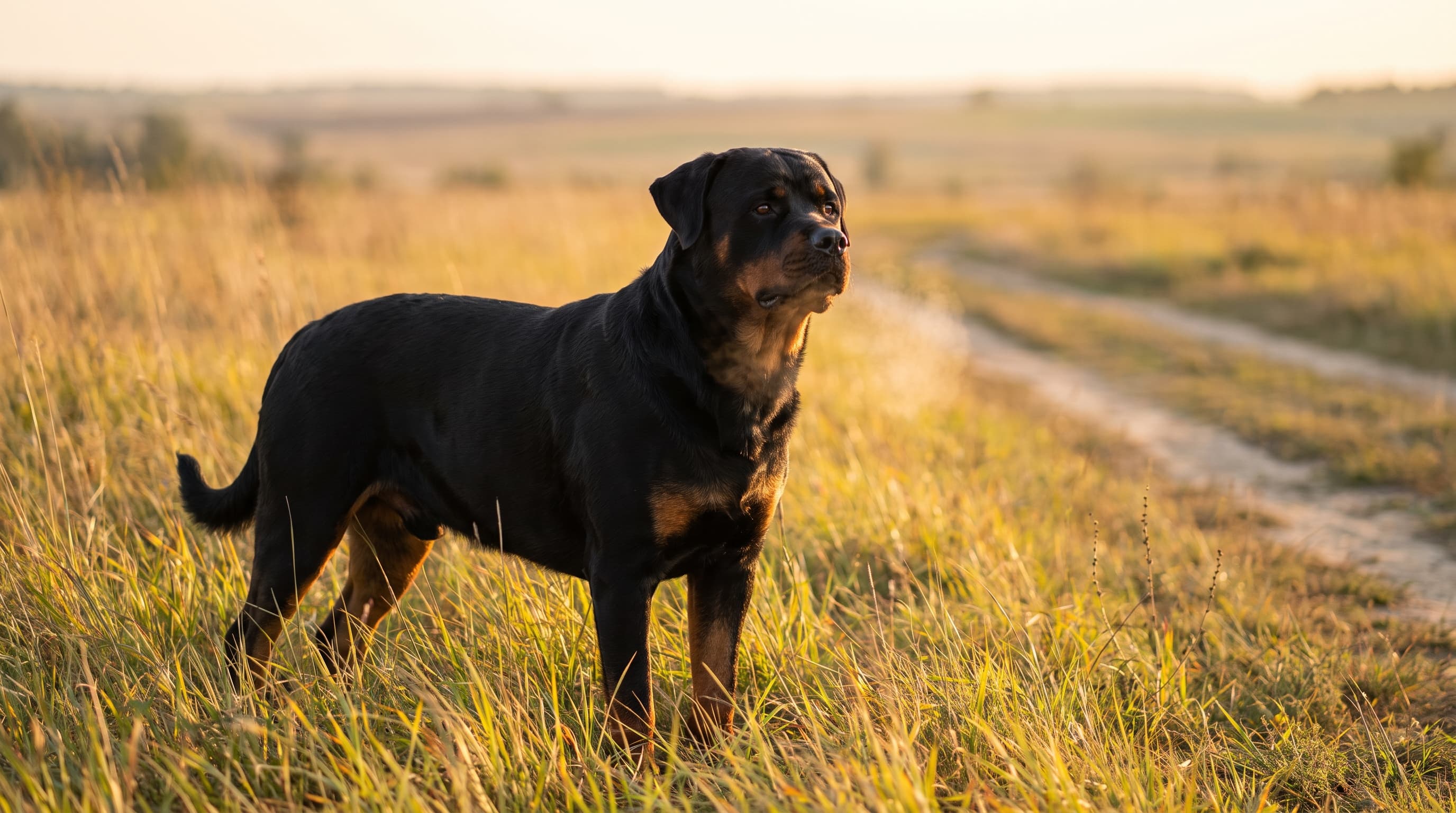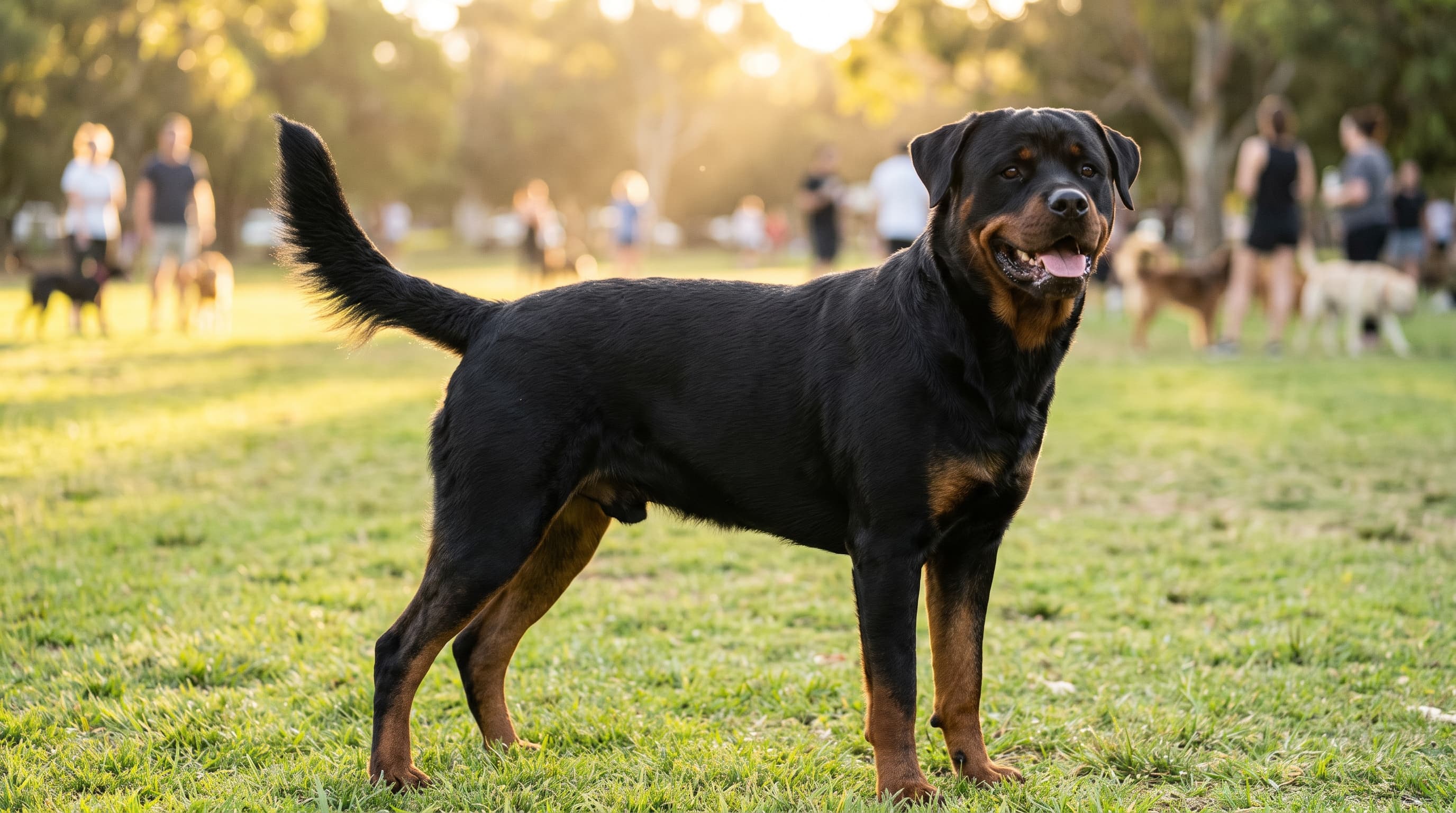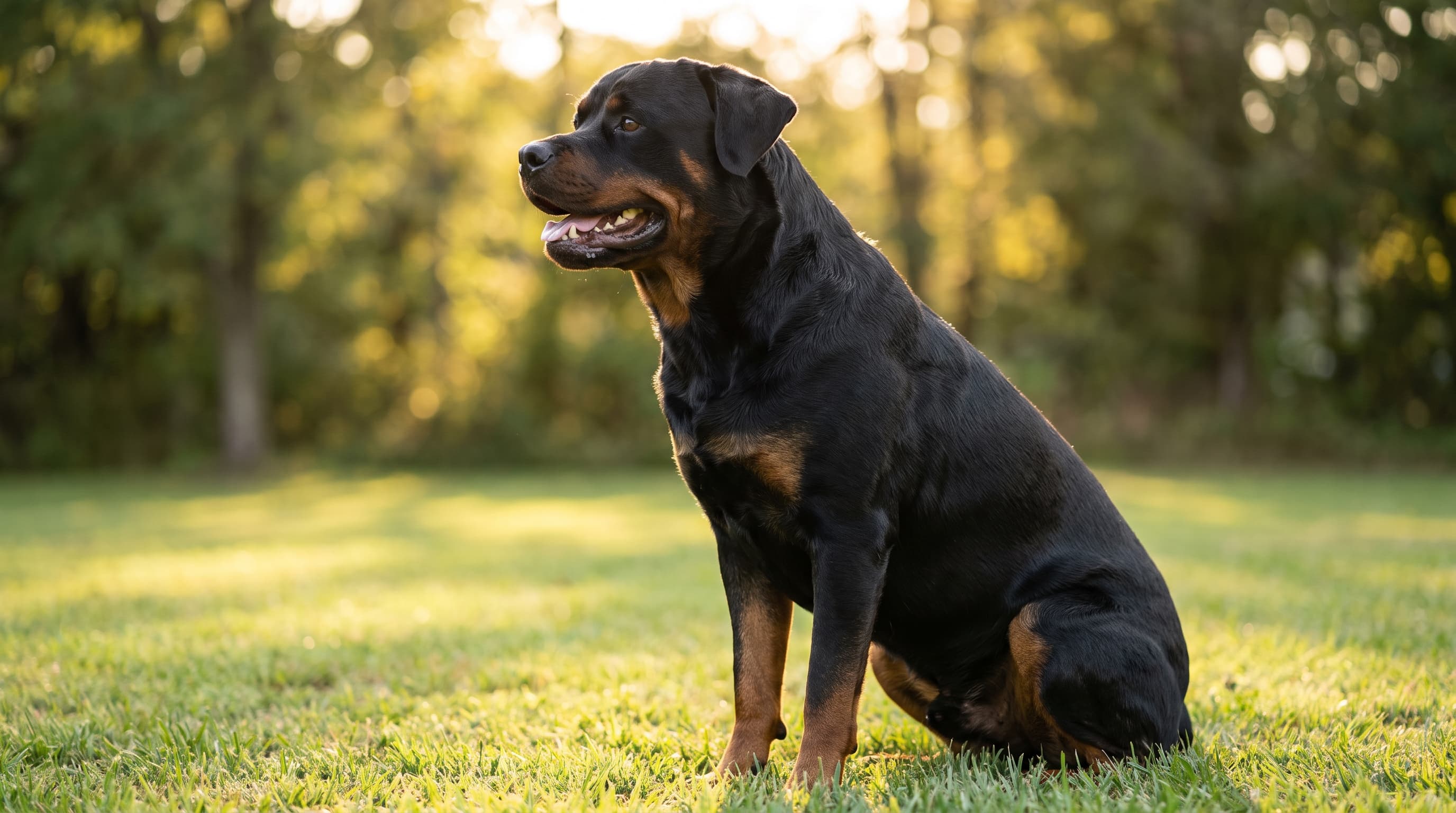

A Rottweiler's bite force is roughly 320-328 PSI (pounds per square inch), placing it among the top ten strongest bites in the domestic-dog world. That's about double a human's ~162 PSI, stronger than a German Shepherd (238 PSI) or a Pit Bull (~230 PSI), but well below specialty guard breeds like the Kangal (~700+ PSI). The most-cited figure comes from Dr. Brady Barr's controlled bite-sleeve testing on National Geographic.
What "Bite Force" Actually Means
Bite force is a measurement of pressure — how many pounds of force a jaw can apply over one square inch of surface area. It's a physics number, not a personality trait, and it's influenced by three things: skull shape, jaw musculature, and how the dog is prompted to bite during a test.
Two testing methods dominate the field:
- Sleeve/pressure-sensor bite: The dog is baited into biting a padded sleeve fitted with a load-cell sensor. This is what Dr. Brady Barr used to reach the widely quoted 328 PSI figure for Rottweilers.
- Cadaver / skull dissection modeling: Researchers estimate maximum theoretical bite force from jaw musculature and lever mechanics. This tends to produce higher numbers because it measures potential rather than actual bite behavior.
The difference matters: real-world bites on things like human skin or clothing are almost always weaker than a dog's theoretical maximum, because most dogs don't bite at full strength unless they're in prey drive or serious defense.
The 320-328 PSI Figure — Where It Comes From
Nearly every reputable source traces the Rottweiler number to Dr. Barr's 2005 National Geographic testing, which measured a trained Rottweiler at 328 PSI on a bite sleeve. Dogster, ReadyToRottweiler, and PetsCare all use the same 320-328 PSI range. Some sources round to 328 PSI; others cite the broader 320-350 PSI band.
What you'll rarely see in one place: the Rottweiler's number is a single-dog measurement, not a population average. Bite force varies dog-to-dog based on skull size, jaw muscle mass, age, training, and motivation. A well-muscled male Rottweiler could push higher; a smaller female probably wouldn't reach 328 in a real test.
How the Rottweiler Ranks Against Other Breeds
Cross-referencing Lawsuit Information Center's breed rankings and Petzooie gives a working ranking (all approximate):
- Kangal — ~700+ PSI
- Cane Corso — ~700 PSI (see our cane corso bite force deep dive)
- English Mastiff — ~552 PSI
- Tosa Inu — ~556 PSI
- Dogo Argentino — ~500 PSI
- Rottweiler — 320-328 PSI
- American Bulldog — ~305 PSI
- German Shepherd — ~238 PSI
- American Pit Bull Terrier — ~235 PSI
- Labrador Retriever — ~230 PSI
- Human — ~162 PSI
- Chihuahua — ~180 PSI (surprisingly strong for size)
The Rottweiler sits mid-pack among large guardian breeds — powerful, but not the top of the chart. For comparison, saltwater crocodiles register 3,700+ PSI and a hyena about 1,100 PSI, so no domestic dog is anywhere near the wild-carnivore ceiling.
Why the Rottweiler Bites Harder Than Most Dogs
Three anatomical features stack in the Rottweiler's favor:
- Broad, deep skull. A wider skull anchors bigger temporalis and masseter muscles — the two main jaw closers.
- Short muzzle relative to skull length. Shorter lever arms translate more muscle force into the tip of the bite.
- Heavy body mass. Adult males run 95-135 lb, giving them the base structure to power a serious grip.
The Rottweiler was bred in Germany as a drover — driving cattle to market and protecting the butcher's purse on the road home. That work rewarded a dog that could grip and hold, not just nip. Modern show and working lines still carry those bite mechanics.
Bite Force vs. Real Bite Risk
Here's the piece most bite-force articles miss: bite force is not the same as bite risk. A dog's likelihood of biting a person is driven mostly by temperament, socialization, training, and situation — not jaw physics. A well-raised Rottweiler is often calmer and more predictable than a poorly socialized small dog with a much weaker bite.
Injury severity, on the other hand, does correlate with bite force and body size. When any large-breed dog does bite, the consequences tend to be worse. The right takeaway isn't "avoid Rottweilers" — it's train, socialize, and manage any large-breed dog with respect for what its jaws can do.
Raising a Rottweiler Who Never Uses That Bite
Responsible Rottweiler ownership leans on a handful of well-worn practices:
- Early socialization (8-16 weeks): Positive exposure to people, dogs, environments, and handling. The single biggest predictor of adult behavior.
- Bite inhibition training: Puppy classes that teach soft mouth and gentle play prevent hard-mouthing habits from forming.
- Reward-based obedience: Rottweilers are highly trainable — the AKC ranks them consistently high in trainability. Force-based training risks pushback in a strong-willed dog.
- Structured exercise and mental work: 60-90 minutes daily plus training tasks or working sports (herding, obedience, protection sports with a qualified club).
- Trigger management: Even balanced Rottweilers benefit from clear rules about strangers, resource guarding, and off-leash interactions.
Our full Rottweiler breed guide covers temperament and training in detail; Are Rottweilers good with kids? and do Rottweilers shed? handle two of the most common household questions.
What to Do If You're Bitten
Because larger dogs cause more severe injuries when they bite, know the response protocol:
- Clean the wound with soap and running water for 5-10 minutes.
- Apply pressure to control bleeding; elevate the limb if possible.
- Seek medical care — deep punctures need professional cleaning and, often, antibiotics.
- Get a tetanus booster if it's been more than 5 years.
- Report the bite per local ordinance; confirm the dog's rabies vaccination status.
Most Rottweiler bites documented in the U.S. involve familiar dogs, not strangers — a reminder that management and training beat avoidance.
Rottweiler Bite Force by Age and Life Stage
- Puppies (0-4 months): Puppy needle-teeth bites are painful but weak — good time to install bite inhibition.
- Adolescents (4-18 months): Adult teeth in, jaw muscles developing, coordination unreliable. Bite force climbs quickly.
- Adults (18 months-8 years): Peak bite force — the 320-328 PSI figure fits here.
- Seniors (8+ years): Bite force gradually declines with muscle mass and dental wear.
Frequently Asked Questions
Does a Rottweiler have the strongest bite of any dog?
No. That title generally goes to the Kangal at ~700+ PSI, with the Cane Corso, English Mastiff, and Tosa Inu also outranking the Rottweiler.
How does a Rottweiler's bite compare to a Pit Bull's?
The Rottweiler's ~328 PSI is about 40% stronger than the Pit Bull's typical ~235 PSI. Body size differences amplify that gap in real-world bite injuries.
Can a Rottweiler bite through a human bone?
At full strength on a small bone (finger, wrist), yes, damage is possible. On larger long bones, dogs generally don't produce the sustained pressure needed to snap them cleanly — most severe injuries are tearing rather than breaking.
Do female Rottweilers bite as hard as males?
Slightly less on average because females tend to have smaller skulls and lighter jaw musculature, but the difference in practice is small.
Are Rottweilers dangerous because of their bite force?
Bite force alone doesn't make a breed dangerous. A well-bred, well-socialized, well-trained Rottweiler is a stable family companion. Behavior is a product of genetics and upbringing.
Is 328 PSI enough to break skin easily?
Yes. Any dog's bite over ~100 PSI will readily break human skin. That's a low bar; almost every adult dog clears it.
How is bite force actually measured in dogs?
The most common method uses a pressure-sensor sleeve or bite bar that records the maximum force applied. Results depend on the dog's motivation, testing conditions, and equipment sensitivity.
The Bottom Line
A Rottweiler's bite force of 320-328 PSI is impressive but not chart-topping — enough to demand respect and thoughtful ownership, not enough to define the breed. What determines whether that jaw ever becomes a problem is how the dog is raised. Consistent socialization, positive training, and structured exercise create Rottweilers that are calm, confident, and famously loyal — with a bite reserved strictly for their food bowl.
This article is educational and not a substitute for professional training or veterinary guidance. Work with a certified trainer for any behavior concerns.
Want more evidence-based breed content? Read our full Rottweiler breed guide or the Cane Corso bite force comparison, and subscribe to the Daily Wag newsletter for weekly breed deep-dives.