
Every Rottweiler with a tail is simply a Rottweiler in its natural state — all Rottweilers are born with a long, thick tail. The familiar "tailless" look comes from docking, a procedure done on puppies within days of birth. As docking bans spread worldwide and the AKC updated its 2025 breed standard to accept natural tails, full-tailed Rottweilers are becoming a common and increasingly celebrated sight.
If you've only ever seen Rottweilers with a short stub, meeting one with a full, wagging tail can be surprising. But the natural tail is the original — and in much of the world, it's now the only legal option. This guide explains why Rottweiler tails were traditionally docked, where the practice is banned, what the AKC's recent standard change means, and how a natural tail affects a Rottweiler's health, behavior, and looks. Curious about the breed in general first? Start with our full Rottweiler breed guide.
Are Rottweilers Born With Tails?
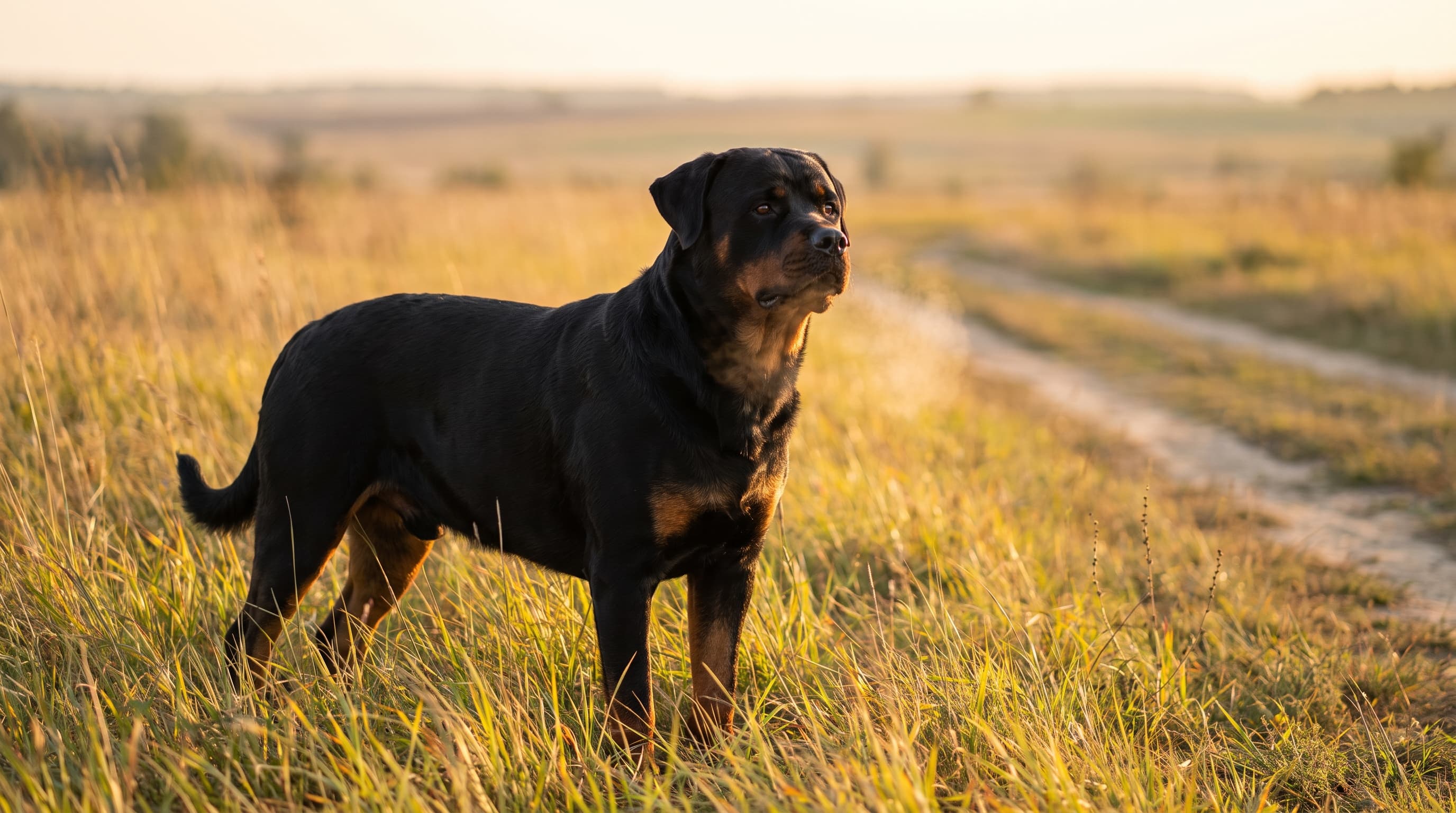
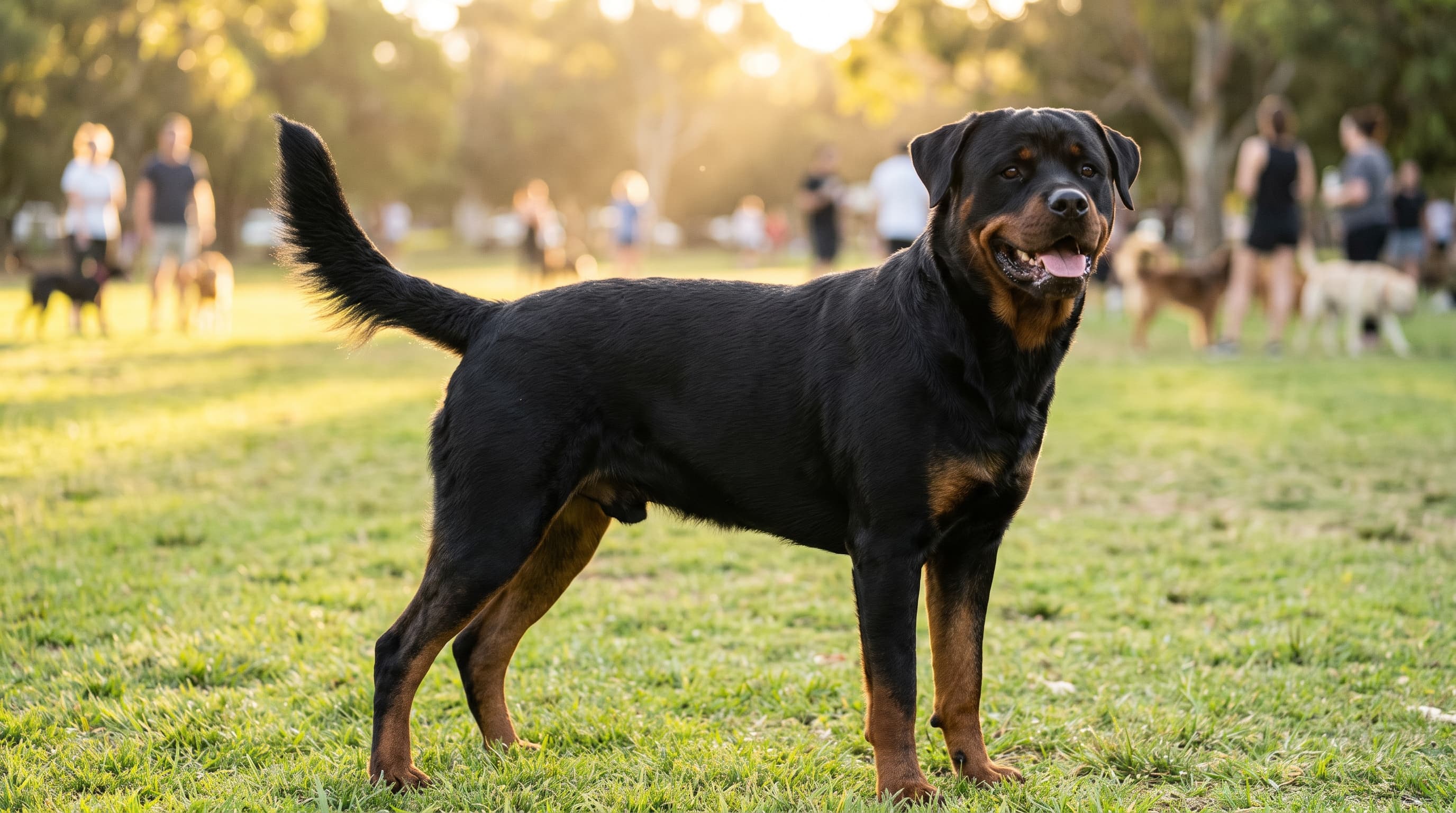
Yes. Like nearly all dogs, Rottweilers are born with a full-length tail. As Dogster explains, the breed naturally carries a medium-length tail that many dogs hold in a slight curve or straight out when alert. The tailless appearance is never genetic in a purebred Rottweiler — it is always the result of docking, where the tail is surgically shortened in the first few days of a puppy's life. A Rottweiler you see with a stub was almost certainly born with a normal tail that was later removed.
Why Rottweiler Tails Are Traditionally Docked
Tail docking in Rottweilers has deep historical roots. The breed descends from Roman drover dogs that herded livestock and pulled carts, and owners believed a docked tail was less likely to be trampled, caught in cart wheels, or bitten by the cattle the dogs drove. There were also old superstitions — dating back to Ancient Rome — that shortening the tail could ward off rabies, a belief long since debunked.
Over time, the docked look simply became the fashion for the breed. According to PetMD, docking persisted mostly as tradition and to conform to show expectations rather than for any modern working need. Today, with most Rottweilers living as family companions rather than cart-pullers, the original practical justifications no longer apply, which is a big reason attitudes are shifting. Speaking of family life, our guide on whether Rottweilers are good with kids covers what these dogs are really like at home.
The Law: Where Tail Docking Is Banned or Restricted
Cosmetic tail docking is now illegal or tightly restricted across much of the world. Germany — the Rottweiler's homeland — banned docking in 2006, permitting it only for genuine medical reasons, and the German Rottweiler club (ADRK) requires dogs to keep their natural tails. Most of Europe, the United Kingdom, Australia, and many other countries have similar bans, generally allowing tail shortening only when a veterinarian deems it medically necessary.
The United States is the major exception: there is no federal ban, and docking remains legal in every state, usually performed by breeders on newborn puppies. However, the American Veterinary Medical Association opposes cosmetic docking, and Dogster's vet-verified overview notes that many veterinarians will decline to dock a tail purely for appearance. Because it's a surgical procedure, any decision about docking or a medically necessary tail amputation should be discussed with a licensed veterinarian.
The AKC Breed Standard Change That Made Natural Tails Official
For decades, the American Kennel Club breed standard described the ideal Rottweiler as having a docked tail, which pushed many U.S. breeders to dock automatically so their dogs could compete in conformation. That changed in 2025, when the AKC updated the Rottweiler standard to accept both natural and docked tails, emphasizing the set and carriage of the tail over its length. Multiple breed sources, including PawLeaks, highlight this as a turning point: a full-tailed Rottweiler can now be shown in the ring without penalty. The AKC's breed profile continues to describe the Rottweiler as a robust, confident working breed regardless of tail length.
Natural Tail vs. Docked: Health, Behavior, and Appearance
Health considerations
Docking is performed on very young puppies and, like any surgery, carries risks such as pain, bleeding, and infection. Keeping the natural tail avoids the procedure entirely. On the other hand, working or highly active dogs occasionally injure long tails, and a very small number of dogs require a medical amputation later in life — a decision that should always be made with a veterinarian.
Behavior and communication
A tail is a key part of canine body language. Dogs use tail position and movement to signal excitement, caution, and mood, and some experts suggest that dogs with full tails may communicate more clearly with other dogs. A wagging natural tail is also, frankly, one of the most joyful things about living with a Rottweiler.
Appearance
A natural tail gives the Rottweiler a more balanced, "complete" silhouette that many owners now prefer, while others still favor the traditional docked look. Neither changes the dog's signature black-and-mahogany coat — if coat and markings fascinate you, our guide to canine coat colors is a fun deep dive.
Caring for a Rottweiler's Natural Tail
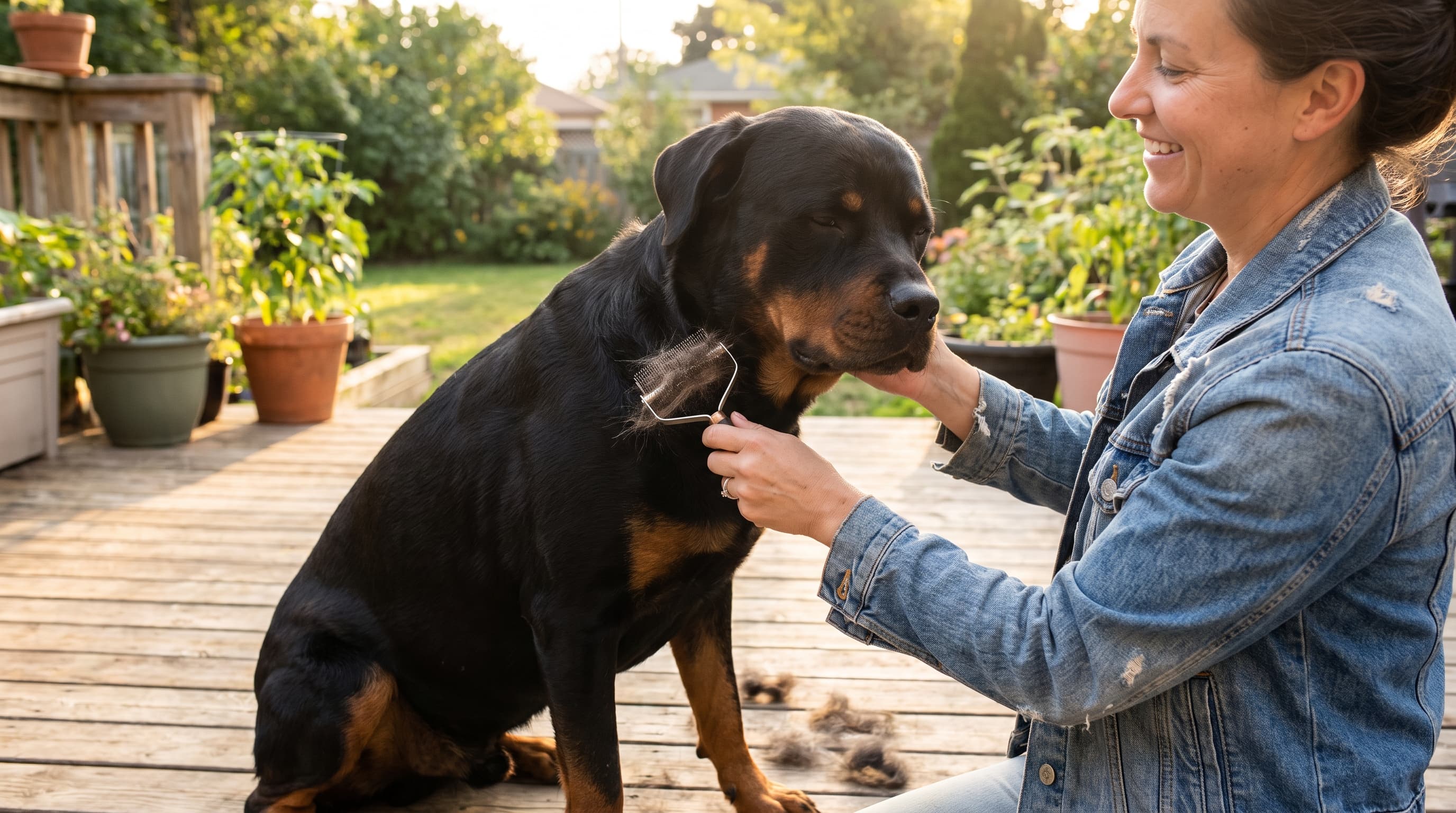
A natural tail needs very little special care, but a few habits keep it healthy. Check the tail during regular grooming for any cuts, swelling, matting, or signs of irritation, especially after vigorous play or time in dense brush. Because Rottweilers wag with real enthusiasm, some active dogs can develop "happy tail" — a sore or split tip from repeatedly banging the tail against hard surfaces like crate walls or door frames. If you notice bleeding, persistent licking, a change in how your dog carries the tail, or any sign of pain, contact your veterinarian rather than trying to treat it yourself. Routine coat care applies to the tail too: Rottweilers are moderate shedders, and you can learn more in our guide to how much Rottweilers shed. Beyond that, a natural tail simply gets to do its job — wagging, balancing, and communicating.
Should You Choose a Rottweiler With a Tail?
That's increasingly a personal and ethical choice rather than a practical one. If you live in a country where docking is banned, the decision is already made — your Rottweiler will have a natural tail. In the U.S., more breeders are leaving tails intact, both because of shifting veterinary and public opinion and because the AKC now welcomes natural-tailed dogs in the show ring. If keeping your dog's natural anatomy matters to you, seek out a breeder who does not dock. Whichever look you prefer, temperament, health testing, and responsible breeding matter far more than tail length when choosing a puppy.
Frequently Asked Questions
Do Rottweilers naturally have tails?
Yes. All Rottweilers are born with a full-length natural tail. The short-tailed appearance seen on many Rottweilers is the result of docking, not genetics.
Is it legal to dock a Rottweiler's tail?
It depends on where you live. Cosmetic docking is banned or heavily restricted in Germany, the UK, most of Europe, and Australia, but it remains legal throughout the United States, where it's typically done by breeders on newborn puppies.
Did the AKC change its rules on Rottweiler tails?
Yes. In 2025 the AKC updated the Rottweiler breed standard to accept both natural and docked tails, so a full-tailed Rottweiler can now be shown in conformation without being penalized.
Are natural-tailed Rottweilers still purebred?
Absolutely. A tail has no bearing on pedigree. A Rottweiler with a natural tail is exactly as purebred as a docked one — it simply hasn't had the docking procedure.
Do natural-tailed Rottweilers behave differently?
Their temperament is the same, but a full tail lets them communicate through body language more completely. Some trainers believe dogs with intact tails signal mood and intent more clearly to other dogs, which can make greetings and play read a little more smoothly.
Can you show a Rottweiler with a natural tail?
Yes. Since the AKC's 2025 standard update accepts both natural and docked tails, a full-tailed Rottweiler can compete in conformation in the United States without penalty, and natural tails have long been required in many other countries.
Is docking painful for the puppy?
Docking is a surgical procedure and does cause pain, which is a central reason major veterinary organizations oppose cosmetic docking. Any tail procedure should be discussed with a licensed veterinarian, who can advise on what is appropriate and humane for an individual dog.
Fascinated by this powerful, devoted breed? Explore more Rottweiler reading — from our complete breed guide to Rottweiler bite force — and subscribe to the Daily Wag newsletter for daily, dog-obsessed guides delivered straight to your inbox.