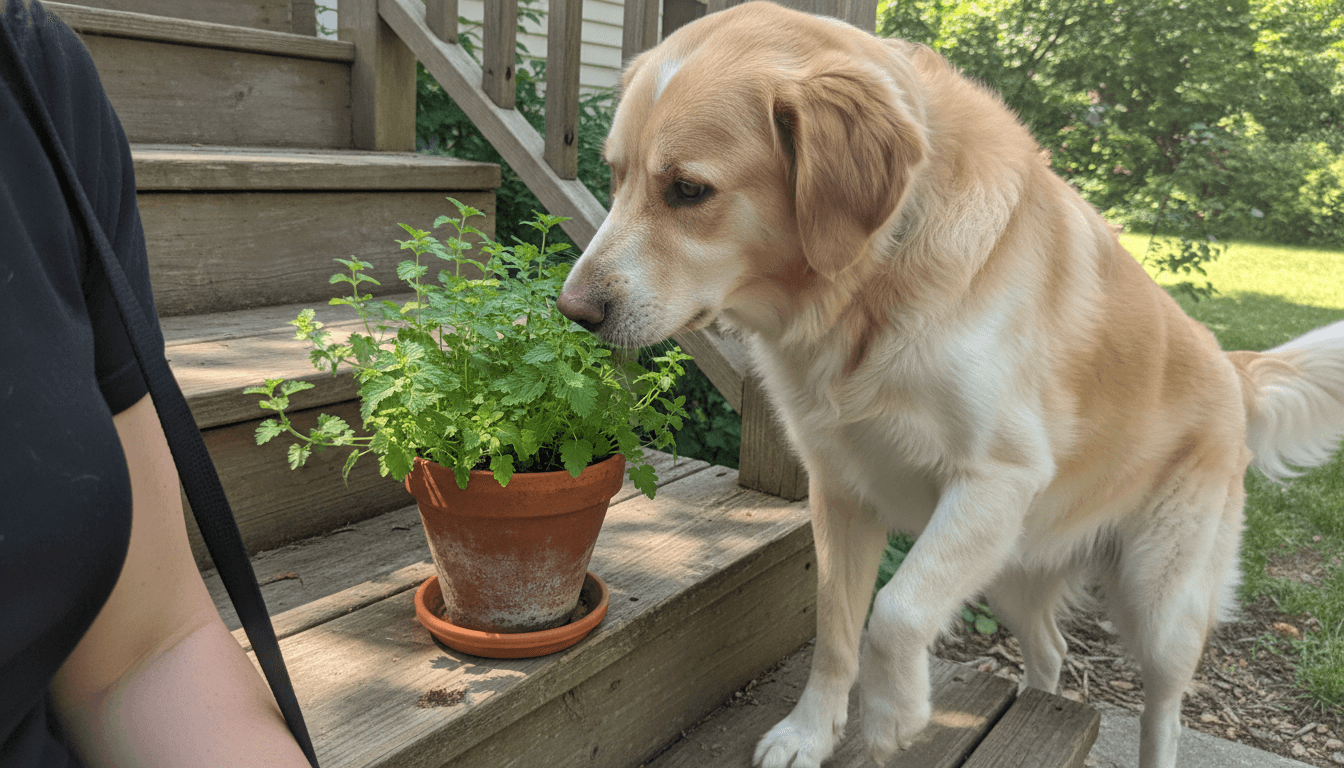

Mostly no — catnip doesn't work on dogs the way it works on cats. The famous catnip "high" — rolling, drooling, twirling, kicking — is a cat-specific response triggered by a compound (nepetalactone) that hits a sensory organ dogs don't use the same way. In dogs, catnip is usually a non-event. A minority of dogs show a mild calming or sedative effect; a few get a small stomach benefit; many notice nothing at all. So if you sprinkled catnip on your dog's toy expecting kitty-style fireworks, the silence isn't a defect — it's normal canine biology. For a deeper dive, check out Is Catnip Safe for Dogs.
Quick Answer: Does Catnip Work on Dogs?
- Does catnip get dogs high? No. Dogs don't have the same nepetalactone receptor response cats do.
- Does catnip do anything to dogs? In about 1 in 3 dogs, a mild calming or sedative effect. The rest react little or not at all.
- Is catnip safe for dogs? Yes, in small amounts. The ASPCA doesn't list Nepeta cataria as toxic to dogs.
- How much catnip can a dog have? Roughly 1/8 to 1/2 teaspoon of dried catnip sprinkled on food, no more than once a day.
- What if I want the cat-style "wild" reaction in my dog? Try anise (aka "dognip"), not catnip. Different compound (anethole), different mechanism, opposite effect.
The Short Answer: What Catnip Actually Does in a Dog's Body
Catnip (Nepeta cataria) is a member of the mint family. Its active compound, nepetalactone, is released when the leaves are crushed, chewed, or bruised. In cats, nepetalactone binds to receptors in the vomeronasal organ (a specialized scent organ in the roof of the mouth) and triggers a roughly 10-minute behavioral high that mimics female pheromone signaling.
Dogs have a vomeronasal organ too. But the nepetalactone-receptor binding that produces the dramatic feline response simply doesn't happen the same way in canines. As MetLife's veterinary advisors note, when catnip does have an effect on dogs, it's the opposite of the cat reaction — a mild sedative rather than a stimulant.
In practical terms, that means most dogs sniff catnip, log it as "another minty plant," and walk away. A subset will lie down a little sooner, settle a little easier, or burp a little less after a meal. None will roll across the floor like a cat on a bender.

Why Cats Go Wild and Dogs Mostly Don't
The cat-vs-dog catnip divide comes down to receptor biology. A 2021 study published in Science Advances showed that plant iridoids — nepetalactol from silver vine and the related nepetalactone from catnip — activate the μ-opioid reward pathway in domestic cats, lions, and tigers, raising β-endorphin levels and producing the euphoric rolling, rubbing, and face-mashing. Roughly two-thirds of cats respond; the trait is heritable.
Dogs evolved without that same opioid-receptor link to iridoid compounds. Their reward chemistry simply isn't tuned to nepetalactone. The molecule still enters the nose, the brain still registers a scent, but the dramatic dopamine-and-opioid cascade that defines the cat response doesn't fire.
What dogs do get is the herb's mild GABA-modulating and antispasmodic properties. Nepetalactone is structurally similar to compounds in valerian root, which has long been used as a calming herb in both humans and dogs. That's why some dogs — though not all — show a small drop in arousal after a measured dose.
The percentage of dogs who respond is hard to pin down precisely. Anecdotal data from veterinarians and the Whole Dog Journal's reporting on the herb puts it in the rough neighborhood of 25–35%. The rest are non-responders — which is also normal.
What You Might See If You Give Your Dog Catnip
If your dog is a responder, the signs are subtle. You're looking for shifts toward lower arousal, not the spinning and head-rubbing you'd expect in a cat. Watch for:
- Slower, deeper breathing within 5–15 minutes
- Soft eyes, partially closed
- A willingness to lie down and stay down
- Less reactivity to the doorbell, footsteps, or the cat walking past
- A small, slightly slack mouth — not panting, just relaxed
If your dog is a non-responder, you'll see… nothing. They'll sniff the catnip, possibly lick a few crumbs, and resume their day. This is by far the most common outcome. It does not mean catnip is "broken" or that your dog is "doing it wrong."
A small number of dogs go the other way and become mildly restless or get an upset stomach. This is usually a sign you've given too much, or that catnip simply isn't a good fit for that dog. Stop and don't try it again.
How to Try Catnip With Your Dog (Safely)
If you want to test whether your dog is in the responder minority, follow these rules. The goal is "small, infrequent, observed" — not "experiment liberally."
Step 1: Get clean, dog-safe catnip
Use dried, organic catnip — the same kind sold for cat toys is fine, as long as there are no added oils, sweeteners, or "catnip blends" with unknown additives. Avoid catnip essential oils for dogs entirely; concentrated essential oils can irritate the gut and liver.
Step 2: Start with a tiny dose
The most commonly cited starting dose, recommended by veterinary clinics and vet-reviewed pet outlets, is roughly 1/8 to 1/2 teaspoon of dried catnip sprinkled on food, scaled to the dog's weight:
- Small dog (under 20 lb): 1/8 teaspoon
- Medium dog (20–50 lb): 1/4 teaspoon
- Large dog (50–90 lb): 1/3 to 1/2 teaspoon
- Giant breed (over 90 lb): up to 1/2 teaspoon
Always start at the low end and work up only if your dog tolerates it and you want to confirm a response.
Step 3: Time it around the stress event
Catnip's peak effect, when it has one, is roughly 15–30 minutes after ingestion. So give it about half an hour before the thunderstorm rolls in, the houseguests arrive, or you load the dog into the car for a trip to the vet. Catnip is not an emergency calming tool — it's a gentle pre-event nudge.
Step 4: Observe for two hours, then call it
If you see calming effects, great — note the dose and use it sparingly (no more than once a day, a few times a week). If you see nothing, your dog is a non-responder and there's no benefit to repeating. If you see GI upset or restlessness, stop and don't retry.
5 Dog-Specific Alternatives That Actually Work
If catnip didn't move the needle and you're still looking for a low-risk calming herb, dogs have their own short list of botanicals with better evidence behind them. Talk to your veterinarian before adding any new supplement, especially if your dog is on medication, pregnant, or under one year old.
1. Anise ("dognip")
If you wanted the cat-style reaction in your dog, anise (Pimpinella anisum) is the closest equivalent. Its active compound, anethole, produces excitement, playfulness, and bursts of energy in roughly half of dogs who try it — the mirror image of the catnip response. Anise is the most common ingredient in scent-trail training products and in lures used by professional dog handlers. A pinch on a toy or training treat is plenty.
2. Valerian root
Valerian is the closest botanical relative of catnip in terms of effect on dogs — except it works more reliably. PetMD's vet-reviewed guide to valerian root for dogs describes it as a mild sedative that works on GABA receptors (the same target as benzodiazepines) and can help short-term with noise phobia, travel stress, and situational anxiety. Dosing is dog-specific and should be set by your vet; over-the-counter dog calming blends often combine valerian with chamomile and passionflower for this reason. Important: valerian can interact with anesthetics and sedative drugs, so always tell your vet before a scheduled procedure.
3. Chamomile
Chamomile is one of the gentlest calming herbs for dogs and is the most commonly recommended alternative by veterinary clinics. It has mild antispasmodic and anti-inflammatory properties that can help with both stress and a nervous stomach. Brewed as a cooled tea added to drinking water (about 1 tablespoon of tea per 10 lb of body weight) is a typical home use.
4. Passionflower
Passionflower (Passiflora incarnata) supports GABA activity in the brain and is often used in canine anxiety formulations alongside valerian. It's particularly useful for dogs with situational anxiety — fireworks, separation, vet visits — rather than chronic anxiety disorders.
5. L-theanine and casein-based supplements
Not herbs, strictly speaking, but worth mentioning: L-theanine (the calming amino acid in green tea) and alpha-casozepine (a milk-protein derivative) both have small but real evidence bases in canine anxiety. They're the active ingredients in widely-used over-the-counter calming chews. They're often a better first stop than catnip for situational anxiety because the response rate is higher and the dose is standardized.
When Catnip (or Any Herb) Won't Cut It: Talk to Your Vet
Catnip is a low-risk, low-reward tool for dogs. It's great for the curious dog parent who wants to see whether their pup is in the responder minority. It is not a treatment for clinical anxiety, separation anxiety, noise phobia, reactivity, or aggression.
If your dog is panting, pacing, drooling excessively, hiding, destroying things when alone, or has trouble sleeping, those are signs of a real anxiety problem — not a "needs more catnip" problem. The right next step is a conversation with your veterinarian or a board-certified veterinary behaviorist. Prescription anxiolytics, structured behavior modification, and environmental management have far stronger evidence than any herb.
Tufts Cummings School of Veterinary Medicine's overview of canine anxiety, written by board-certified animal behaviorist Dr. Stephanie Borns-Weil, is a solid starting point if you're not sure whether what you're seeing is normal nerves or something more.
FAQ: Catnip and Dogs
Does catnip make dogs sleepy?
Sometimes — in roughly 25–35% of dogs, catnip produces a mild calming or sedative effect within 15–30 minutes of a small dose. The rest of the population shows little or no response. It is not a reliable sleep aid and shouldn't be used as one.
Will my dog react to a cat toy filled with catnip?
Usually no. Most dogs treat a catnip toy like any other plush — sniff it, maybe carry it, possibly chew it. The catnip itself rarely produces a visible reaction. The bigger concern is the toy's stuffing if your dog is a heavy chewer; check the toy is dog-safe before leaving it out.
Is there a "dognip" that works the same way catnip works on cats?
The closest equivalent is anise — sometimes marketed as "dognip." Its active compound, anethole, triggers excitement and play behavior in many (not all) dogs. It's the herb commonly used in scent-trail training and in lure products for handler-led dog sports.
Can puppies have catnip?
Most veterinarians recommend waiting until a dog is at least 12 months old before introducing catnip or any calming herb. Puppies have developing digestive and nervous systems, and their reactions to plant compounds are less predictable. Talk to your vet first.
How long does catnip take to work on dogs?
When catnip does produce a response, the peak effect typically arrives 15–30 minutes after a small oral dose and lasts about an hour. If you're using it before a known stressor (storm, car ride, fireworks), give it roughly half an hour in advance.
Can catnip make a dog sick?
In very large doses, yes — most commonly vomiting or diarrhea from the herb itself, or GI obstruction from chewed-up plant matter. The dose ranges in this article (1/8 to 1/2 teaspoon depending on dog size) are well below the threshold for problems in healthy adult dogs. If your dog ate a large quantity, call your vet or the ASPCA Animal Poison Control Center (888-426-4435).
Does silver vine work on dogs like it works on cats?
No. Silver vine triggers the same iridoid-receptor euphoria in cats that catnip does — often more strongly — but dogs don't have the receptor wiring to respond. There's no canine equivalent of silver vine; for dogs, anise is the closest thing to a "make my pet excited" herb.
The Bottom Line
If you were hoping catnip would give your dog a few minutes of feline-style chaos: it won't. If you were hoping for a gentle, low-risk calming nudge before a thunderstorm, it might help — for the 1 in 3 dogs who happen to respond. Either way, the herb is generally safe at small doses, and the experiment costs you nothing but the time it takes to sprinkle a pinch on dinner and watch.
For everything beyond mild curiosity calming, you have better tools: anise for excitement, valerian and chamomile for measurable calm, prescription help from your vet for actual anxiety. Catnip is a fun side trip in your dog's life, not a destination.
Want more dog-curiosity deep-dives like this one? Subscribe to The Daily Wag — our free newsletter for curious dog people. While you're here, you might also like our guides to whether catnip is safe for dogs to eat, whether dogs have nightmares, and whether dogs can see in the dark.