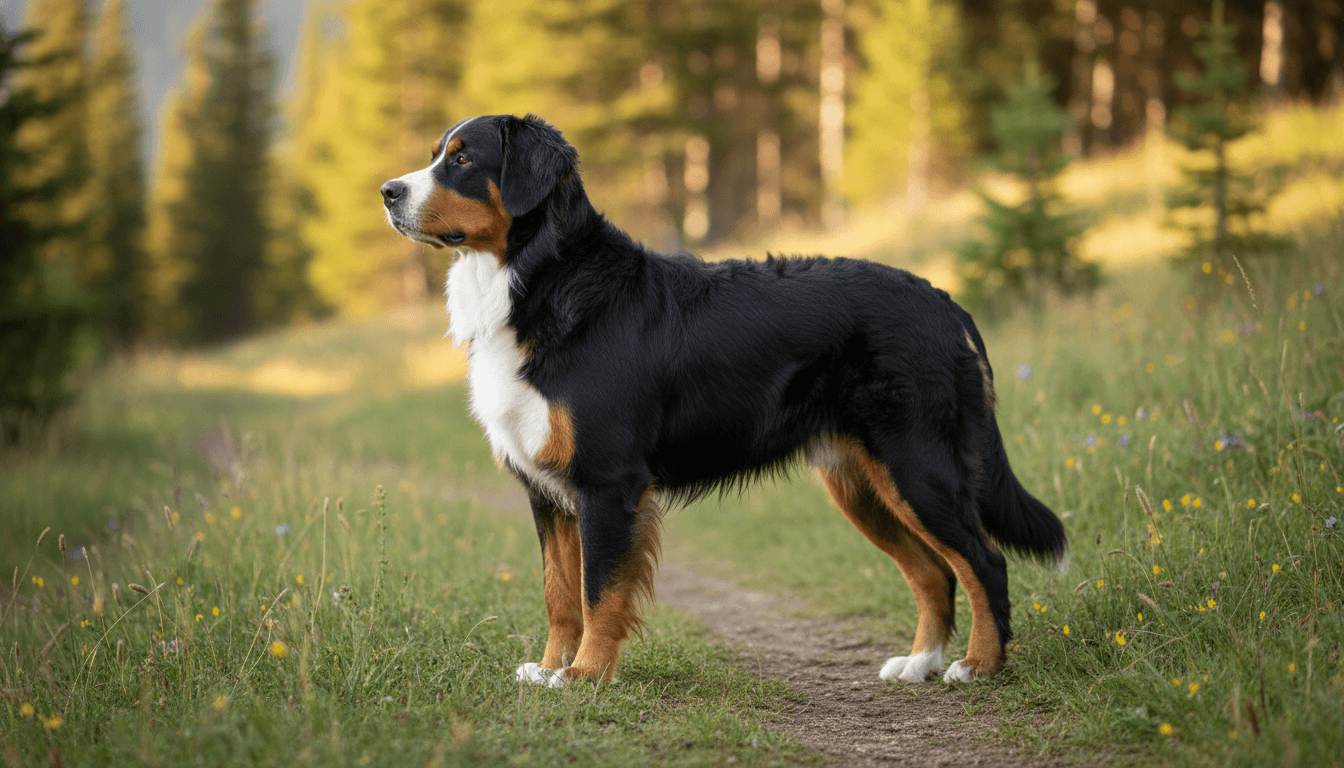

A full grown Golden Mountain Dog typically stands 24 to 28 inches tall at the shoulder and weighs between 65 and 140 pounds — putting this Golden Retriever × Bernese Mountain Dog cross firmly in the large-to-giant breed category. Most reach their adult height between 12 and 18 months, but like both parent breeds, they continue filling out in chest and muscle until they're 2 to 3 years old. This guide breaks down exactly what to expect at each stage so you know whether your puppy is on track, what their adult size will likely be, and how to help them grow up healthy.
How Big Does a Full-Grown Golden Mountain Dog Get?
The Golden Mountain Dog is a designer crossbreed between a Golden Retriever (one of America's most popular family dogs) and a Bernese Mountain Dog (a Swiss working breed bred to haul carts in the Alps). Because the two parent breeds vary significantly in size, full-grown Golden Mountain Dogs land in a wide range — but most fall into a predictable adult window:
- Height (full grown): 24–28 inches at the shoulder
- Weight (full grown): 65–140 pounds, with most adults landing between 75 and 110 pounds
- Life expectancy: 9–15 years
- Adult height reached: 12–18 months
- Full physical maturity (chest, muscle): 2–3 years
To put that in perspective: a fully grown Golden Mountain Dog is roughly the size of a Bernese Mountain Dog parent, often slightly lighter and a touch leaner thanks to the Golden Retriever side. According to Wag!, "a full grown Golden Mountain Dog can stand up to 28 inches in height, and weigh up to 120 lbs." The breed isn't AKC-recognized (it's a designer mix, not a purebred), so there's no official standard — but vet reference sites consistently report the same range.
If you're picking up a puppy and want a quick rule of thumb: large-breed cross puppies often reach roughly 50% of their adult weight by 5–6 months. So an 8-week-old puppy weighing 20 pounds will likely settle around 80–95 pounds full grown, while one weighing 25 pounds at 8 weeks may push past 100 pounds.
Male vs. Female Adult Size Differences
Like most large breeds, male Golden Mountain Dogs are noticeably bigger than females. Expect roughly a 10–25 pound difference between the sexes at full maturity:
- Adult males: 26–28 inches tall, 80–120+ pounds
- Adult females: 24–26 inches tall, 65–95 pounds
That mirrors what you see in the parent breeds. DogTime's breed profile notes that Golden Mountain Dog size "can vary greatly due to the distinctive differences in their parent breeds" — meaning two littermates can end up 30+ pounds apart depending on which parent's genes dominate. A real-world snapshot from a Golden Mountain Dog owner profiled on The Bernese showed one of their dogs (Gus) weighing 95 pounds and the other (Rovi) at 66–70 pounds — same breed mix, same household, almost 30 pounds apart.
If you specifically want a smaller adult, ask the breeder about the parents' weights and pick a puppy whose mother is on the lighter end of the Bernese Mountain Dog scale. The female Berner is the more variable parent here.
Golden Mountain Dog Growth Chart by Month
There's no published growth chart specifically for Golden Mountain Dogs (the cross is too rare for vet weight datasets), but you can confidently extrapolate from the Bernese Mountain Dog growth chart, since that's the parent that drives the upper range. Here's what to expect month-by-month, blended from The Bernese's size chart and Snowy Pines' Golden Retriever growth data:
Male Golden Mountain Dog growth chart
| Age | Weight | Height |
|---|---|---|
| 8 weeks | 13–22 lbs | 9–11" |
| 3 months | 28–38 lbs | 14–17" |
| 4 months | 40–55 lbs | 17–20" |
| 6 months | 55–78 lbs | 21–24" |
| 9 months | 70–95 lbs | 23–26" |
| 12 months | 80–110 lbs | 24–27" |
| 18 months | 90–120 lbs | 26–28" |
| 24 months | 95–125 lbs | 26–28" |
| 36 months (full grown) | 100–130+ lbs | 26–28" |
Female Golden Mountain Dog growth chart
| Age | Weight | Height |
|---|---|---|
| 8 weeks | 11–18 lbs | 8–10" |
| 3 months | 22–32 lbs | 13–16" |
| 4 months | 32–45 lbs | 16–19" |
| 6 months | 48–68 lbs | 20–23" |
| 9 months | 60–82 lbs | 22–25" |
| 12 months | 68–92 lbs | 23–26" |
| 18 months | 72–98 lbs | 24–26" |
| 24 months | 78–105 lbs | 24–26" |
| 36 months (full grown) | 80–110 lbs | 24–26" |
These ranges are wide on purpose. A Golden Mountain Dog whose genes lean Bernese will track the higher end; one with stronger Golden Retriever influence will track the lower end. If your puppy is consistently above or below these ranges, that's not necessarily a problem — it just means they're skewing toward one parent. Check with your vet at every wellness visit, since growth velocity matters more than absolute weight in large-breed puppies.
When Is My Golden Mountain Dog Full Grown?
Here's where Golden Mountain Dog owners often get tripped up: your dog "looks" full grown long before they actually are. There are two milestones to track:
1. Full height (12–18 months). By the first birthday, most Golden Mountain Dogs have hit their adult height or are within an inch of it. They'll look tall, lanky, and a little awkward — like a teenager who hasn't filled out yet. Males usually finish growing taller a few months later than females.
2. Full body mass and chest (2–3 years). The Bernese Mountain Dog side of the family is famously slow to mature — among "the slowest-maturing breeds in the world," according to The Bernese. Your dog will continue widening their chest, building muscle, and putting on weight through age 3. A Golden Mountain Dog that looks lean at 14 months can look like a different dog entirely by 30 months.
If your dog is past 36 months and still gaining weight steadily, that's no longer growth — that's pudge. Talk to your vet about diet.
Why Some Full-Grown Golden Mountain Dogs End Up Bigger Than Others
Three factors drive the wide adult-size range in this cross:
Parent breed dominance. Mixed breeds don't split traits 50/50. A puppy may inherit 70% of one parent's size genes and only 30% of the other's. Look at both parents at the breeder visit — that's your best size predictor.
F1 vs. multi-generational crosses. An F1 (first-generation Golden Retriever × Bernese Mountain Dog) tends to be the most size-variable. F2 or later crosses (two Golden Mountain Dogs bred together) usually produce more predictable adult sizes — but they're rare because the breed is still relatively new.
Spay/neuter timing. Recent research summarized by the American Kennel Club suggests that early spay/neuter (before growth plates close) in large breeds can lead to slightly taller, leggier adults due to delayed growth-plate fusion. Most vets now recommend waiting until 18–24 months for large-breed dogs like the Golden Mountain Dog.
Caring for a Large-Breed Puppy as They Grow
Because Golden Mountain Dogs grow fast and stay growing for 2–3 years, they're more vulnerable than smaller breeds to diet- and exercise-related developmental issues. A few practical guidelines from veterinary nutritionists:
- Feed a large-breed puppy formula. Standard puppy food is too calorie-dense and too high in calcium for a Golden Mountain Dog puppy. Large-breed-specific formulas slow growth to a healthier rate. PetMD recommends looking for an AAFCO statement that the food is "formulated for large breed puppies" or supports "growth of large size dogs (70 lbs or more as an adult)."
- Don't over-exercise puppies. No forced jogging or repetitive jumping until growth plates close at 18–24 months. Free play and short leashed walks are fine; structured running and agility should wait.
- Keep them lean. A 2002 Purina lifespan study famously found that lean-fed Labradors lived an average of 1.8 years longer than their littermates kept at a heavier weight. The same logic applies to Golden Mountain Dogs — every extra pound during growth stresses joints.
- Add joint support early. Many vets recommend adding glucosamine/chondroitin supplements starting at 6–12 months for large-breed crosses with hip dysplasia risk, including this one.
Common Health Issues in Full-Grown Golden Mountain Dogs
Because both parent breeds share some hereditary issues, the cross is predisposed to several large-breed health concerns. Wag! lists the major risks as:
- Hip and elbow dysplasia — a malformation of the joints common in fast-growing large breeds. Reputable breeders screen parents with OFA or PennHIP certifications.
- Bloat (gastric dilatation-volvulus) — a life-threatening condition where the stomach twists. Both parent breeds are deep-chested and at higher risk. Feed two smaller meals daily instead of one large one, and avoid exercise for an hour after eating.
- Cancer — particularly relevant on the Bernese Mountain Dog side, which has one of the highest cancer rates of any breed.
- Von Willebrand's disease — a hereditary bleeding disorder.
- Hypothyroidism — manageable with daily medication if it develops.
Adult Golden Mountain Dogs benefit from twice-yearly wellness exams after age 6 to catch joint and cancer issues early. Pet insurance — purchased while the dog is still a puppy — is worth pricing out, since large-breed orthopedic surgeries routinely run $4,000–$8,000.
Frequently Asked Questions
How big is a full grown Golden Mountain Dog?
A full grown Golden Mountain Dog stands 24–28 inches tall at the shoulder and weighs 65–140 pounds. Most adults land between 75 and 110 pounds. Males are typically 10–25 pounds heavier than females and slightly taller.
At what age is a Golden Mountain Dog full grown?
Golden Mountain Dogs reach their adult height between 12 and 18 months but don't reach full physical maturity (chest, muscle mass) until they're 2 to 3 years old. The Bernese Mountain Dog parent is one of the slowest-maturing breeds in the world, and that trait carries through to the cross.
How much should a 6-month-old Golden Mountain Dog weigh?
A 6-month-old male Golden Mountain Dog typically weighs 55–78 pounds, while a 6-month-old female weighs 48–68 pounds. By this age, your puppy should be roughly 50–60% of their projected adult weight.
Are Golden Mountain Dogs bigger than Golden Retrievers?
Yes, significantly. Adult Golden Retrievers typically weigh 55–75 pounds and stand 21.5–24 inches tall. Golden Mountain Dogs average 20–40 pounds heavier and stand 2–4 inches taller, thanks to the Bernese Mountain Dog parent.
Do Golden Mountain Dogs ever stop growing?
Yes — by age 3 at the latest. After 36 months, any continued weight gain is fat, not growth. If your adult Golden Mountain Dog is still putting on pounds past 3, schedule a vet visit to rule out hypothyroidism and review their diet.
Is a Golden Mountain Dog a giant breed?
Technically, the Golden Mountain Dog is classified as a large breed, not a giant breed. Giant breeds (Great Danes, Saint Bernards, Newfoundlands) typically exceed 30 inches tall and 130+ pounds. That said, the largest male Golden Mountain Dogs do approach giant-breed territory at 140 pounds.
What's the lifespan of a Golden Mountain Dog?
Golden Mountain Dogs typically live 9–15 years. The Bernese Mountain Dog parent has one of the shorter lifespans among purebreds (7–10 years), but hybrid vigor and the longer-lived Golden Retriever parent often push the cross toward the higher end of that range, especially in lean-fed, well-exercised dogs.
The bottom line on full-grown Golden Mountain Dogs
If you're bringing home a Golden Mountain Dog puppy, plan for a large dog — most likely 75 to 110 pounds at full maturity, with some males pushing 130+. Expect a slow grower: your dog will look adult by 18 months but won't really finish filling out until they're 3. Feed a large-breed puppy formula, keep them lean, and don't push hard exercise until their growth plates close.
The reward for that patience is one of the most strikingly large, gentle, family-friendly crosses in the designer dog world — a dog that combines the Golden Retriever's people-pleasing temperament with the Bernese Mountain Dog's calm, steady presence. For more on this specific cross's temperament, training, and care, see our complete guide to the Golden Mountain Dog and our Bernese Mountain Dog breed profile. If you're weighing other Golden Retriever crosses with similar size profiles, take a look at the Golden Newfie (Golden × Newfoundland) — another large, gentle giant in the same category.
Want more dog-owner guides delivered weekly? Subscribe to The Daily Wag — our free newsletter for dog parents, sent every weekday morning.