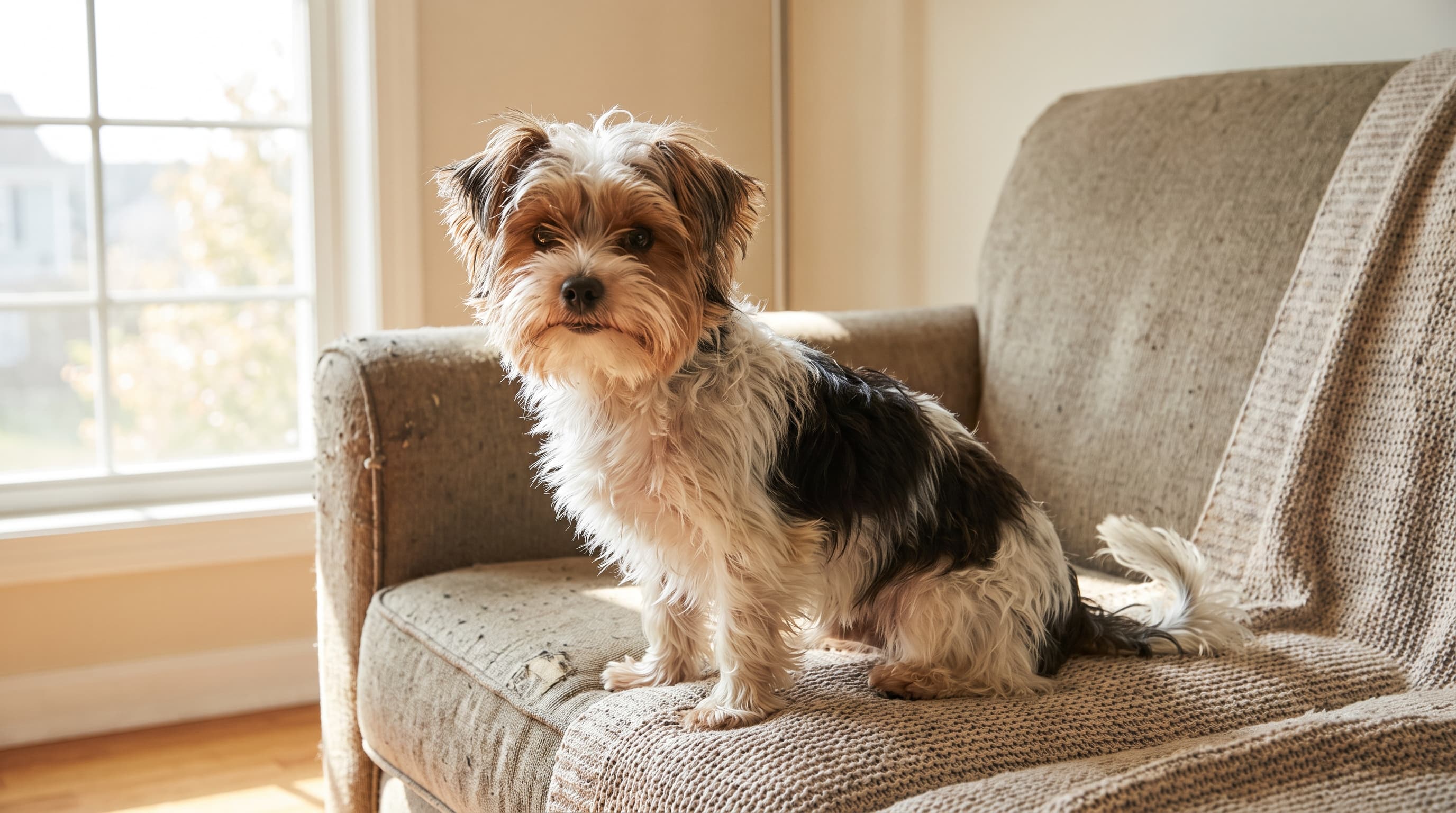

A parti Yorkie is a purebred Yorkshire Terrier whose coat carries large patches of white alongside the breed's classic black (or blue) and tan. The look comes from a recessive piebald gene, not from crossbreeding. Parti Yorkies match standard Yorkies in size, temperament, and personality, and the American Kennel Club has recognized the color since 2000.
What is a parti Yorkie?
The word "parti" is short for "particolored," meaning a coat broken up by two or more clearly separated colors. A parti Yorkie is typically tri-colored, combining white with the black-and-tan (or blue-and-tan) pattern that defines the breed. Unlike a traditional Yorkie, whose color is confined to blue and tan with at most a tiny white chest spot, a parti wears bold, irregular white patches across the body, legs, and head.
The single most important thing to understand is that a parti Yorkie is not a mixed breed or a designer hybrid. Both parents are full Yorkshire Terriers, and puppies are 100% Yorkie. The only difference between a parti and a "regular" Yorkie is where the pigment lands on the coat. Everything else — the silky single coat, the compact toy frame, the confident terrier attitude — is exactly the same. According to the AKC's Yorkshire Terrier breed profile, the Yorkie is a long-haired toy terrier prized as a lively, affectionate companion, and parti individuals fit that description in every way but color.
The piebald genetics behind the coat
Parti coloring is produced by the recessive piebald gene, often written as the "S locus" (the white-spotting locus) in canine genetics. This gene controls where a dog's body produces pigment. When a dog inherits two copies of the piebald variant, pigment production switches off in patches, leaving areas of white hair and pink skin between the colored zones. Embark's coat color genetics primer explains that the S locus (the MITF gene) governs this white spotting, and that two copies typically produce the largest, most defined white patterning.
Because piebald is recessive, both parents must carry the gene for a litter to include partis. Two traditional-looking Yorkies can each quietly carry one hidden copy and still produce parti puppies — and even then, not every puppy in the litter will be parti. This is why partis were historically uncommon: carriers went unrecognized for generations. VCA's overview of coat color genetics in dogs notes that the S (spotting) locus is responsible for patterns including piebald and particolor, and that recessive traits require two copies to appear. Modifier genes also influence how much white shows, which is why no two partis look identical.
Appearance and colors
Most parti Yorkies are tri-colored, showing white plus black and tan. Because piebald only rearranges where color appears, partis come in the same underlying palette as standard Yorkies, so you will also see variations such as:
- Black, white, and tan — the classic, most common parti combination.
- Blue, white, and tan — as the black matures into the breed's signature steel-blue.
- Chocolate parti — warm brown replacing black, paired with white and tan.
- Golden or "honey" parti — predominantly light tan and white.
The white is usually splashed across the chest, belly, legs, muzzle, and often a blaze up the face, with no fixed pattern — each dog is unique. The coat itself is long, fine, straight, and silky, lying flat rather than fluffy. Like all Yorkies, partis are born darker and lighten and refine in color as they mature over the first year or two.
Temperament and personality
A parti Yorkie has the same big personality packed into a tiny body that the breed is famous for. Expect a confident, curious, affectionate little dog that bonds intensely with its people and wants to be involved in everything. Bred down from working terriers that hunted rats in Victorian mills, Yorkies retain a bold, spirited streak — they are alert watchdogs who will bark to announce visitors despite their size.
Partis are playful and loyal, thriving on companionship and often shadowing a favorite person from room to room. They are smart and trainable but can carry a stubborn terrier independence, so consistent, reward-based training and early socialization pay off. Their small size means play with young children should always be supervised, since a Yorkie is fragile and can be injured by rough handling. If you're weighing a parti against other Yorkie-family companions, our profiles on the King Charles Yorkie and the Boston Yorkie break down how temperament shifts across related mixes.
Size and lifespan
Parti Yorkies are true toy dogs, identical in size to standard Yorkshire Terriers. The official AKC breed standard caps the Yorkie at 7 pounds, and most partis weigh roughly 4 to 7 pounds and stand about 7 to 8 inches at the shoulder. Be cautious of breeders marketing "teacup" partis under 4 pounds; extremely undersized dogs often face added health fragility.
Yorkies are a long-lived breed. Reputable sources place the typical lifespan around 11 to 15 years, and the VCA Animal Hospitals breed overview notes many Yorkies live comfortably into their mid-teens with good care. Coloring has no bearing on longevity — a well-bred parti can expect the same lifespan as any traditional Yorkie.
Grooming needs
That gorgeous silky coat is high-maintenance. Because Yorkie hair is more like human hair than typical dog fur, it grows continuously and tangles easily. Plan on brushing every day or two to prevent mats, especially around the ears, legs, and rear. Many owners keep their parti in a shorter "puppy cut" to cut down on daily upkeep, with professional grooming every 6 to 8 weeks.
Rounding out the routine: a bath every few weeks, regular nail trims, and hair kept clear of the eyes. One upside of that hair-like single coat is that Yorkies shed very little, which is part of why the breed is often considered a good fit for tidy households and some allergy sufferers — we cover the nuances in are Yorkies hypoallergenic and share broader tips in our guide to reducing dog shedding and keeping a clean home. Don't forget dental care: small breeds are prone to tartar, so regular tooth brushing is important.
Health considerations
Parti Yorkies are generally healthy, and their color gene is not linked to any illness — the piebald variant affects pigment placement, not health. That said, they share the same breed predispositions as all Yorkies. Conditions commonly discussed for the breed include luxating patella (slipping kneecaps), collapsing trachea, dental disease, and hypoglycemia (low blood sugar) in very young or very tiny puppies. Some lines can also carry eye conditions.
This article is general information, not veterinary advice. Coat color aside, a responsible breeder should health-test their dogs, and every parti puppy should see a licensed veterinarian for an individual exam, preventive care, and any specific health concerns. Always consult your own vet before making decisions about your dog's health.
Price and finding a breeder
Parti Yorkies typically cost more than traditional Yorkies because the color is less common and demand is high. Prices commonly range from about $1,200 to $3,500 or more, depending on the breeder's reputation, health testing, pedigree, and how striking the markings are. Be wary of bargain "parti" pups — rock-bottom prices are a red flag for puppy mills or misrepresented mixes.
Choose a breeder who genetically tests for the piebald gene, health-screens their breeding stock, raises puppies in the home, and welcomes questions and visits. Ask to see health clearances and meet at least one parent. If a "parti" looks more like a two-breed cross than a Yorkie, it may actually be a hybrid rather than a purebred particolor — a distinction that matters for both price and expectations.
Is the parti Yorkie AKC-recognized?
Yes — with an important nuance. In 2000, after DNA evidence confirmed that parti-colored dogs are genetically purebred Yorkshire Terriers, the AKC began allowing them to be registered, listed under alternative color codes. So a parti from registered parents can be AKC-registered as a purebred Yorkshire Terrier.
However, registration is not the same as meeting the show standard. The official Yorkshire Terrier conformation standard calls for a blue-and-tan coat and treats significant white markings as a disqualification in the show ring. In other words, a parti Yorkie is a recognized purebred you can register and love as a companion, but it cannot compete in AKC conformation shows because its color falls outside the written standard. That's a fine distinction that trips up a lot of first-time buyers, so it's worth understanding before you pay a premium.
Frequently asked questions
Is a parti Yorkie a purebred Yorkshire Terrier?
Yes. A parti Yorkie is 100% Yorkshire Terrier. Both parents are Yorkies, and the parti coat is simply the result of a recessive piebald gene, not crossbreeding.
Are parti Yorkies more expensive than regular Yorkies?
Usually. Because the color is rarer and in demand, partis often sell for more than traditional Yorkies — commonly $1,200 to $3,500 or higher depending on breeder, health testing, and markings.
Do parti Yorkies shed a lot?
No. Like all Yorkies, partis have a fine, hair-like single coat that sheds minimally. They still need frequent brushing to prevent tangles and mats, but loose-hair cleanup is low.
Can a parti Yorkie be registered with the AKC?
Yes, since 2000 parti-colored Yorkies from registered parents can be AKC-registered as purebred Yorkshire Terriers under alternative color codes. They cannot, however, compete in AKC conformation shows because white markings are a disqualification in the breed standard.
How big does a parti Yorkie get?
They are toy-sized, typically 4 to 7 pounds and about 7 to 8 inches tall — the same as any Yorkshire Terrier. Coat color has no effect on size.
Are parti Yorkies good family pets?
They can be excellent companions: affectionate, playful, and loyal. Because they are small and fragile, play with young children should be supervised, and early socialization helps curb the breed's watchful barking.
Bring home a parti Yorkie
A parti Yorkie gives you everything people love about the Yorkshire Terrier — the silky coat, the huge personality, the devoted companionship — wrapped in a one-of-a-kind tri-color coat. If you're still comparing your options, explore our related profiles on the King Charles Yorkie and the sturdy little Cairn Terrier to find your perfect match. Love learning about breeds like this? Subscribe to the Daily Wag newsletter for fresh breed guides, grooming tips, and dog-care insights delivered straight to your inbox.