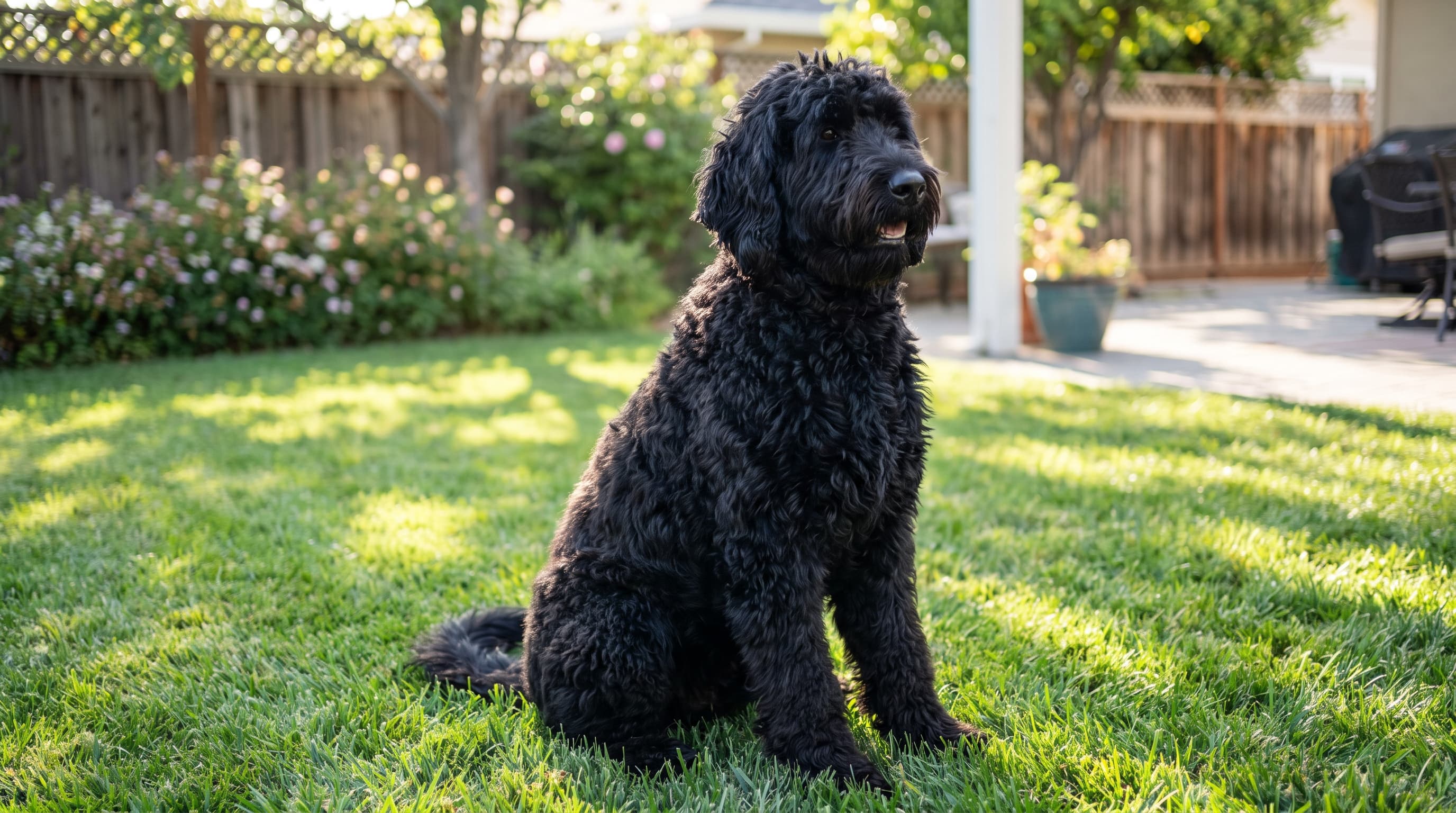

A black goldendoodle is a Golden Retriever × Poodle mix with a solid black coat instead of the classic gold. The color happens when a puppy inherits the dominant black (K locus) gene from its Poodle parent along with the ability to produce dark pigment — something purebred Golden Retrievers can't do on their own. Because the right gene combination is uncommon, black is one of the rarer goldendoodle colors.
What Is a Black Goldendoodle?
A black goldendoodle is simply a goldendoodle — the crossbreed of a Golden Retriever and a Poodle — born with a solid black coat instead of the breed's more familiar gold, cream, red, or apricot shades. It isn't a separate breed or a "rare designer variety" marketed by any club; it's a genetically explainable color outcome that shows up when specific coat-color genes line up. Black goldendoodles come in every size the breed does, from petite mini to standard, and every coat type, from loose wavy "fleece" to tight Poodle-like curls. Most breeders classify solid black (little to no white) separately from black-and-white parti or black-and-tan phantom patterns, which are different genetic patterns layered on top of the same base color.
Why Are Black Goldendoodles Black? (Coat Genetics Explained)
Coat color in dogs comes down to a handful of gene locations working together, and goldendoodles are a good case study because their two parent breeds sit at opposite ends of the color spectrum. Golden Retrievers are almost universally homozygous for the recessive "e" variant at the MC1R (E locus) gene. That genotype (e/e) blocks the coat from producing black pigment (eumelanin) at all, which is why every Golden Retriever is some shade of gold, cream, or red no matter what other color genes it carries underneath.
Poodles don't have that restriction, and many carry the dominant black variant at the K locus, commonly written KB. When a black or dark-coated Poodle is bred to a Golden Retriever, the puppy can inherit a functional "E" copy from the Poodle side, which unlocks the ability to show black pigment, plus a KB copy that tells the coat to go solid black rather than patterned or agouti. Get both, and you get a black goldendoodle. Miss either piece — no functional E, or no dominant K — and the puppy reverts to gold, red, cream, or a parti/phantom pattern instead. This is also why breeders can't simply "breed for black" from any two goldendoodles; they need to know the underlying genotypes, which is where DNA panel testing (like the coat-color panels from UC Davis's Veterinary Genetics Laboratory) comes in.
Are Black Goldendoodles Rare?
Yes, relative to the gold, cream, and red goldendoodles that dominate the breed's image, black is uncommon. Since Golden Retrievers essentially never carry a working black gene, every black goldendoodle traces its color back to the Poodle side of the pedigree, and specifically to a Poodle parent (or grandparent, in later generations) that is itself black, blue, silver, or another dark color. Multigenerational goldendoodles (F1B and beyond, which are bred back to Poodles) produce black puppies far more consistently than first-generation (F1) litters, simply because they carry more Poodle genetics overall. Because the color depends on a specific genetic combination rather than being selectable at will, reputable breeders often can't guarantee a black puppy in any given litter, and waitlists for confirmed black pups commonly run 6–12 months.
Size, Coat & Grooming
Coat color has no effect on size — black goldendoodles come in the same range as any other color, from petite/mini dogs around 15–35 pounds and 13–17 inches tall, up to standard goldendoodles that reach 50–90 pounds and 20–24 inches at the shoulder, according to the size classes used by the Goldendoodle Association of North America. If you're specifically after a smaller black dog, our guide to the full-grown mini goldendoodle breaks down expected adult size by generation.
The coat itself ranges from loose "fleece" waves to dense Poodle-like curls, and it's typically low-shedding rather than fully non-shedding — see our breakdown of whether goldendoodles shed for what "hypoallergenic" actually means in practice. Black coats show lint, dander, and dust more visibly than lighter colors, so regular brushing (2–3 times a week minimum) matters both for coat health and appearance. Most owners book professional grooming every 6–8 weeks; our goldendoodle haircuts guide covers the most popular cuts and what to ask your groomer for.
Temperament & Family Fit
Temperament in goldendoodles is driven by breeding and upbringing, not coat color — a black goldendoodle behaves like any other goldendoodle of the same generation and lines. That means most are friendly, eager to please, sociable, and quick to learn, traits inherited from both the people-oriented Golden Retriever and the highly trainable Poodle. They're widely considered excellent family dogs, generally good with children and other pets once properly socialized, and their intelligence makes them responsive to positive-reinforcement training. They aren't known as chronic barkers, though under-stimulated dogs can develop boredom-driven barking or chewing. Energy levels run moderate to high, especially in dogs under three years old, so daily exercise matters — a securely fenced yard is ideal, but a well-exercised black goldendoodle can adapt reasonably well to apartment living too.
Do Black Goldendoodles Fade or Change Color?
Many do, and it's one of the most-asked questions from new owners. A separate gene, often called the graying or "fading" gene (the G locus), is common in Poodle lines and causes a dog born black, blue, or brown to progressively lighten with age — frequently toward silver, gray, or a smoky "blue" shade. Fading usually becomes noticeable within the first one to two years of life and can continue gradually afterward; it's a cosmetic genetic trait, not a health issue, and it's unrelated to the graying around the muzzle that all dogs get with old age. Not every black goldendoodle carries the fading gene, so some stay solid black for life while littermates lighten considerably — there's currently no widely available DNA test that reliably predicts which puppies will fade.
Health & Lifespan
Black goldendoodles have the same health profile as goldendoodles of any other color — coat color genes and health genes are inherited independently, so black pigment itself isn't a risk factor. Like other goldendoodles, they can be prone to hip and elbow dysplasia, ear infections (a byproduct of their floppy, hairy ears), and inherited eye conditions such as progressive retinal atrophy. Standard-size goldendoodles typically live around 10–13 years, while smaller mini and petite goldendoodles often live closer to 13–15 years. Reputable breeders screen parent dogs with OFA hip and elbow evaluations, eye certifications, and genetic panels to reduce the odds of passing on these conditions. This article is meant as a general overview — always talk to your veterinarian about your individual dog's health, screening needs, and any breed-related risk factors.
Price & Finding a Reputable Breeder
Because true black is a less common outcome, black goldendoodle puppies often sell at or above the high end of typical goldendoodle pricing, generally in the $2,000–$5,000 range depending on region, generation, and breeder reputation, with rare or "confirmed black" puppies sometimes commanding a premium of a few hundred dollars over standard litters. When vetting a breeder, look for health clearances (OFA hips/elbows, eye and cardiac exams) on both parents, willingness to show you the puppy's actual parents (not just marketing photos), and transparency about coat-color genetics rather than vague "rare color" claims. Be cautious of listings that guarantee a specific color before puppies are even born — genetics can be predicted with testing, but rarely promised outright. A waitlist, health-tested parents, and clear documentation are better signs of a responsible breeder than a lower price or faster availability.
Frequently Asked Questions
Is a black goldendoodle purebred?
No. Goldendoodles of any color are a crossbreed between a Golden Retriever and a Poodle, not a purebred or an AKC-recognized breed. Black is simply a coat-color variation within that cross.
Can two golden-colored goldendoodles produce a black puppy?
It's extremely unlikely. Since color depends on specific genes carried (often invisibly) by the Poodle side of the pedigree, two gold-coated goldendoodles would each need to carry hidden black-producing genes for a black puppy to appear, which is uncommon outside of intentional multigenerational breeding programs.
Do black goldendoodles cost more than other colors?
Often, yes. Because true black puppies are harder for breeders to produce consistently, they're frequently priced at the higher end of the typical goldendoodle range, and waitlists for them tend to be longer.
Will my black goldendoodle puppy stay black as an adult?
Maybe not. Many black goldendoodles carry a fading (graying) gene inherited from their Poodle ancestry that gradually lightens the coat toward silver or gray, usually within the first two years. Others stay solid black for life — there's no way to know for certain until the coat matures.
Are black goldendoodles hypoallergenic?
Coat color doesn't affect allergen levels. Like other goldendoodles, black goldendoodles typically shed less and produce less loose dander than a straight-coated Golden Retriever, which some allergy sufferers tolerate better, but no dog is truly 100% hypoallergenic.
Are black goldendoodles healthier or less healthy than other colors?
Coat color and health are inherited separately, so a black coat doesn't make a goldendoodle more or less prone to conditions like hip dysplasia or eye disease. Overall health depends far more on the individual breeder's health testing than on coat color.
Related Reading
Want to compare other Poodle-mix breeds before you decide? Check out our guides to the Aussiedoodle and the Bernedoodle for two more popular doodle crosses, or read up on the black Poodle to see how the same coat-color genetics play out in a purebred parent breed. And for more breed deep-dives, grooming tips, and dog news delivered weekly, subscribe to the Daily Wag newsletter.