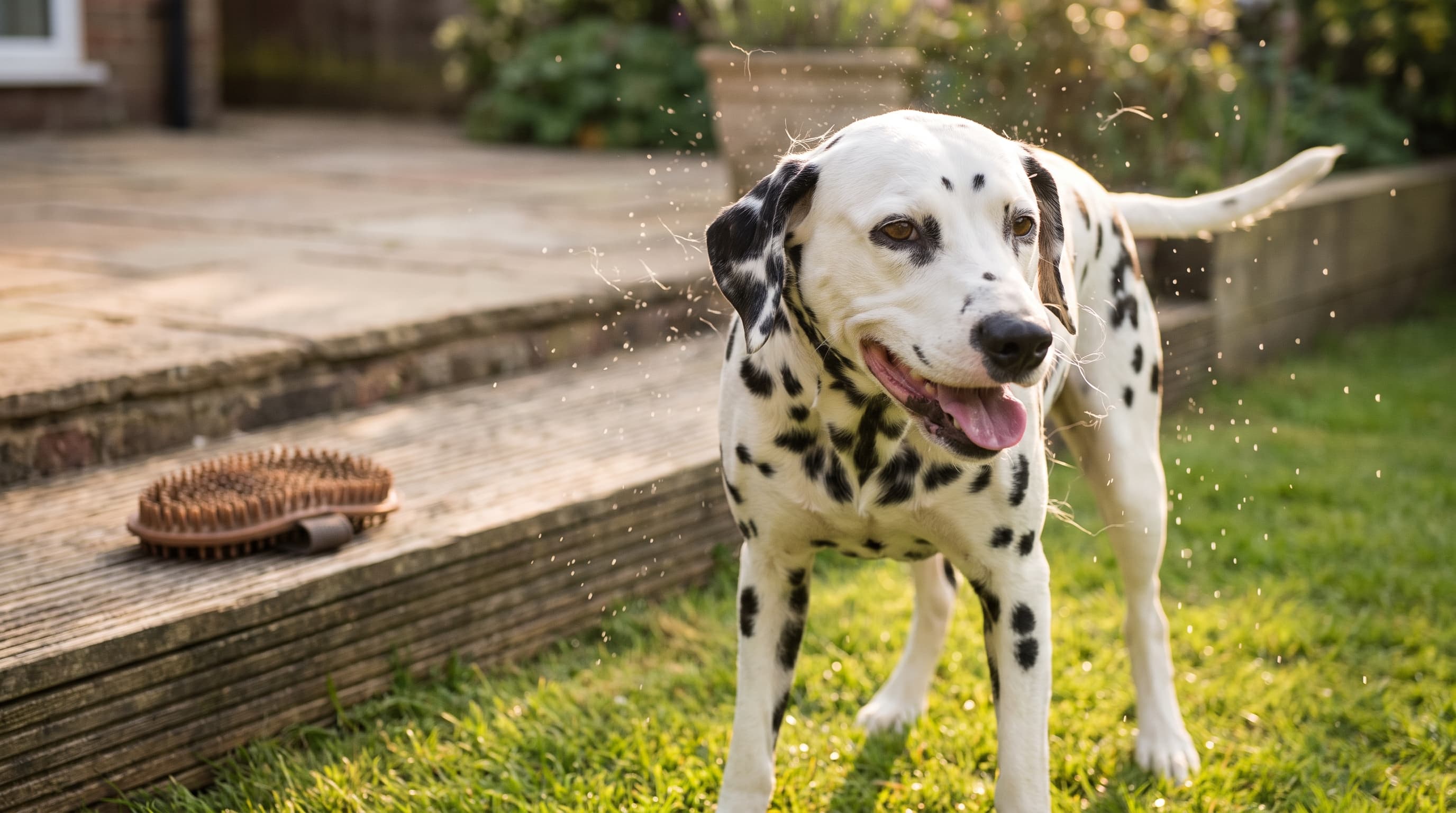

The Lemon Dalmatian: A Complete Guide to the Rare Spotted Beauty
A lemon Dalmatian is a purebred Dalmatian whose spots appear pale lemon-yellow or soft tan instead of the usual black or liver. The color is caused by a recessive gene at the E locus, so a dog needs two copies to show it. Lemons are rare, and every other trait, from size to temperament, matches the standard Dalmatian.
What Is a Lemon Dalmatian?
Picture the classic Dalmatian, the coach dog immortalized by Disney, and then swap its inky black spots for a wash of buttery yellow. That is a lemon Dalmatian. It is not a separate breed, a designer cross, or a mixed dog. It is a full Dalmatian carrying an uncommon color combination that turns the dark pigment in its spots to a pale, honeyed shade ranging from faint cream to a warmer apricot-gold.
Lemon Dalmatians are born with the same clean white base coat as their black- and liver-spotted littermates. Puppies actually arrive almost pure white, and the faint lemon flecking develops over the first few weeks of life, becoming clearer as the dog matures. Because the pigment is so light, the spotting on a lemon Dalmatian often looks softer and less crisp than the bold contrast most people expect from the breed. Most lemon Dalmatians keep a black nose, while a paler subset described by some breeders as "orange" carry a liver-brown nose instead.
The Genetics Behind the Lemon Coat
Standard Dalmatian spots come in two colors: black and liver (brown). Which one a dog wears is decided at the B locus, where black is dominant and liver is recessive. The lemon coloring, however, is controlled by a completely different gene, the E locus, which governs whether dark pigment (eumelanin) reaches the coat at all.
A dog with at least one dominant "E" allele expresses its normal black or liver spots. A lemon Dalmatian is homozygous recessive, meaning it carries two copies of the recessive "e" allele (an ee genotype). This ee combination blocks dark pigment from filling the spots, leaving only the lighter phaeomelanin (yellow-red) pigment behind. It is the same mechanism that produces a yellow Labrador Retriever, according to the DNA-testing lab Genomia. The dog still has the genetic instructions for spots, so the pattern shows up, just in a faded lemon tone rather than black or brown.
Because ee is recessive, both parents must carry at least one copy of the "e" allele to produce a lemon puppy. Two standard-spotted Dalmatians that each secretly carry the gene can produce a lemon in the litter, which is exactly how the color surprises breeders. A simple DNA test for the E locus (and the companion B locus) lets breeders know which dogs are carriers. This same "hidden recessive" pattern drives the unusual coats seen in other breeds, such as the striped or dappled variants you can read about in our guide to the merle pitbull.
Appearance & Size
Apart from spot color, a lemon Dalmatian is built exactly like any other Dalmatian. This is a lean, athletic, medium-to-large dog. According to the American Kennel Club and breed references such as PetMD, Dalmatians typically stand 19 to 24 inches at the shoulder and weigh roughly 45 to 70 pounds, with males generally larger than females.
The coat is short, dense, fine, and sleek, sitting close to the body. The base is bright white, and the lemon spots are usually round, well-defined in placement even if soft in color, and scattered evenly across the body, with smaller flecking on the head, ears, and legs. Eyes are typically brown or amber; blue eyes occur but are linked to a higher risk of deafness, a point we return to below. The overall impression is elegant and sporty, a dog that clearly looks bred to run.
How lemon Dalmatians differ from liver Dalmatians
People often confuse lemon and liver Dalmatians because both stray from the familiar black. The difference is genetic and visual. Liver Dalmatians have rich chocolate-brown spots and always a brown nose; the color comes from the recessive B locus. Lemon Dalmatians have pale yellow to gold spots produced by the recessive E locus, and most keep a black nose. Liver is a fully accepted show color, whereas lemon is not, which is a key distinction for anyone shopping for a puppy.
Temperament & Personality
A lemon Dalmatian has the classic Dalmatian personality, because coat color has no bearing on behavior. These are high-energy, intelligent, playful dogs that were originally bred to trot for miles alongside horse-drawn carriages. That endurance still shows: they need serious daily exercise and mental stimulation, and a bored, under-exercised Dalmatian can become restless and destructive.
Dalmatians are loyal and affectionate with their own families and often form a strong bond with their people. With strangers they tend to be more reserved or aloof, which makes them alert, capable watchdogs. Early, consistent socialization is important so this natural caution does not tip into shyness or over-guarding. They are generally good with children who respect them and can live happily with other dogs when introduced properly, though their exuberance means supervision around very small kids is wise.
They are smart and eager, which makes them trainable, but they also have an independent streak and respond far better to positive, reward-based methods than to heavy-handed correction. Dalmatians thrive when they have a job, whether that is agility, canicross, long jogs, or trick training. If you love this drive but want to compare it with another tireless working breed, our profiles on the Siberian Husky and the Australian Shepherd are useful side-by-side reads.
Health & Lifespan
Lemon Dalmatians generally enjoy the same lifespan as the rest of the breed, commonly cited at around 11 to 13 years. Importantly, the lemon coloring itself is not known to cause any extra health problems compared with black or liver Dalmatians. This is general information only and not a substitute for veterinary advice; always work with a licensed veterinarian for anything concerning your dog's health.
The health issues to be aware of are those that affect Dalmatians as a whole. The two most notable are:
- Congenital deafness. Dalmatians are one of the breeds most affected by inherited deafness. Roughly one in three Dalmatians worldwide is deaf in one or both ears. Research summarized by the Louisiana State University deafness database links this to the extreme-piebald (white) patterning gene, which can suppress the pigment cells needed for normal hearing; blue-eyed dogs carry a higher risk. Reputable breeders BAER-test puppies for hearing.
- Urinary (urate) stones. Dalmatians have a unique quirk of purine metabolism that predisposes them to urate bladder stones. As the VCA Animal Hospitals breed guide explains, plenty of fresh water and a suitable diet help manage the risk.
Other conditions occasionally seen in the breed include skin allergies and hip dysplasia. A deaf lemon Dalmatian can still live a full, happy life; many owners successfully train deaf dogs with hand signals and vibration cues. Choosing a breeder who health-tests their stock is the single best way to stack the odds in your favor.
Grooming & Care
The good news is that a lemon Dalmatian is low-maintenance in the grooming department but high-maintenance in the exercise department. That short white coat needs little more than a weekly once-over with a rubber curry or bristle brush. The catch is shedding: Dalmatians are famously heavy, year-round shedders, and those fine white hairs weave themselves into upholstery and clothing. Regular brushing and a good vacuum keep it manageable.
Bathing is only needed occasionally, since the coat has a slightly water-repellent quality and stays relatively clean. Round out the routine with nail trims every few weeks, weekly ear checks, and regular tooth brushing. The far bigger commitment is activity: plan on at least one to two hours of vigorous exercise a day, plus enrichment such as puzzle feeders or training games. For this reason a lemon Dalmatian is not an ideal apartment dog unless the owner is genuinely committed to daily hard exercise; a securely fenced yard and an active household suit the breed best.
Is a Lemon Dalmatian Rare, and How Much Does It Cost?
Lemon Dalmatians are genuinely uncommon. Because the color needs both parents to carry the recessive "e" gene, most litters produce black- or liver-spotted puppies, and a lemon appears only when the genetics line up. That said, lemon is not the rarest Dalmatian coloring; tri-color, brindle, and blue variations are scarcer still.
Pricing varies widely by region and breeder, but a well-bred Dalmatian puppy from a health-testing breeder generally runs somewhere in the range of about $600 to $1,500, and lemon puppies sometimes command a premium simply for their novelty. Be cautious of any breeder marketing lemon (or any color) as "ultra-rare" to justify an inflated price, or one who prioritizes color over health testing. A responsible breeder BAER-tests for hearing, screens their breeding dogs, and will happily discuss the color genetics behind their litters. Adoption through Dalmatian-specific rescues is another excellent route, and occasionally a lemon turns up needing a home.
Is the Lemon Dalmatian AKC Recognized?
Yes and no, and this is the most misunderstood point about the color. The Dalmatian is fully recognized by the American Kennel Club, so a lemon Dalmatian is absolutely a registerable purebred dog. However, the lemon color is not part of the official breed standard. The standard recognizes only black-spotted and liver-spotted Dalmatians; any other color, including lemon, is a disqualification in the conformation show ring, a rule echoed by major registries such as the AKC, the UK Kennel Club, and the FCI.
In plain terms: you can register a lemon Dalmatian, love it, and compete with it in performance sports such as agility, obedience, and rally, but you cannot show it in the breed (conformation) ring. For the average pet owner this makes no practical difference whatsoever. It matters mainly to show breeders. If a distinctive, non-standard coat is what draws you to the breed, you may also enjoy our guide to the equally eye-catching long-haired Dalmatian, another Dalmatian variant outside the standard.
Frequently Asked Questions
Are lemon Dalmatians purebred?
Yes. A lemon Dalmatian is a 100% purebred Dalmatian. The lemon color is simply the result of a recessive gene at the E locus, not any crossbreeding. These dogs can be registered with the AKC as Dalmatians.
Why are lemon Dalmatian spots yellow instead of black?
Their spots are yellow because the dog inherited two copies of the recessive "e" allele, which blocks dark (black or brown) pigment from filling the spots. Only the lighter yellow-red pigment remains, producing the lemon tone. It is the same gene that makes a yellow Labrador yellow.
Are lemon Dalmatians more likely to be deaf?
The lemon color itself does not add deafness risk. However, Dalmatians as a breed have high rates of congenital deafness tied to their white patterning, so a lemon Dalmatian carries the same breed-wide risk as any other Dalmatian. Reputable breeders BAER-test puppies for hearing.
How much does a lemon Dalmatian cost?
Prices typically range from roughly $600 to $1,500 from a responsible, health-testing breeder, though lemons sometimes fetch a premium for their rarity. Be wary of breeders charging far more simply on the promise of a rare color while skipping health testing.
Can you show a lemon Dalmatian in AKC conformation?
No. Lemon is a disqualifying color in the breed standard, so a lemon Dalmatian cannot compete in conformation shows. It can, however, be registered and can compete in performance events like agility, obedience, and rally.
Do lemon Dalmatians act differently from regular Dalmatians?
No. Coat color has no effect on personality. A lemon Dalmatian is just as energetic, intelligent, loyal, and exercise-hungry as any black- or liver-spotted Dalmatian, and needs the same active lifestyle to thrive.
Related Reads & Newsletter
If the lemon Dalmatian has you curious about the breed's other unusual forms and comparable high-energy companions, keep exploring with these guides:
- The Long-Haired Dalmatian: Guide to the Fluffy-Coated Variant
- The Australian Shepherd: A Complete Breed Profile
Love spotted, rare, and remarkable dogs? Subscribe to the Daily Wag newsletter for fresh breed profiles, training tips, and health guides delivered straight to your inbox. Join the Sidewalk Dog pack and never miss a story.